A cloudy sunday ... maybe the right day to dig deep into the crate. Out came a HOB 45 released in June 1973 (according to the stamp on both labels; it actually says »June 27 1973«).
HOB # 1379 has two songs by the Greater St. Paulettes. Reference is to the Greater St. Paul Baptist Church in Durham, North Carolina. The former local pastor, Dr. W.T. Bigelow, is mentioned as arranger of »He Touched Me« on the A side; the song itself is the famous hymn written by William (Bill) J. Gaither and first recorded in 1964. Now, Durham is known not only as the birthplace of Pigmeat Markham and John D. Loudermilk but also of Clyde McPhatter and Shirley Caesar (few names, but what a bunch of artists!). Unfortunately, by 1973 black gospel (and not only black gospel) had already started to move into its »mass choir-phase«. This may have reflected changes in the forms of worship and may have been due to enhanced technology as well, but musicallywise it proved a disaster (it still does). Anthony Heilbut lamented bitterly, and oh so justly, that by taking this turn gospel music buried the vocal qualities of individual singers. What is more, mass groups are pretty much unfitted to perform quieter and less frantic (indeed less frenzical) songs; some also said, correctly I think, that the mass-choir style tends to stress rhythm over harmony and thus resembles the development from soul to disco during the early to mid-1970s. You'll hear all this on this 45. The B side is a prime example of what went wrong (at least if you're looking for vocal artistry). However, there is still a recognizable individual voice that stands out on the A side, a voice I find quite intriguing.
For the record, I have no idea to whom the voice belongs (is she Dorothy Fox, mentioned on the labels as arranger of the group?). Nor do I know anything about the Greater St. Paulettes. This was their only 45, but in early 1974 Scepter-HOB also released a LP entitled Gospel Train (HBX-2166) and containing ten songs in all, including those two you can hear now. Happy Sunday all!
The Greater St. Paulettes: »He Touched Me« / »Working In The Vineyards« on HOB # 1379 (1973):
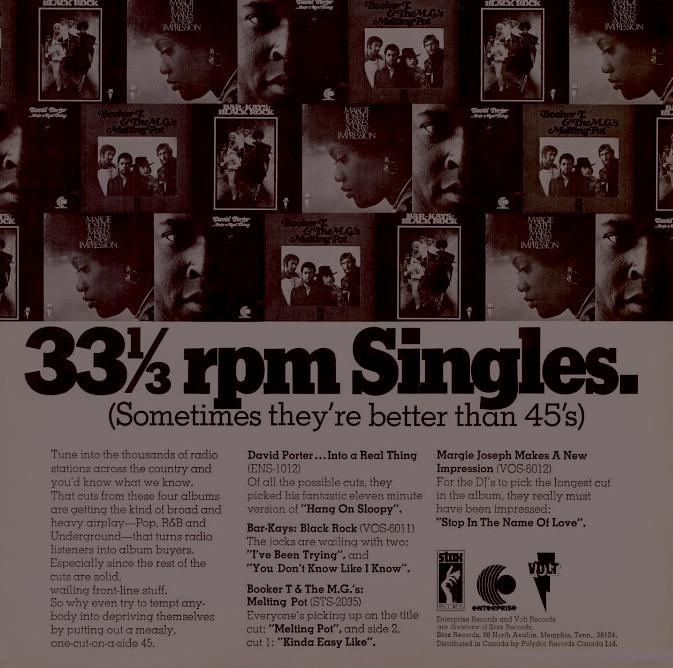
Margie Joseph's earliest recordings were done at the Muscle Shoals Sound Studio in 1967 and resulted in two OKeh 45s, out in December 1967 and in May 1968. They didn't chart but made enough noise to earn passing mention in Billboard. Later, after she had been picked up by Stax in 1969, she returned to Muscle Shoals in 1970 for another four songs which then found their way unto her first LP (Volt LP # 6012, 01/1971). And although her Muscle Shoals output was limited (and actually ended with her 1970 session), her name remained bound up with the »Muscle Shoals Sound Story«. This is attested, curiously, by an ad from September 1970 where Margie's name appears in the flattering company of the Rolling Stones, Sam & Dave, Solomon Burke, Mavis Staples, Odetta, Joe Tex, Aretha Franklin, Wilson Pickett and many others (see ad below). This ad was placed months before her first Volt LP was released.
Now, I never lost any sleep about why Margie's second LP was called Phase II, being her second LP and all. What I have never grasped so far is the pun or message, if there is any, of why her very first LP was entitled ... Makes A New Impression (for a pic of the cover, see yesterday's post). In any case, it seems that the LP was either at first (or alternatively as an afterthought) destined to be called Meet Margie Joseph, which apart from the nice initial alliteration would make some good sense for an artist's premiere album. However, only the labels show Meet Margie Joseph, while the sleeve has Makes A New Impression. So we are left to guess whether sleeve or labels were printed first (and, depending on this, whether Meet Margie Joseph was the original title or not; I guess it was).
Stax/Volt ad from Billboard, Jan 30, 1971
Not that it really matters, because she does make a pretty solid impression in any case. Andrew Hamilton called this first LP Margie's »most successful and aesthetically pleasing album« (AMG to Soul, p. 379). It famously contains the 10-minute monster track of »Stop! In The Name Of Love« preceded by a »Monologue: Women Talk«. It soon proved to be the LP's stand-out song, was quickly used for a Stax-Volt ad and finally released as a 45. I have to confess, it is not my kind of bag. And to the probable bewilderment of some among you, several other songs on this LP aren't my bag either. Basically all those which were recorded in the Memphis Stax Studios, with the exception of »Sweeter Tomor- row« (as heard on yesterday's post). Andrew Hamilton described the LP as being »a mixture of Stax and city slick R&B sounds«, but frankly, I would object that the Stax songs on this LP are the very epitome of everything I would call »city slick« ... and just about too slick for my modest taste at that.
Which leaves us, or me at least, with the tracks Margie Joseph recorded at Muscle Shoals. They are quite a contrast to the rest of the album. One of those, »Punish Me«, was released as a 45 (Volt # 4046) by Stax-Volt in September '70 in order to wax the floor for the coming album but it didn't succeed in doing so. (The result was that Margie's LP was then released without any hit single attached to it. The more astonishing that the album reached the Top Ten of Soul LPs and made it to #67 in the general Top LPs listing. But no, not astonishing; it's called quality. However, minds have been divided over this album.) Two other of the Muscle Shoals tracks are the songs I like most about this album. Dig them here:
Margie Joseph: »Same Thing« / »I'm Fed Up« from the Volt LP # 6012 (01/1971):
Most of you will have noted (or ordered) already, so it's probably somewhat late, and actually overdue, for me to remind you that the second volume of Bob McGrath's Soul Discography (G-M) (Eyeball Productions) has been published - not even recently, but several months ago. I always wanted to mention it here, because it really is a very welcome and most useful addition to the (not too numerous) research tools at our disposal. As this calls for a little celebration the obvious thing to do was to take my inspiration from the cover of the second volume and make it come alive musically (or rather vocally if you like).
Volt LP # VOS-6012
The cover image is taken (and laterally revers- ed) from Margie Joseph's first ever LP Makes A New Impression (Volt LP # VOS-6012, released in January 1971), so inspiration has to flow from there. Tonight I don't have the time to say much about Margie and her first album; suffice it to say that half of the songs of her first LP were recorded at Stax, the other half at the Muscle Shoals Sound Studios. I'll follow up her story tomorrow, or as Margie tells us: »(Everything Will Be) Sweeter Tomorrow« ...
Margie Joseph: »Sweeter Tomorrow« from the Volt LP # VOS-6012 (1971):
After his fabulous success with »Mercy, Mercy« (feat. Jimi Hendrix on guitar) Don Covay was soon picked up by Atlantic. In February 1966, they put out his album See-Saw, the second on Atlantic but actually the first entirely produced and recorded under Wexler's supervision; it has acquired its place in the history of memorable covers, showing a decently dressed white girl in a wintery landscape on a see-saw ... so much for Atlantic's shrewd (if inherently racist) policy of how to sell the energy-loaded music of a black singer, tall, handsome and sexually attractive, to the mainstream market in mid-60s America.
Covay's initial time at Atlantic was not as successful as many had hoped for, the only hit in 1965-66 being the album's title song »See-Saw«. What most don't know, however, or do not care to remember, is that four of the album's 12 songs were written by Steve Cropper & Covay and recorded at Stax Studios in Memphis on 30 June '65: »See-Saw«, »I Never Get Enough Of Your Love«, »Iron Out The Rough Spots« and »Sookie Sookie«. (According to some, »Iron Out The Rough Spots« was recorded in a later session but this is almost certainly wrong.) The personnel playing in the June '65 session was actually made up of Booker T. & the MG's, together with other known Stax session musicians: Duck Dunn, Steve Cropper, Al Jackson, Booker T Jones, Wayne Jackson, Andrew Love and Floyd Newman. Hard to think of anything more »Stax« than this mix! And indeed, those four songs are about the best on this album which has its fair share of fillers; hear two of them below.
In the Stax studio: Jim Stewart, Don Covay, Steve Cropper, David Porter (right to left); photo from Rob Bowman's Soulsville U.S.A.
As is known, Atlantic brought on several occasions promising singers to Memphis, and for the use of the Stax studio and musicians Atlantic then split with Stax the publishing and Stax got a share of the sales from Atlantic product recorded in Memphis. Before Wexler headed to Memphis with Covay, Atlantic had recorded Wilson Pickett there. So towards the end of June, Covay appeared in the Stax Studio. Rob Bowman in Soulsville U.S.A. has some details about the Covay sessions (p. 62 f.); in particular he quotes Steve Cropper with the words:
I remember that Jim Stewart [the boss of Stax] called Jerry Wexler and said, 'Get Don Covay out of here. He's driving us nuts.' Don Covay was a little bit on the weird side. I loved Don to death. We get along great but I don't think Jim and them understood Don. He ... was kind of driving people bananas. ... He's kind of frantic when he makes decisions. He jumps from this place to that. You never know what he's gonna do next.
Bowman puts this a bit more neatly in saying that »Covay's high energy and extreme unpredictability were the antithesis of Jim Stewart's banker personality«.
Both Pickett and Covay were difficult to work with and their respective Stax sessions turned out to be rather turbulent. What is more, the Stax studio musicians started to rebel and Jim Stewart was likewise not gifted with undue patience. So after the Pickett and Covay sessions, Stax wouldn't let Atlantic stars record as often or as easily as before. However, the Covay sessions produced some prime Memphis soul from the first heyday of the legendary Stax sound.
Don Covay: »Iron Out The Rough Spots« / »Sookie Sookie« from the Atlantic LP # 8120 (1966):
..., well sort of. At least that's what it says on the label. Apart from this, I know little about this record or the group. All I know is the information provided by the labels of A- and B-side (see scan below) which, fortunately, name the respective soloists and credit the songwriters. In addition, this records appears in a 2009 playlist on the webpage of St. Louis photographer Bob Reuter but he also seems to possess no further information.
The slogan »Revelation: Records with Soul« places this 45'' somewhere in the time between 1964 and 1966, I should think, and this would vaguely fit the visual style of the label. (Hayes & Laughton in their Gospel Discography say »ca. 1968«, however.) It doesn't look like the Gospel Colettes ever recorded something else.
The songs are also otherwise unknown, at least to me. Both song titles, »Come To The Fountain« and »He's By Your Side«, are famous enough but nevertheless the songs here are not identical to any of the others known by these titles. As to the lyrics, the concepts expressed are familiar and in a general manner resemble those of the other songs known by the above-mentioned titles.
So, as little as we know about this record, may it take us back in time and remind us that the spirit of it transcends the years.
Gospel Colettes: »Come To The Fountain« / »He's By Your Side« on Revelation # 301:
Be prepared, folks, tonight the bells strike up a merry peal! I, once again, return to one of the LPs of the fabulous Loving Sisters of Little Rock.
You can hear on this blog a number of songs from their 1970's LPs, so tonight we'll go back further in time, and actually as much you can when following up the Loving Sisters' career, all the way back to their first Peacock LP, Trying Time (PLP # 125), released in May 1965. As their later allbums, this LP offers consistently outstanding material and, a fact especially noteworthy, this material is mainly self-penned (penned by the group's leader Gladys Williams-Givens-McFadden, that is). It is not much of the standard studio LP, that is, all the songs being recorded for the occasion. Rather, the tunes featured were recorded between 1962 and 1965, and some were previously released on 45s, viz. Peacock # 3011 (1962) and # 3027 (1964); a third 45, Peacock # 3060, seems to have been released more or less at the same time as the LP, in 1965. They all were recorded, over the years mentioned, in Houston's Gold Star Studios (see Andy Bradley / Roger Wood: House of Hits. The Story of Houston's Gold Star Recording Studios, Austin 2010, p. 109 for details). So this LP is kind of a summary of the Loving Sisters' early work for Peacock; it also contains one song with the Sisters' father, Reverend Williams, singing the lead vocals.
Because there is not much known about the Loving Sisters, I hope it might be interesting to some of you to read the liner notes from the back cover of their 1965 Peacock LP; the relevant parts - leaving out all generic panegyrics praising the group's excellence, which I take for granted - are the following:
Their singing career started when they were very young. The girls, Leona, Lorraine, Josephine, Anner (!) and Gladys, the original members. The daughters of Reverend and Mrs. Aaron Williams. Reverend Williams pastored a small church and Mrs. Williams served as Choir Directress. During those years the girls participated in the church singing activities along with their two brothers Archie and Luther. When Gladys (the baby girl) reached the age of nine she organized the girls group and they performed at the church and along with the school glee clubs ... At twelve years she began to compose her own compositions. When these songs were performed by the girls, the audiences were amazed at the fact that young children could display the words of God so emphatically ... In 1951, the girls faced a sudden shock at the death of Leona, the oldest sister. It was some time before they recovered from the loss and attempted to continue their career. They accepted a new member Bobbie Lewis, to fill the vocal vacancy and since then have accepted her as though she were a sister of their family. Fortunately in 1962, they were heard by the Pilgrim Jubilee Singers, a professional singing group. They recommended the girls contact Peacock Records Inc., in regards to becoming members of the Peacock Spiritual Family. The group auditioned and was accepted for recording. At the first session their favorite selection (and what they felt most appropriate) »Who Can Ask For More,« was recorded and and later released as their initial Peacock effort. The record sold very well and The Loving Sisters joined with Reverend C.L. Franklin for their first personal appearance tour. The tour proved successful and offered quite an experience for the girls. Since then they have toured the United States many times and many recordings have been recorded and sold. Including such favorites as »Don't Let My Running Be In Vain,« »Sing Your Troubles Away,« »Fix Me« and the ever popular »Trying Time,« which was written by Gladys in a small Mississippi town, during the time the Sisters were participating in a freedom march ... The Loving Sisters recently added another member Mary Moore, who serves when needed as vocalist and also designs costumes for the group.
As for the names mentioned in the first paragraph, »Anner« should of course be »Anna« (or »Ann«), and the spelling of the names in general deviates in more than one case from the names as we find them on their 1970's LP (check them here). But it matters not.
The song »Don't Let My Running Be In Vain«, mentioned in the notes on the back cover, was copyrighted by Gladys Givens in Dec. 1962, presumably recorded around that time and subsequently released on Peacock # 3011 (B-side). You can hear it below. It's a beautiful example of a song that comes in two parts, the first almost lyrical, featuring a vocal solo and preparing, with much melodic suspense, for the second part, the second having the background vocals joining in fully. And it comes together with another song from their LP, »Lord Deliver Me«, again penned by Gladys, and only released on this album; it was probably recorded at a later date, possibly in 1965. After an ear-catching piano cascade that opens the song, Glayds powerful voice sets in and, as the song goes on, she cries her soul out. Let not anybody tell me that the Loving Sisters, and their lead singer in particular, have not been underrated in the history of black gospel music!
The Loving Sisters: »Don't Let My Running Be In Vain« / »Deliver Me Lord« from the Peacock LP # 125 (1965):
I am interested in the music, not in the relative rarity of discs. I also listen with great pleasure to Aretha Franklin, because she has the voice of the century. Music is no Faith and therefore has no heretics.
* * *
No music downloads on this site. All mp3s (with very few exceptions where noted) are ripped from original vinyl discs. If something on this blog is objectionable to anyone or should, for valid reasons, be re- moved from the net please let me know; it will be removed. And to reiterate: This is a non-profit blog.