Showing posts with label Curiosity. Show all posts
Showing posts with label Curiosity. Show all posts
Monday, September 19, 2011
Press Item of the Week

Sunday, September 04, 2011
Phew!

From 1962. The first album of the Crystals, the first LP out on the Philles label, plus a D.J. copy, in very good condition. And yes, it is certainly a rare item.
The winning bid was $ 2,600 . Phew! ... gotta find some new source of income ...
Monday, August 22, 2011

Monday, August 15, 2011

Wednesday, May 11, 2011
Happy Birthday, Eric!
Today, Eric Burdon of »The Animals«-fame celebrates his 70th birthday. I wish him all the best.
It is a good occasion to re-read his 1966-essay on race and music in the U.S.A., published in the December '66 issue of EBONY, here:
»An "Animal" Views America: Young British rhythm-and-blueser talks on music and race« (EBONY, Dec. 1966, pp. 160 ff.)
Eric Burdon since the 1960s passes as the white musician who more than anybody of the British music scene emulated black music, tried to sound black and spoke out in favour of black musicians. This made him, during the 1960s, not a very popular figure in the U.S.-mainstream media, especially when he was commenting on race issues: »The white people in America are the most hospitable that I have ever met anywhere in the world. It's only when the race issue is brought up that they suddenly turn into something monstrous« Burdon boldly stated.
He constantly stressed the big impact black music had on himself and his generation, while at the same time criticizing the U.S. public to have forgotten or ignored the black roots of 1950s-Rock 'n' Roll and 1960s-Beat music. In the EBONY- essay he says: »An example was a guy I met in Tampa, Fla., who asked me where the Animals got their ideas and style from. And just one mile down the road was a Negro church that he passed by probably 20 times a week and he didn't even know it was there.« And this attitude did lead him to pass severe judgments on white musicians popular at the time, e.g. Bob Dylan: »Bob Dylan has arrived now. It has taken him all of his 25 years to get to the point Chuck Berry was at 10 years ago. Dylan didn't know which direction he was going in until he found out that what he really wanted to do was what Chuck Berry had been doing for years. To me, now, Dylan is the modern-day, white Chuck Berry.«
On the other hand, however, I cannot agree with everything he put forward. His enthusiasm for black music is undoubted but Burdon unconsciously still condoned basic elements of ethnic stereotypization or even white racism towards the blacks, e.g. by seeing the musical expression of black people as something »animalistic«, and certainly his respective comments in this vein do sound rather outlandish from today's perspective, to say the least. In EBONY he referred to the likes of Fats Domino, Big Maybelle, Wynonie Harris, Louis Jordan and others, saying: »I knew ... that someday I just had to try and sing like that. ... Rock and roll music is simple, basic, animalistic.That's why we call ourselves the Animals. To most people Animals mean tigers, lions, elephants and zoos. But to me it means sweat, lies, music, worry, soul.« And not satisfied with playing on the »animal-metaphor« he returns to it when speaking about Nina Simone: »I've been in the States often and I've met most of the people I worship. I've learned so much, not only about their music, but about life from people like Sonny Boy Williamson, B.B.King, John Lee Hooker, Nina Simone (being in the same room with Nina for the first time is like being face to face with a black panther) and Chuck Berry.«
But then, these were other times. It is to Burdon's credit, in any case, that he always spoke out strongly against any prejudice based on race conceptions or others. And he didn't hold back when it came to that: »When I was in Mississippi I spoke to the mayor of Laurel and other government officials. Whatever they may say in the newspapers, I found out where they are really, because they talked to me as a fellow white person. I taped one interview and brought it back to New York. I listened to it time and time again and thought, "Jesus Christ, you know, those guys are running a state!"«. In saying this, Burdon surely had a point.
Happy Birthday.
It is a good occasion to re-read his 1966-essay on race and music in the U.S.A., published in the December '66 issue of EBONY, here:
»An "Animal" Views America: Young British rhythm-and-blueser talks on music and race« (EBONY, Dec. 1966, pp. 160 ff.)
Eric Burdon since the 1960s passes as the white musician who more than anybody of the British music scene emulated black music, tried to sound black and spoke out in favour of black musicians. This made him, during the 1960s, not a very popular figure in the U.S.-mainstream media, especially when he was commenting on race issues: »The white people in America are the most hospitable that I have ever met anywhere in the world. It's only when the race issue is brought up that they suddenly turn into something monstrous« Burdon boldly stated.
He constantly stressed the big impact black music had on himself and his generation, while at the same time criticizing the U.S. public to have forgotten or ignored the black roots of 1950s-Rock 'n' Roll and 1960s-Beat music. In the EBONY- essay he says: »An example was a guy I met in Tampa, Fla., who asked me where the Animals got their ideas and style from. And just one mile down the road was a Negro church that he passed by probably 20 times a week and he didn't even know it was there.« And this attitude did lead him to pass severe judgments on white musicians popular at the time, e.g. Bob Dylan: »Bob Dylan has arrived now. It has taken him all of his 25 years to get to the point Chuck Berry was at 10 years ago. Dylan didn't know which direction he was going in until he found out that what he really wanted to do was what Chuck Berry had been doing for years. To me, now, Dylan is the modern-day, white Chuck Berry.«
On the other hand, however, I cannot agree with everything he put forward. His enthusiasm for black music is undoubted but Burdon unconsciously still condoned basic elements of ethnic stereotypization or even white racism towards the blacks, e.g. by seeing the musical expression of black people as something »animalistic«, and certainly his respective comments in this vein do sound rather outlandish from today's perspective, to say the least. In EBONY he referred to the likes of Fats Domino, Big Maybelle, Wynonie Harris, Louis Jordan and others, saying: »I knew ... that someday I just had to try and sing like that. ... Rock and roll music is simple, basic, animalistic.That's why we call ourselves the Animals. To most people Animals mean tigers, lions, elephants and zoos. But to me it means sweat, lies, music, worry, soul.« And not satisfied with playing on the »animal-metaphor« he returns to it when speaking about Nina Simone: »I've been in the States often and I've met most of the people I worship. I've learned so much, not only about their music, but about life from people like Sonny Boy Williamson, B.B.King, John Lee Hooker, Nina Simone (being in the same room with Nina for the first time is like being face to face with a black panther) and Chuck Berry.«
But then, these were other times. It is to Burdon's credit, in any case, that he always spoke out strongly against any prejudice based on race conceptions or others. And he didn't hold back when it came to that: »When I was in Mississippi I spoke to the mayor of Laurel and other government officials. Whatever they may say in the newspapers, I found out where they are really, because they talked to me as a fellow white person. I taped one interview and brought it back to New York. I listened to it time and time again and thought, "Jesus Christ, you know, those guys are running a state!"«. In saying this, Burdon surely had a point.
Happy Birthday.
Saturday, April 09, 2011
Reality Sucks: Press Item of the Day
In JET from September 7, 1961, we find a little notice that somehow very well illustrates the state of The States in the early 1960s. Seen from today's perspective, but probably in its own day as well, the news item appears completely bizarre ... it reports why the black musicians of the AFM in Cincinnati had to face charges of ... racial discrimination, of all things!
 |
| JET-magazine, Sept. 7, 1961, p. 62 |
Wednesday, March 30, 2011
Nuclear Sounds
Not so in the 1940s and 1950s. Not that every reference to nuclear power during that epoch was unambigously positive. The possible use of nuclear weapons was seen with great fear, even panic, and the U.S. were living under the nuclear threat coming from the Soviet Union. Yet it was the U.S. government that had, in 1945, used this terrible weapon for the first and only time in human history and ushered in the nuclear age. But also the optimism concerning the non-military use of nuclear power continued unabated in those years. Only few were afraid that human engi- neering could prove insufficient for the handling of atomic energy, while many saw the advantages and believed in unlimited progress anyhow. Both, the fear and the uncritical optimism, left their mark in the music. I will speak here of R&B, Blues and Gospel in particular.
It is mainly thanks to the Dutch R&B specialist Guido Van Rijn that we know more about the very special, actually quite bizarre category of »atomic songs«. The second chapter of his very interesting study The Truman & Eisenhower Blues. African-American Blues and Gospel Songs, 1945–1960 (London – New York: Conti- nuum 2004) is entitled »Atom And Evil« (!), and this moderately funny wordplay stems from a song of the Golden Gate Quartet, released in summer 1946. In this chapter, Van Rijn presents the results of his reseach on »atomic songs« and also refers to a seminal article by Charles Wolfe: »Nuclear Country: The Atomic Bomb in Country Music«, in: The Journal of Country Music 6 (1978), pp. 4-21. Finally, a fine ressource in the worldwide web is »Atomic Platters: Geerhart's Periodic Table of Atomic Music«, part of the larger database of Cold War Music.
 |
| From LIFE, November 20, 1950 |
I'm talking 'bout Atom and Evil
If you don't break up that romance soon,
We'll all fall down and go: Boom, boom, boom! (...)
Now, Atom is a youngster and pretty hard to handle,
But we'd better step in and stop that scandal.
Because if Atom and Evil should ever wed,
Lord, then darn near all of us are going to be dead.
 |
| From BILLBOARD , September 30, 1950 |
There now was certainly an atmosphere of fear and awe, and the gospel songs referred to above consequently called upon mankind to turn back to Jesus in view of the new, terrible threat. The impact of Jesus is said to be much stronger than any nuclear weapon: »You know, now everybody's worried, well, about that atomic bomb. And no one seems worried about the day my Lord shall come ... Well, and he'll hit like an atom bomb when he comes.«
 |
| From BILLBOARD, November 23, 1946 |
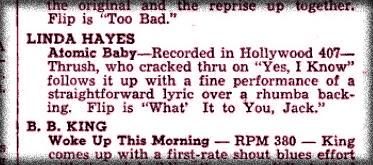
In the same vein »atomic vocabulary« began to crop up in secular songs, for example in Amos Milburn's »Atomic Baby« in which he called his baby »U 92«, that is by the number of uranium in the periodic table of chemical elements! Quite obviously, the enormous power produced by nuclear fission invited its metaphorical use with clear sexual innuendo:
I love my baby, she makes me, oh, so blue
She keeps me so worried, that I call her U92.
She's got a high potential and a low resistance point,
I have to be careful, that gal might blow up the joint.
Yes, she heats my room, she lights my light,
She starts my motor and it runs all night.
 |
| From BILLBOARD, March 7, 1953 |
 |
| From BILLBOARD, April 19, 1952 |
 |
| From BILLBOARD, May 14, 1949 |
In blues, atomic energy appears mainly as a sexual metaphor, but in gospel music it was used as a metaphor for God's power. (...) A sense of wonder instilled by the awesome atomic power possessed by the United States is mingled with feelings of apprehension when it is learned that the Russians have acquired their own version. (Van Rijn, The Truman and Eisenhower Blues, p. 39 f.)The fear of nuclear weapons is still with us today, due to the sinister efforts of North Corea, Pakistan, Iran, and Israel. But at least we have learned (and the people in the Ukraine and lately in Japan have paid dearly for this!) that the immense danger lurking behind the civil use of nuclear energy cannot be eliminated by human control. The »sense of wonder instilled by atomic power« is a thing of the past and not likely to return soon. Or so we must hope.
Subscribe to:
Posts (Atom)