This is nothing less than... the 200th post on this blog!
With some bad and a lot of good times, this blog has made it into its 26th month and reached its 200th post. I had many glorious ideas, all discarded eventually, what I would write tonight. In the end, I settled for an unashamed display of self-complacency. Thus I went through the pages of this blog and concocted sort of a chart list of the best stuff I put online. Needless to say that these mini-charts are exclusively based on my own peculiar likings, but that's what blogs are all about. This is what I came up with, three in each category ... and phew, choices were hard:
Thanks to all those who contributed to this blog by writing comments or getting in contact with me!
I wish you all the best. Keep tuned in to this blog.
... to conclude, the following song comes just for the fun of it, and what fun it is! The incomparable Sugar Pie DeSanto, usually appearing barefeet on stage and famously leaving her high heel sneakers in the locker ('cause they hurt her toesies so bad). This tune was first presented in Billboard on a 21st of March which is a nice coincidence ... from 1964 and just as fresh and peachy as when it was recorded.
Sugar Pie DeSanto: »Slip-In Mules (No High Heel Sneakers)« on Checker # 1073A (1964):
At least three »Murrell Singers« are known from the gospel field, and two of them do not concern us here. I just mention them briefly to avoid confusion later on:
(1) A group, maybe male, attested in the New York area in 1948-49. I found the following news reports about them: New York Age, July 24, 1948, p. 4: »Pastor's Aid Club of Mt. Calvary Baptist Church sponsored a program last Sunday afternoon, with Murrell Gospel Singers as guests [!] artists. Mrs. Clara Ivy was mistress of ceremonies.« - The Afro-American, March 26, 1949, reports from Brooklyn that a group called the »Murrell Singers« was among the groups appearing in a gospel program at Little Zion Baptist Church.
(2) The Carnell Murrell Singers, who hail from Dallas, Texas, and are contempo- rary; for Carnell Murrell, see more here.
The Anna Murrell Singers
The group I'd like to present tonight are the "Anna Lee Murrell Singers" from Pittsburgh. (The photo to the left is probably taken from their only Gospel LP # 3031, rel. in 1964 or early 1965, but I haven't seen a copy of this LP yet; if anybody does happen to own it please let me know or send me scans of the cover!). During their history, the Anna Lee Murrell Singers were also billed as »Anna Murrell Singers« (e.g. on their Gospel records), »Madame Murrell Gospel Singers« (in a concert ad from 1968) and »Anna Murrell Gospel Singers« (in a news report from 1970).
The personnel of the group, according to the Gospel-Savoy files and Hayes-Laugh- ton's Gospel Discography, were for their mid-1960s recordings: Anna Lee Murrell, lead; Betty Jayne Thomas (also on piano); Geneva Bostic; Doris Beach; Verna Williams; Delores Johnson. *Anna Lee Murrell , founder and leader of the Murrell Singers, was born in 1930. In 1983, she was among the first winners of the Pennsylvania-based Gold Penny Award, and in 2011 she was honored as a Pittsburgh Gospel Legend. Here is the respective news report from the New Pittsburgh Courier, January 05, 2011:
(Click for larger version)
Apart from her 60's songs, Mrs. Murrell composed in 1982 a »dramatic gospel musicale« entitled Whatever Happened to the Beautiful Church?, but I do not know anything more about it.
*Delores Johnson is today probably known as »Dee Johnson«, and you can read more about her life in an article by Sharon S. Blake, »Song Bird: For Dee Johnson, the joy of music is only a heartbeat away«.
*Betty Jayne Thomas can be presumed to be a parent of Anna Murrell if the information is correct that a certain Tessie L. Thomas was Anna's father. About the further members of the group I do not possess any information. As far as I know, the group had no male members during the 1960s but in 1983 the musical singer Carl Hall was quoted to the effect that he »sang for ... Madame Anna Lee Murrell's Sin- gers« (from The Pittsburgh Press, November 06, 1983). It remains unclear at which period this may have been the case.
(click to enlarge)
The history of the Anna Murrell Singers began probably in or around 1953 since Mrs. Murrell in 1967 claimed that they were in the business for 15 years. The photo to the left, taken by Pittsburgh press photographer Charles »Tee- nie« Harris (more on him in the note at the end of this post), shows the Murrell Singers in August 1962 »in Calvary Baptist Church for All Night Gospel Sing for the Charles "Buggsy" Drafts Fund« (the photo is from the digitalized collection of the Carnegie Museum of Art Collection).
The group seems to have been particularly active from 1967 to 1970. There are several news items covering their appearances:
(1) Uniontown Morning Herald, July 06, 1967 (p. 14): »Murrell Gospel Singers, under the direction of Anna Lee Murrell, will present a program on Sunday at 7 p.m. in Mt. Olivet Baptist Church, Stewart Ave. The singers, one of the most popular groups of its kind in this section of the country, have sung in 25 states in the past 15 years. Ten years ago they were presented in New York City by the famed gospel promoter, Joe Bostic Jr. They are currently under contract to the Savoy Record Co. of Newark, N.J. Their current records are »A Shoulder to Lean On« and »The Lighthouse«.
(2) Uniontown Morning Herald, September 15, 1967 (p. 20): »Murrell Gospel Singers will present a gospel musical program on Sunday at 7:30 p.m. in Mt. Olivet Baptist Church. The singers, under the direction of their founder and leader, Anna Lee Murrell, sing only gospel songs written by Miss Murrell. They have sung in 25 states in the past 15 years. (...)«.
(3) News Dispatch (Jeannette, Pa.) March 26, 1970: »BLACK HISTORY PROGRAM PRESENTED AT HEAD START. - The Anna Murrell Singers presented a program of »Black History Through Song« as the second in a series of programs for parents and staff of the Westmoreland County Head Start Program. (...) The Anna Murrell Singers, led by Mrs. Anna Murrell, reside in the Pittsburgh area. They have performed musical programs in 36 states as well as in Mexico and Canada. Mrs. Murrell began the program by giving a brief outline of Black History. She mentioned such outstanding persons as Benjamin Banneker, Crispus Attucks, and Phyllis Wheatley. (...) Mrs. Murrell stated that the purpose of the »Black History Through Song« program was to ease dissension among the people of America through the educational approach. She stated that »we are the ones who must make history for tomorrow.« Mrs. Murrell pointed out the significant role Black men have played in all of our major battles and wars. She also mentioned that many slave revolts took place but that most Americans have not been told of these uprisings. Mrs. Murrell listed »ice cream, golf tees, potato chips, the player piano, gas masks, and the first traffic light« as inventions created by Black people. She went on to state that »the Black cowboy and the Black frontiersman have been almost totally ignored.« Mrs. Murrell cited as a »sign of progress« the fact that »Representative James Shore of New York has introduced a bill to establish a National Commission of Afro-American History and Culture.« She suggested all parents who teach their children »who they are, what they are, where they come from, what they're worth, and to humanity.« (...)
(4) The Pittsburgh Press, March 28, 1971, 10 f.: Excerpts from the essay GOSPEL MUSIC ... RELIGION OR ENTERTAINMENT ? by Al Donalson:
»On a recent Sunday afternoon, the Anna Murrell Singers made a joyful noise unto the Lord in St. Paul's Cathedral, Oakland. The Gothic splendor of St. Paul's was an unusual setting for a gospel music concert. Most gospel programs are performed in storefront churches, sanctified churches or the so-called »hard-shell« Baptist chur- ches in the ghettos. The program at St. Paul's was performed before a predominantly white congregation. And although there was a heavy snowfall that afternoon - not to speak of the televised Sunday sports - the cathedral was nearly filled to capacity. »We had sung there the year before,« said Mrs. Murrell, the group's leader and soloist. »At first, I had to sort of lead them into the spirit of the music by showing them how to clap their hands and pat their feet. None of them got up and did the 'Holy Dance,' but some of them were crying and really getting involved in what we were doing. They were moving with Murrell and enjoying it,« she said. The Murrell Singers are black, and like most black gospel groups, are identified as »hard-gospel« exponents as opposed to the Nashville gospel sound normally associated with white gospel singers. (...)"
In 1969, the Anna Murrell Singers did appear in a TV special on Channel 4 entitled »This Is Soul« (as announced in the Pittsburgh Post-Gazette April 29, 1969, p. 29):
As for their released music, the Anna Murrell Singers recorded for Gospel-Savoy in 1964 a mere twelve songs, two of which remained unissued. The remaining ten songs went on their one and only Gospel LP # 3031 (The Light House) (which I am, by the way, desperately looking for ...), and four songs were released as 45s on Gospel # 1089 and # 1097. According to the Savoy discography as well as Hayes-Laughton's catalogue, the first single was recorded on 28th February 1964, the second several months later on 15th October. However, there is something wrong with these dates, because the labels of my promotional copy of Gospel # 1097 bear a radio station stamp with the date »February 27 1964«. This being hard evidence, so to speak, I am inclined to believe that the recordings were done somewhat earlier than stated in the discographies.
Well, this is about it. If somebody knows more about the Anna Murrell Singers, please contact me. For conclusion, let's hear their two songs released on Gospel # 1097 (I put the B side first on a personal inkling ...):
The Anna Murrell Singers: »Wait On The Lord« / »The Light House« on Gospel # 1097 (1964):
* * *
Additional Note: Charles »Teenie« Harris (1908-1998) photographed for the Pittsburgh Courier for almost 40 years, documenting life in the African-American community. His appro- ximately 70.000 negatives, recently acquired by the Carnegie Museum of Art, form one of the richest-known archives of Black life in an American city from the 1930s to the 1970s.
On the net, you can see a small but significant selection of Harris's photos in the collection of the Carnegie Museum of Art. Search the database for his photos here.
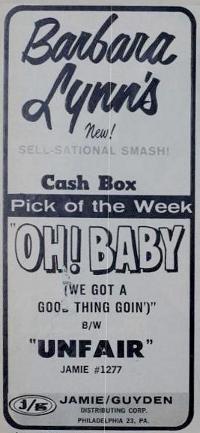
In early summer 1964, Barbara Lynn's infectious »Oh! Baby (We Got A Good Thing Goin')« was released. Now, some of you may not have heard the live version of that song recorded in the Uptown Theatre of Philadelphia on July 24, 1964 (from Atlantic LP # 8101). In fact, Barbara's live version is much rawer than the single version which was put out on Jamie ... without horn section the tune comes across in a considerably less polished way than the 45 version. Btw, Barbara is introduced by Jimmy Bishop.
Just the right track for a Monday night. Enjoy!
Barbara Lynn: »We Got A Good Thing Goin'«
from the Atlantic LP # 8101 (1964) (live):
Postscript
That night in Philadelphia Barbara Lynn performed two more songs which were recorded but unfortunately never released.
There is a nice summary of her career, by Michael Corcoran, here: True Heroes of Texas Music, Part II (you have to scroll down a bit).
And, why not, just let's have a photo of Barbara Lynn here, together with her guitar ... it is taken from the cover of Atlantic LP # 8101 and shows her, presum- ably, during the concert at the Uptown:
For the first time in months I'd like to play a song which I actually haven't got on vinyl myself (and that's a pity!) The song has been around in the net for a while (also on Youtube, see here) and was released on CD. I'm speaking of Little GiGi's »Take The Bitter With The Sweet« on Select # 731B from 1964. (The single is known with a yellow or with a blue/silver label; for a 45 rpm discography of Select, a New York label, click here and here).
Billboard, May 9, 1964
The Billboard critic (who considered »Take The Bitter With The Sweet« the A-side) was right when he attributed an »Etta James sound« to Little Gigi's voice. Who Little Gigi (or rather »GiGi«) was remained a mystery until some months ago. Then substantial information appeared over on Derek's Daily 45s blogspot saying (in the comment section and actually featuring a comment by the singer herself!) that she was managed at the time by Jean Grace and that her real name is Gloria Glenn. As of January 2011 she was fine and, it appears, still active. So, this mystery has been solved.
Another mystery remains: Who was the drummer playing on »Take The Bitter With The Sweet«? Now, folks, listen to the song below, listen to it several times if needs be, and then tell me: Do you know any r&b recording of the classic '60s that features a better, more solid, more diversified drum part? I don't know any and am open for suggestions. I've listened to that song countless times and still discover some new subtleties on the drummer's part. Listen closely, you'll find them as well, they get more obvious the more the song goes on. And taken together with Little GiGi's powerful vocal performance this tune is a song for the ages. It's perfect:
Little GiGi (feat. an unknown but brillant drummer): »Take The Bitter With The Sweet« (1964):
P.S. In case you'd like to hear how this song can be played »regularly«, that is without either a world-class drummer or a first-class powerhouse voice, listen to a recent version of it done by a Spanish r&b outfit called »The Excitements«. Click here (and, in case, buy it here). No, not bad at all! But does it bear comparison with Little GiGi and her fantastic drummer?
Over at Record Connexion, a song by Sister Lucille Pope & The Pearly Gates was posted as download for November 2011, »Almighty God« (Vee-Jay, 1964). The month before, there was another song by the same ensemble, »Highway« (actually the B- side of Checker # 5004, from 1964).
As there are only a few '60s recordings by Sister Pope & The Pearly Gates, I thought I might supply another one here, viz. the A-side of Checker # 5004, »Jesus Tore My Heart To Pieces«. In contrast to »Highway«, which features Larry Blivens (uncredited) as lead singer, it's the voice of Lucille Pope on the A-side. (For completeness' sake, you can hear also »Highway« below.) I love the rhythmic complexity of both songs which is particularly evident at the beginnings.
You'll find a lot of information about Lucille Pope (and some of her later Nashboro recordings) at Red Kelly's Holy Ghost Blog: see here and here. There's also news about Lucille Pope's recent performances, together with some interesting readers' comments. ... and well, by the way, I think that »The Pearly Gates« (Revelation 21:21!) is just one of the most charming names for a gospel outfit ever!
Sister Pope & The Pearly Gates (*feat. Larry Blivens):
»Jesus Tore My Heart To Pieces« / *»Highway« on Checker # 5004 (1964):
In general I love duets, those of the same-gender kind and even more so those of the mixed variety. So I thought about posting duets on Tuesdays and that's what I'll start today. There'll be some classic & well-known duets, some lesser known and some, probably, not much known or remembered at all. And they'll be mostly of the mixed variety. At least, that's my idea at the moment. Let's see what comes of it.
Today, Rufus & Carla Thomas from 1964. They did several duet singles for Satellite/Stax/Atco, and Stax # 151 was their first on the Stax label, released in April '64. »That's Really Some Good«, penned by Rufus Thomas, is conventionally considered the A-side and peaked at # 90 of Cash Box's Top 100 in mid-June. A little more famous, in retrospect, has become the B-side, »Night Time Is The Right Time«. It's a very close cover of Ray Charles's (& Margie Hendricks's) immortal song, but it doesn't really come close, I think, to Charles's original. Carla's presence is way not as forceful as Margie's. Still, it is a groovy tune. What has never ceased, say: disturbing me is that we have here father and daughter singing this highly charged lovers' tune. No, not in the sense we hear it so often in the news nowadays. I mean knowing that here's father and daugh- ter singing just doesn't fit this song, or does it? (The same problem poses itself with a number of other Rufus & Carla duets!) Well, never mind, it's about night time here and I'm not dogmatic about it.
Rufus & Carla [Thomas]: »Night Time Is The Right Time« / »That's Really Some Good« on Stax # 151 (1964):
Jerry Leiber has died, aged 78. The sad news has been known for some days now.
His is a name that needs no introduction, and so I won't give any. Just some words about his early years.
He grew up in Baltimore, and his first language was Yiddish. His neighborhood was mainly Polish and Italian, with many Jews and blacks around. Jerry was one of the »Jewboys«. Aged 12, he moved to L.A. with his mother and sister. All was to begin there, and it was there that he teamed up with Mike Stoller. They had their first record out in 1951.
In memoriam of Jerry Leiber I thought I might play today three songs: words by Jerry, music by Mike. The framed photo above shows them both seated at the piano; standing behind, Jerry Wexler from Atlantic (2nd from left) and the Coasters.
Actually, Leiber & Stoller did not produce many songs over the decades, but almost all of them charted. Two of the most famous, and most widely covered over the years, are »Kansas City (Here I Come)« and »Hound Dog«. Equally popular are some tunes they wrote (or co-wrote) for the Drifters during the '60s, such as »On Broadway«.
Kansas City. One of their first songs, written in 1952 for Little Willie Littlefield. Here, you can hear the version of Shirley Ellis, from her 1965 LP »The Name Game« (Congress # CGL-3003, mono). In order to fit her »female version«, the lyrics were changed to »... they got some crazy little fellows there and I'm gonna get me one« (instead of »they got a crazy way of loving there and I'm gonna get me some«).
Shirley Ellis: »Kansas City« from the Congress LP »The Name Game« (1965, mono):
Hound Dog. This song was penned in 1953 for »Big Mama« Thornton. There are quite a few anecdotes about how this happened and what the chemistry was like between the singer and Jerry. According to Jerry, the song had »a country-funky feel« (Jerry Leiber & Mike Stoller, with David Ritz: Hound Dog. The Leiber and Stoller Autobio- graphy, London - New York 2010, p. 62). Infamously, the song's lyrics, much to the dismay of Leiber, were changed substantially in order not to offend the white public when the song was re-recorded by a Tupelo-born celebrity. It was this version by Elvis that made the song worldfamous. The original lines, as written by Jerry, run »... quit snooping 'round my door. You can wag your tail, but I ain't gonna feed you no more«, and appeared in Elvis's version as »... crying all the time. You ain't never caught a rabbit and you ain't no friend of mine«. Jerry later said: »To this day I have no idea what that rabbit business is all about. The song is not about a dog ... Elvis's version makes no sense to me, and, even more irritatingly, it is not the song that Mike and I wrote« (Hound Dog, p. 94). Yet he also acknowledged that the tremen- dous sales success of Elvis's »Hound Dog« »took the sting out of it«, that is, he accepted the garbled lyrics, went along with it and cashed in on the credits. After
all, Jerry Leiber was a song-seller, not a moralist. In the following, you can hear
the rather unlikely cha cha cha-version of the song as recorded by Betty Everett in October 1963. Good thing is that Betty's version has the original lyrics. The song title is given as »Hounddog« on the cover, as »Hound Dog« on the label of Side 1.
Betty Everett: »Hound Dog« from the Vee-Jay LP # 1077 (second release) »It's In His Kiss« (1964):
On Broadway. One of the best-known songs of the Drifters. This tune was originally composed by Barry Mann and Cynthia Weil. Mann had it conceived as »a Gersh- winesque kind of melody« (Ken Emerson: Always Magic in the Air. The Bomp and Brilliance of the Brill Building Era, London - New York 2005, p. 137), and Weil added the lyrics because she was infatuated with Broadway. However, the song eventually wasn't satisfying. So in January 1963, Mann & Weil took the song to Leiber & Stoller. They re-wrote it to a great extent, thus earning their credits. The version you can listen to in the following was recorded in the Uptown Theatre of Philadelphia on July 24, 1964, and released on Atlantic LP # # 8101 (Saturday Night At The Uptown) later that year. It certainly is the most unusual version of the song you are likely to hear: apart from the excitement of the crowd, the song is done »properly« in the first part, but gradually slips into an ad-hoc group improvisation in the second part. During their performance, the Drifters at one point change »Broadway« into »Broad Street«, »in honor of the Philadelphia thoroughfare« as the notes on the back cover duly remark.
The Drifters: »On Broadway« (live) from the Atlantic LP »Saturday Night At The Uptown« (1964):
1964 was an annus horribilis for Ray Charles. When his album »Have A Smile With Me« (ABC-Paramount LP # 495) was released in late June, he had lost a paternity suit barely five months ago and become, at least by way of judicial decision, father of Sheila Jean Robinson. Charles himself had »admitted to sexual intimacies with pretty, 21-year-old Ohioan Sandra Jean Betts on at least five occasions«, but said he did not believe that he is the father of the baby girl. He didn't take it with much of a smile. However, worse was still to come: his concert tour in autumn during which he was arrested on drug charges led not only to riots in several locations, but was over- shadowed by racial incidents. Some three weeks before his tour, a Jet Magazine staff writer speculated (Sept. 3 issue, p. 63) whether Ray Charles was about to quit singing. Quote: »That's what the man, Charles, himself, said in Paris. He said he would give up singing "very soon and play with my orchestra ...".« Well, this didn't happen as we know, but given the events of 1964 (and especially after touring in Europe and the Boston drug arrest in November) Ray Charles quit touring the following year. In his autobiography he said: »I decided not to tour in 1965. This
was the first time in twenty years that I wouldn't be performing in public. I had lots on my mind, and I couldn't see myself running around. I needed to stop and think.« (Ray Charles with David Ritz: Brother Ray. Ray Charles' Own Story, New York 3rd ed. 2004, p. 254).
ABC-Paramount LP # 495 (1964)
The LP »Have A Smile With Me« fits into that gloomy year 1964, the untimely title included. Billboard (Aug. 1.) hyped it, against all good reason, with the thinly-veiled panegyric: »Charles, the master of the soulful blues, shelves it all in this outing for a raft of fun songs. He sings 'em all with his usual genius. ... A real ball for all.« The curious expression »his usual genius« excepted (can genius ever be usual?), I beg to disagree. I think it's an awful album and quite a contrast to the brillant live recording »In Concert« which was taped some months later in L.A. The personnel on the record is outstanding, though, David »Fathead Newman« on alto sax, The Raelettes backing. Alas, this was to little avail, and Charles's choice of songs was meant to result in a »lighthearted« album »with the idea of letting Charles just kick back and have fun« (Richie Unterberger in the AMG to Soul). The sleeve notes stressed that point: »Here's the other side of the coin! ... this time around your phonograph, he'll bring you a smile, and even a laugh. Here is the light-hearted Ray Charles, again exploring material that, until now, has never been heard by his listeners.« Yet the overall impression doesn't live up to what Charles was aiming at. The best that may be said about this album is, in the words of Mike Evans, that it was »a collection of humorous novelty songs« (The Birth Of Soul, p. 179). And this, again, was also trumpeted out on the back cover: »This novelty package explores still another facet of the art of Ray Charles.«
As it goes with novelty packages, they tend to be a mixed blessing. As mixed as the songs on the album: jazzy C&W, old vaudeville songs or even »pop standards« (that's how Billboard described »Feudin' & Fightin'«). On the other hand, all ten songs on the LP (six with the Raelettes) sound strangely alike, professionally done oldtime jazz-pop, but actually little of that was in any way up to the »modern trends« in music. Charles, who was proud of being a trend-setter and indeed had set different trends in the past, offers nothing much trendy on this LP. And just think what times these were! The first year of the Great British Invasion during which, ironically, black music played by white UK bands outsold black music played by black US artists. In this context, Ray Charles acquired, for some diligent observers at least, the status of a »father figure«, but with a twist to it: He had prepared the way of the »Mersey Sound« in many ways yet his UK emulators outstripped his fame by 1964. In a noteworthy gloss by P.F. Kluge, published in LIFE (Oct. 2, 1964, p. 28: »U.S. Roots of the Beatle Beat«), we read: »If the Mersey sound is an art form, this (i.e. black U.S. music) is the music that gave birth to it, although not one of its inventors, not even the very popular composer-performer Ray Charles, has ever been as sought after, televised, filmed, interviewed and just plain loved as their English imitators.«
* * *
The 50's-sounding song »Smack Dab In The Middle«, shuffling along in a R&B-style of years past, was the only moderately successful tune of that album. It entered the Billboard Hot 100 Pop the first week of October and one month later was lingering at #52. Another week later, in mid-November, the song dropped out of the charts. This all becomes more emblematic of Charles's status and style in '64 if you consider for a moment the songs which meanwhile climbed the charts: When »Smack Dab In The Middle« entered the Hot 100, »Dancing On The Street« (Martha & The Vandellas) had reached # 04, »The House Of The Rising Sun« (Animals) stood at # 08. The Shangri- Las' »Leader Of The Pack« and The Velvelettes with »Needle In A Haystack« were coming up behind; at the beginning of November, Motown's sequin-dressed valkyries made it to the top with »Baby Love«; when Charles's song left the charts, the Rolling Stones' cover of Irma Thomas's »Time Is On My Side« was approaching the Top Ten. Compared to all that, Charles's album seems come out of another epoch.
Need some demonstration of this? Well, there is ample choice on the LP. As I have a special liking for the Raelettes, you can hear in the following two songs that feature them as backing vocal group. I picked »Two Ton Tessie (from Tennessee)« and »Who Cares For Me« since in these tunes the backing vocals are given much room. The first song was recorded on May 7, '64, at the N.Y. Bell Sound Studios (days before Ray Charles would depart for Europe), the latter back in February 1962 in L.A. For the record I can add that almost all other songs of the LP were recorded in May '64 in New York, with the exception of »Move It On Over« (likewise from '62). Here you go:
Ray Charles (feat. The Raelets/Raelettes):
»Two Ton Tessie« / »Who Cares (For Me)« from the ABC-Paramount LP # 495 (1964, mono):
It's time to follow up the story of the Meditation Singers. Roughly one month ago, I wrote about their 1958 album which was spear-headed by Della Reese presenting »her« Meditation Singers.
The Meditation Singers (1964), left to right: E. Rundless, L. Lee, D. Hammonds, V. Rogers,
M. Waters. - Photo from the Gospel LP # MG-3038.
The problem for the Meditation Singers in the early 1960s was that they had crossed over into secular venues, e.g. when they accompanied Della Reese in night clubs or Las Vegas casinos. This brought them considerable disrepute in the traditional gospel community. You can sense it to the present day. Thus, in most of the better known literature on Black Gospel (suffice it to mention the names of Anthony Heilbut, Bil Carpenter or Robert Darden) the Meditation Singers are virtually ignored. Horace C. Boyer in his The Golden Age of Gospel (Urbana- Chicago 2000, p. 127 f.) does mention and acknowledge them as »one of the premier female gospel groups of Detroit«, but apart from noting their »great influence on the Motown Sound« exclusively deals with their '50s activity and gives much space to the role of Della Reese (which, after all, was somewhat limited really). And as if to underline this near silence in the literature on gospel music we find them variously, and sometimes in greater detail, treated in non-gospel works, e.g. in Jay Warner's American Singing Groups which basically is concerned with non-religious music. There, and thanks to the happy coincidence provided by the alphabet, we find the Meditation Singers in the company of the Medaillons (a male West Coast outfit of the '50s) and the Mello-Kings (»one of the blackest-sounding white groups of the 50s«, a quintett from New York). They likewise appear in the priceless encyclopaedia of Keith Rylatt (Groovesville USA. The Detroit Soul & R&B Index, Worthing 2010), because they recorded in 1961/2 several songs for the Detroit labels »D-Town« and »HOB« under the name »The Meditations«.
Gospel LP # MG-3038 (1964)
However, the Meditation Singers did not abandon the field of gospel music in the first half of the 1960s and »went pop«, far from it. A good example of their output during these years is their last album for Savoy Records, released on the subsidiary »Gospel«. At the same time, it was to be their last LP before they moved to Checker / Chess Records. I am speaking of the Gospel LP # MG-3038 entitled »I'm Holding On«. Pondering the title and considering the pretty symbolic cover (SEE POSTSCRIPT) it seems to me that they inten- ded to put across a clear and unequivocal message with this LP: Look here, we're still »holding on«, namely to gospel (and to the Gospel), and we're still holding up the cross (right into the spotlight as the cover shows)! It was like saying, don't you think we've become night club singers! And fittingly, this LP does not contain anything that could be called »pop-gospel«, and the dominant piano viz. organ, coupled with the absence of guitars, restricts the similarity of the overall sound to what »secular« outfits of the time were doing. But then, where can you draw the line? It certainly can't be determined solely on the basis of which instruments are employed, and in regard to the purely vocal aspects it's very hard to separate the fields of gospel and '60s-r&b anyway. Needless to add the truism that the latter could not have come into being without the former when it comes to the vocal techniques.
Unfortunately, the sound quality on this LP is not perfect, but that can't be helped. The songs were recorded on September 23, 1964, at the Medallion Studios in Newark, New Jersey, and supervised by Rev. Lawrence Roberts, Pastor at the First Baptist Church in Nutley, likewise in New Jersey. Roberts was an »iconic gospel producer at Savoy Records and director of the famous Angelic Choir of Nutley«, who had produced one of Savoy's best-selling LPs, »Peace Be Still«, in 1963. You can hear E[a]rnestine Rundless (lead), Verlene Rogers (sometimes incorrectly spelled Verlaine Rogers), Donna Hammonds, Marie Waters and Laura Lee (Rundless).
The two songs you can hear below are »Lord I've Tried« and »My Soul Looks Back«. Both are standards that have been recorded by many other gospel singers or groups. The first song was written by William Herbert Brewster (1897-1987), the second by Rev. James Cleveland (1931- 1991); Cleveland himself did much work with the Meditation Singers. And both songs are primarily a showcase for the lead singer, while the backing vocals remain rather passive throughout and basically accompany the lead voice; more so in the first song than in the second. It is up to you to judge how close this kind of gospel music really was to contemporary soul and r&b, which I think is pretty much the case in many important respects. Of course, the message was different, and the similarities in vocal performance, rhythmic structures and harmonies should not make us forget that we're dealing here with religious songs. They are meant as such, and deserve to be heard as such. Yet it remains a fact that you could buy this album when the first wave of the »British invasion« had just overflowed the U.S.A. If you concentrate on the music, this is an interesting point to keep in mind.
The Meditation Singers:
»Lord I've Tried« / »My Soul Looks Back« from the Gospel LP »I'm Holding On« (1964)
* * *
Postscript 16. Sept. 2011:
The cover was designed, as is obvious at the first glance, by the legendary Harvey (see this collection for his cover art). Curiously, this cover was then re-used on another Savoy LP from ca. 1970 (by Dorothy Norwood, see here). There are several other Harvey covers not identical but rather similar to the one under discussion (see here and here).
There are more live recordings of the Ike & Tina Turner Revue than of any other r&b outfit from the 1960s. Fortunately. Yes, I know, some of you will object that not all of what we hear on these recordings is worth listening, and I agree because Ike & Tina not only tended to repeat their show programme for years on end with little variation, but often they sound, if not plainly bored, purely professional. Well, true. Yet still, the recordings are as documents of their time of some historical value, for one. In addition, on several recordings we hear other singers as well who never became truly famous in their own right. And I do not speak about The Ikettes, who are famous after all, but of various other artists who toured with Ike & Tina.
United Superior LP # 7765 (1970)
One of the better known live recordings of the Ike & Tina Revue was made in 1964, in the Club Imperial & Harlem Club in St. Louis. Originally, this recording was released on Kent LP # 5014 (ST-514) »Ike & Tina Turner Revue Live«, and at the same time (that is, in 1964) in the UK on Ember LP # 3368. However, I possess this LP only as a re-issue, namely on United Artists / United Superior LP # 7765, released in 1970 (see cover). This re-issue, together with others of the same recording, was released with the title »Please, Please, Please«. (This title may, up to a point, be justified by the fact that the LP contains a 7-minutes rendering of »Please, Please, Please« by Tina, even though she is talking-preaching for the greater part; »Please, Please, Please« was out as a new Ike & Turner single in November '64, on Kent # 409. The song charted only locally, e.g. hitting the Top Ten in Memphis in December '64).
For almost half of the show, as released on this LP, we do not hear Tina Turner but other members of the Ike & Tina Revue. One song, »Feel So Good«, is performed by Jimmy Thomas who worked for many years with Ike Turner and in 1964 was part of the Ike & Tina Revue. In later years he made a solo career of sorts. The feelgood song »Feel So Good« is losely adapted from John Lee Hookers »Boogie Chillun« from 1948, and Hooker himself recorded several versions of it. The song was recorded by many others, not the least by Buddy Guy and Van Morrison. Jimmy Thomas's version is memorable in its own way, and I love how he kicks it off with the falsetto shriek »Hey!« ...
Jimmy Thomas: »Feel So Good« from the United Art./Superior LP 7765 (1970):
Towards the end of January, 1965, an album was released which in the future would not belong to the more famous recordings made by Ray Charles: Ray Charles Live In Concert, his first live-album for ABC (LP # 500). The concert was recorded on the evening of September 20, 1964, in the Shrine Civic Auditorium, Los Angeles (see also the postscript!). It was the opening concert of Ray's autumn tour.
As so often, hearing Ray Charles play in front of a live audience creates a very different feel if compared with his studio recordings. He had picked many of his »old« tunes for this concert, but also included some of his then newly released songs (»Baby Don’t You Cry«, »Makin’ Whoopee«). Right after the intro of the show Ray hits into a 6-minute-version of one his most famous songs, »I('ve) Got A Woman« (the song title appears on the back cover of the LP as »I Gotta Woman«). As is known, he had recorded this song almost ten years before, in mid-November 1954, in an Atlanta radio station converted recording studio. The version of this song which Ray presents in the concert is somewhat peculiar: there is a prelude, closely inspired by Beethoven's Pour Élise, followed by a short and intensely emotional hymn - well, I call it hymn for lack of a better term. And it is only after this opening that Ray switches to the first notes of the song as we know it. Nobody ever again has played this tune as perfect. The Genius at work. Much ink has been spilled discussing whether »I Got A Woman« should be considered the »foundation song« of R&B viz. modern Soul ... but this must not concern us here. Ray's 1964-recording of the song is remarkable in many respects, quite beyond the prelude: there is a lot of jazzy improvisation going on in the second half of the song, with Ray and his big band variously taking up melody lines from other known tunes. On tenor sax we hear nobody less than David »Fathead« Newman. Listen to it here, in mono:
Ray Charles: »I Gotta Woman« from the ABC-Paramount-LP # 500 (1965):
* * *
Ray's autumn tour of 1964 was overshadowed by not a few scandals. First, Ray did not come to grips with his drug addiction. During the tour he was more than once questioned or detained by the police for being found in the possession of drugs (marijuana and heroin), for e.g. in Boston in November. Second, after the tragic events of the »Freedom Summer« the general atmosphere in the southern states was rather explosive and race tensions were high. Thus in October, in Montgomery, Al., the white public was barred from one of Ray's concerts, including those whites who had valid tickets for the show. The local police even entered the tour bus of Ray's band and questioned the passengers. They had orders to only let blacks enter the concert hall. However, a (white) Jewish musician, the guitarist Donald Peake, could pass as well after some discussion ... What times these were! Here is the notice from JET-magazine, Oct. 15, 1964, p. 61:
* * *
POSTSCRIPT April 30, 2011:
Additional information about Ray's autumn tour in 1964 and his show in the Shrine Auditorium can be found here: raycharlesvideomuseum.blogspot. On this page, this concert ad is published:
One of the great summer hits of '64 in the U.S. was »Under The Boardwalk« by The Drifters. While the British invasion was at its peak the song (on Atlantic 2237) reached # 1 r&b and # 4 pop in June.
It was recorded in New York on May 21, 1964. Lead-singer is Johnny Moore, who returned to be part of the Drifters only that spring. As is well-known, the Drifters had, in their long history, several lead-singers some of whom went solo after their stint with the group. Between 1953 and 1971, there were 11 of them in all, among them Clyde McPhatter (1953-55), Bobby Hendricks (1955-56, 58-59), Johnny Moore (1956-58), Ben E. King (1959-61) and Rudy Lewis (1961-63). And in 1963 the group was already marketed as a classic and their '50s recordings were sold as »Golden Oldies«. It was a sign of the times: In May '63, Roulette Records had started a new Oldies-series called »Golden Goodies« (and that included some of the old Drifters' tunes as well).
Ad from Billboard (May 25, 1963)
But with »Under The Boardwalk« the Drifters still had contemporary success. The song was penned by Artie Resnick & Kenny Young after Leiber & Stoller had, for the time being, stopped to deliver material for the Drifters. Most see the song as »pop-soul«, and indeed it is more »pop« than »soul«. However, you will hear the song in a different way after having listened to the live version of it, and without the Latino-Soul gimmicks that characterize its studio version. In fact, there is a nice live-recording of that song, taped in the Uptown Theatre of Philadelphia on July 24, 1964.
This live-version was released on the Atlantic LP # 8101 (Saturday Night At The Uptown) in late 1964. It contains several songs by The Drifters, The Vibrations and Wilson Pickett and one each by The Carltons, Patti La Belle & Her Bluebells, Patty & The Emblems and Barbara Lynn. Quite obviously, the LP was part of the new craze for live albums which was fired by James Brown's »Live At The Apollo«. Soon after that, Sam Cooke, Gene Chandler, Ike & Tina Turner and Etta James appeared »live« on records, and most Motown stars (The Marvelettes, The Miracles, Mary Wells, Marvin Gaye) as well. A number of the earlier live-LPs were technically less than satisfying, and many of the Motown albums in particular were poorly produced. Not so Atlantic 8101. It may not be perfect judged by today's standards, but in the year 1964 it must have appeared well recorded and finely cut.
The intros are spoken by Georgie Woods and Jimmy Bishop, popular DJs from Philadelphia, and the guitar player who is addressed in the middle of »Under The Boardwalk« was Billy Davis. On the back cover of the LP we read:
The audience called for Under The Boardwalk: The Drifters sang their infectious summertime hit ... and the audience quickly joined in and sang with them.
And here we, too, join in ...
The Drifters: »Under The Boardwalk« from the Atlantic LP Saturday Night At The Uptown (1964)
I am interested in the music, not in the relative rarity of discs. I also listen with great pleasure to Aretha Franklin, because she has the voice of the century. Music is no Faith and therefore has no heretics.
* * *
No music downloads on this site. All mp3s (with very few exceptions where noted) are ripped from original vinyl discs. If something on this blog is objectionable to anyone or should, for valid reasons, be re- moved from the net please let me know; it will be removed. And to reiterate: This is a non-profit blog.