Last Thursday, actually Nina Simone's 80th birthday, I tossed about in my sweaty bed, driven from one edge of the frame to the other by feverish dreams, when damp showers and drizzling snow finally had knocked my immune defenses down (There more so as I just had returned from a 6-days trip to Rome). Friday seemed better, but the weekend had me down again. Now, over those last days I had ample occa-
sion to meditate whether it would still make sense to post something in honor of Nina Simone ... and this in turn led me to think about the value of anni- versaries in general. My conclusion was that Nina really doesn't need any special remembrance. As she is present in the hearts and minds of so many, one day is as good as any other. So today be it.
I don't remember where I read that somebody characterized Nina Simone as »undefinable«. It sounds like a non-description, as something said for want of better terms, but if you think about it for a second or two it might just turn out to be the greatest compliment any artist could ever hope to receive. (For my part, I tried to come up, before my inner eye, with artists I wouldn't know how to define for their sheer breadth of achievement and talent, and I couldn't come up with more than a handful.)
(Click to enlarge)
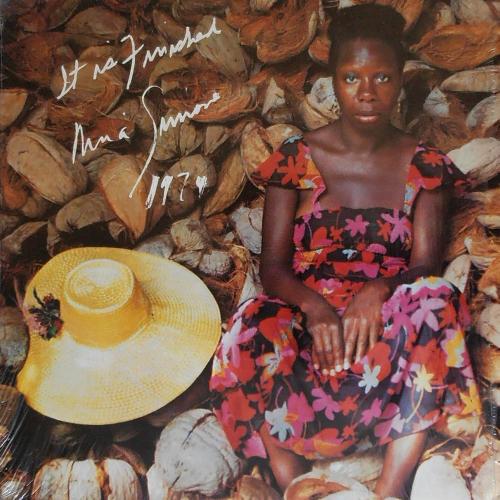
What would do justice to Nina in a special (if belated) anniversary post? First, recalling to mind, once again, her most troubling and indeed thoroughly haunting LP cover, viz. that of her last RCA album released in 1974 (but recorded in '73). And it's not the title (It Is Finished), for all its sinister undertone, that I find most disturbing. It is rather the way she poses and stares right in your eyes: innocent yet menacing, stubborn yet weak, resigned yet provocative, gloomy yet radiant with inner strength, human yet strangely outworldly, in a colorful summer garb with a bright straw hat yet sitting among dried-out and dis- carded coconut shells as if before a heap of skulls. I don't know why but the whole composition strikes me as Van-Goghesque for the importance it gives to color over matter and for the fact of how the simplicity of shapes and expression lays bare the underlying complexity of sentiment and life.
Second, the LP that comes under this cover is a string of masterpieces from the beginning to the end. But there is one song in particular which translates the visual art of the cover shot into a magical sound experience. The song is called Dambala (after a Voodoo deity; the song was written and first performed by Bahamas-born musician Exuma in 1970). I personally feel that this song comes nearest to summing up Nina's being (if that were ever possible). And it shows her, by the way, as the great great pianist she was. And a lot things more. Thanks for everything, Nina! Nina Simone: »Dambala« from the RCA LP It Is Finished (1974):
On the day 45 years ago, The Supremes Live at the Talk of the Town was aired tonight on British TV. The post-Flo Supremes had opened in London's Talk of the Town on January 22, 1968. It was part of a tour through Europe (not their first) which took them to Cannes, Paris, Milan, Hamburg, Amster- dam, Stockholm and, well, London. After their 22 January concert, Diana Ross, Mary Wilson and Cindy Birdsong (not in the photo) were immortalized by a press photographer when Paul McCartney showed up and said hi (... and fittingly the #1 pop song in January 1968 was the Beatles's »Hello Goodbye«!); you can find a larger version of this pic in the February 10 issue of Billboard.
Now, let's pause for a moment and think what was going on in the heads of the persons on the photo. The Supremes had, just before they departed for Europe, stayed in sunny Mexico to deliver their pathetic contribution to an episode of Ron Ely's Tarzan. The episode in question was called The Convert and was aired in the US on January 12, 1968; you can watch it on YouTube. In that episode, the Supremes appear as three nuns and merrily chant a few churchy tunes, e.g. »Michael Row The Boat Ashore«; their boat capsizes because their singing irritates a touchy hippo (can't blame it) and all three are getting a jungle bath before being valiantly rescued by Tarzan. They then act their lordly way through the dire episode to conclude it with shouts of Hallelujah and a lot of hand-clapping.
Motown's admittedly clever publicity idea to insert the Supremes, whose record sales were slacking in late 1967, in a noted TV series was deemed interesting enough to warrant a fully-fledged coverage of their »Swinging Dramatic TV Acting Debut« in JET (issue of January 18, 1968, p. 60 ff.). The JET piece came with a centerfold pic of the Supremes »cooling off ... after a hot day's work in the jungle« (see it here), and there were also a number of pics showing the nuns from Detroit at work ...
(From JET, January 18, 1968, issue, p. 60)
The unlikely nuns then exchanged their modest attire for sequined dresses, flashy elbow gloves and tippy heels, boarded a plane and eventually run into Paul McCartney, or vice versa. What mood was he in? Well, right on 22 January, the new Apple office had opened in London, ushering in the last phase of the Beatles epic. Spiritually, he may have been preparing for his imminent trip to India where he was to study Transcendental Meditation (from mid-February onwards); eventually, he became bored and returned home, although he later claimed that TM »has helped him personally« (see quote here). Before he boarded his plane, he had taken part in shooting a small part for the Yellow Submarine movie and also recorded »Lady Madonna«.
Motown LP # MS 676 (08/1968)
The Supremes meeting Paul McCartney were thus a truly bizarre match. Let's hope that Paul, who reportedly attended the Talk of the Town concert of the Supremes before meeting them afterwards, was too distracted by the Apple launch and the India follies of his buddies to listen closely to what the Detroit ladies were offering on stage. However, Berry Gordy saw to it that the public was, in August 1968, endowed with a live LP which brought the musical enrichment of the British Isles as enacted by the Supremes into the home of unfortunate record buyers. In any case, the LP is one of the best live recordings to come out of Motown, although the measuring standards are poor. Diana and the Supremes did what they could best: trying to make forget the public by their lively appearance that vocal art was an alien concept to their lead singer. Unfortunately this strategy doesn't work on vinyl.
But London survived the Supremes, I guess. And there is still much talk of the town going on there, after all. The Supremes, first medley from the Motown LP # MS 676 (1968):
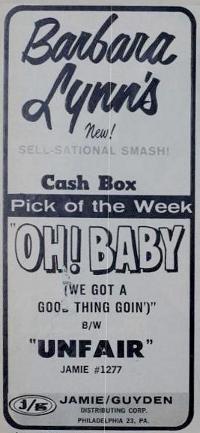
In early summer 1964, Barbara Lynn's infectious »Oh! Baby (We Got A Good Thing Goin')« was released. Now, some of you may not have heard the live version of that song recorded in the Uptown Theatre of Philadelphia on July 24, 1964 (from Atlantic LP # 8101). In fact, Barbara's live version is much rawer than the single version which was put out on Jamie ... without horn section the tune comes across in a considerably less polished way than the 45 version. Btw, Barbara is introduced by Jimmy Bishop.
Just the right track for a Monday night. Enjoy!
Barbara Lynn: »We Got A Good Thing Goin'«
from the Atlantic LP # 8101 (1964) (live):
Postscript
That night in Philadelphia Barbara Lynn performed two more songs which were recorded but unfortunately never released.
There is a nice summary of her career, by Michael Corcoran, here: True Heroes of Texas Music, Part II (you have to scroll down a bit).
And, why not, just let's have a photo of Barbara Lynn here, together with her guitar ... it is taken from the cover of Atlantic LP # 8101 and shows her, presum- ably, during the concert at the Uptown:
In December 1963, Chess released the most exciting live recording of the '60s by any female artist. Famously, it was taped on two days in September 1963 in Nashville's New Era Club. And also technically it was way ahead of what other record companies were putting out at that time (listen to Motown's live albums for comparison!). There is not a second on that album that isn't worth hearing. It's a smash from beginning to the end.
Etta James: »Seven Day Fool« / »Baby What You Want Me To Do« from the Argo LP # 4032 (1963):
Note: The b/w photo at the beginning of this post shows Etta James at the River Rock Casino in Richmond, BC, Jan 30, 2009. Agency/photographer: UPI Photo / Heinz Ruckemann. You can access the photo in original size and colour here.
Esther Phillips lets her hair down once more on this blog! And she did it back in January 1970 when she recorded her live album Burnin' Live at Freddie Jett's Pied Piper, L.A. (Atlantic LP # SD 1565). The album was released in August '70 after some overdubs (flute, trumpet and tenor sax) had been added in New York. The album was both listed on the Best Selling Jazz and Soul LPs charts; it stayed for some 6 months on the Soul LPs charts (beginning Nov. 14, 1970) and peaked at # 07 in January 1971.
From Billboard, Sept. 5, 1970, p. 72
The LP suscitated many reviews and comments in the contemporary press, and her frequent live performances in late 1969 and early 1970 were covered regularly in the California newspapers. (The back cover of the Burnin' album shows facsimiles of three such reviews plus short liner notes by singer Carmen McRae.) Even Ebony Magazine (in the December '70 issue, p. 28) run a review.
Ad from Ebony, Dec. 1970 issue
Interestingly, the variety of songs on the album made the critics differ as to which songs they preferred ... the Billboard writer singled out »Cry Me A River Blues«, while Carmen McRae in her liner notes chose to mention as favorites »Don't Let Me Lose This Dream« and »Please Send Me Someone To Love«. Nice thing is that you can hear the latter song (a Percy Mayfield composition) over on BB's Magic Jukebox blogspot. The Ebony writer preferred to call attention to Esther's version of »I'm Gettin' 'Long Alright«, and this is just fine with me. So get ready for a 6-minute version of that tune! Actually, the song starts only at about 02:10 into the recording, after Esther has done some introductory talking ... I do most of my blues songs for the ladies because we always have the blues, you see ...
Esther Phillips: »I'm Gettin' 'Long Alright« from the Atlantic LP # SD 1565 (1970):
AND ... I couldn't resist the temptation to post another recording of this song along with Esther's live version of it. It's a raw-cut, almost archaic version recorded by the Raelettes (with Ray Charles on the piano) which has never stopped haunting me. Compared to Esther's rather jazzy version (which is marvelous in its own right) you get here the modern version of somewhat like a hollering worksong of old, stripped bare to the basic harmonies and the insisting rhythm. Man, it tears me apart every time I hear it!
The Raelettes (feat. Ray Charles): »I Get Along All Right« from the Tangerine LP # TRCS 1511:
Note: On Tangerine LP # 1511 (Souled Out) the song title is given as »I Get Along All Right«. On the single release (TRC # 984, April 1968) of the same recording the title runs »I'm Gett'n Long Alright«.
In 1961, Clara Ward signed a contract to appear regularly at Las Vegas's New Frontier Hotel and in December performed for the first time at New York's Village Vanguard night club. TIME (April 28, 1961) run a story about The Grandison Singers, a female group who had switched from churches to liquor-serving clubs. »Says Mary Grandison: People in the nightclubs accept the music more than people in the churches. It's more quiet here. It's almost reverent«. In 1962, Clara Ward & her Singers started their long-lasting series of engagements at the Golden Horseshoe Saloon in California's Disneyland (see also here). Meanwhile, Della Reese and the Meditation Singers had taken to the stage of Las Vegas's Flamingo Hotel and graced the platform at New York's Copacabana (read more here). Finally, in 1963, excite- ment about »gospel going pop« peaked when New York's first »gospel night club« opened, the Sweet Chariot on Times Square.
Billboard ad, June 1, 1963
In the Sweet Chariot, a white and predominantly upper-class audience came to wag their feet to the »sanctified beat« of black »tambourine pounders« (Ren Grevatt's choice of words). »Angelic bunnies« floated between the tables as waitresses, »wearing shorty gowns with handsome non-flappable wings attached ... pleasingly female though not provocative« (Billboard, May 18, 1963, p. 12). The rest rooms were labeled »Brothers« and »Sisters«. As for the music, »[t]here is a noticeable avoidance of selections with a direct religious reference. The emphasis is strongly on the music and the beat«. A week later, on May 24, TIME followed-up with the article »Gospel Singers: Pop Up, Sweet Chariot«. It greets the »new sound« with limited enthusiasm, though, and the writer is aware of what may happen when »experienced huntsmen« and »desperate hustlers« of the music business are after a »new sound«. (The article is worth reading, and since TIME has recently closed its archive to non-members I reproduced most of the text at the end of this post; see below.)
The opening of the Sweet Chariot ignited new cash fantasies in the minds of many in the music industry ... and also appealed to a number of gospel outfits. The idea that gospel »had finally made it« was quickly transformed into the strangest of business plans, and the headline in the Billboard May 18, 1963 issue, viz. »Can Gospel Replace The Twist?«, tells it all.
BB, July 13, 1963, p. 20
In the June 8, 1963, issue Ren Grevatt (indefatigable in driving home the message of how gospel was about to become pop) authored another article entitled »And Now Gospel's Popping Into Pop Field«. Grevatt again focused on The Sweet Chariot and also mentioned Clara Ward and her success in pop night club circles in this regard. He also quotes some of the leading cash grabbers, Ewart Abner of Vee-Jay and Columbia's Dave Kapralik. The latter, closely involved in the business of The Sweet Chariot, said about the performances, »[i]t won't be the purest kind of gospel«. Which didn't matter much to him because he felt that »the relig- ious aspect of the gospel is not an important aspect. The customers are not going to gospel clubs to get religion or get the message. They just want to hear what I call happy music. They have fun without the message.« In the above-mentioned TIME article, Kapralik is quoted with the words: »It's the greatest new groove since rock 'n' roll. In a month or two, it'll be all over the charts.«
A businessman could well state the bare facts so bluntly. The participants on the other side, viz. the various Gospel outfits, did not dare or think it right putting it this way. Gertrude and Clara Ward (who by 1963 had yielded completely to the lure of secular venues although they never, to my knowledge, appeared at The Sweet Chariot) are often reported with saying that singing spirituals in night clubs »brings the message of the Lord to all«, spreads the Gospel and could be helpful in saving lost souls, thus selling their performances in pretty unholy places as kind of a missionary work. Few did believe them.
JET magazine, August 8, 1963, p. 65
In summer '63, the estab- lished gospel scene, in unison with many church representatives, started to strike back. A clergyman saw in performing gospel music in night clubs a reckless disregard of the genre's inner essence. This essence was, for him, tied to its roots, namely the birth of sacred song in »blood and toil and sweat and tears« and thus not fit to be the stuff of mere amusement. More importantly, Mahalia Jackson had launched a general onslaught on »pop gospel« in June '63, declaring that »Pop gospel has failed because it's not the voice and sentiments of the American people.« The mixture of pop and gospel was, she went on, a contamination of the latter, and »there are some things people are afraid to mess with and pop gospel was one of those things.« In other words: »No man wants to be pulled down, and pop gospel music was like pulling God down.« (All quotes from Billboard, Sept. 28, 1963, p.1.)
On August 31, Billboard declared that »pop gospel as an important trend is dead« (p. 3). Seen in retrospect, the authoritative voice of Mahalia Jackson gave »the Great Pop Gospel Balloon« (Laurraine Goreau), for the next years at least, a mortal blow:
In 1963 when a number of companies tried to develop a pop gospel sound in New York (complete with gospeleers shouting out ditties in nightclubs) the movement failed. Mahalia Jackson had much to do with putting the fear of the Lord into those companies with her strong stand against taking gospel and watering it down. (Eliot Tiegel in Billboard, Nov. 6, 1971, p. RN-40).
* * *
In the midst of all this excitement, Buena Vista (Disney's pop record label established in 1959) released LP # STER-3318: The Famous Ward Gospel Singers Recorded Live at Disneyland. Obviously, this was a by-product (and a prop at the same time) of the Wards' concerts at the Golden Horseshoe. However, neither Clara nor Gertrude Ward went on record here, and the whole live show is performed by The Gertrude Ward Singers. (For the different cover of the French issue see here.)
The members of the group you can hear on that LP were the following: Viola Crowley (sadly, she passed away recently in June 2011), Geraldine Jones, Clara Thomas, Vermettya Royster, Mildred Means and Malvilyn (Simpson) Statham. The singer best-known among r&b aficionados will be Vermettya Royster, a once-time member of the Ikettes and the Raelettes and still active. Most of them had recorded and performed with Clara Ward and/or her mother since 1959, but none before 1958 when the famous '50s outfit of the Ward Singers (feat. Marion Williams and others) broke up. There's only one reasonably good photograph that shows, with the unfor- tunate exception of Clara Thomas, all of the above-mentioned singers; it was re- portedly taken in 1969 (with Clara Ward and Elvis Presley in the center):
The 12 songs on this LP are mainly uptempo, with much tambourine-shakin' goin' on. All singers have leading parts in one song or the other, but most of the tunes are too fast and chorus-oriented to give the leading voice a chance to shine. However, there is Vermettya Royster's intense, 5-minute version of »Never Grow Old«, and there are two tunes showcasing the rough-edged voice of Geraldine Jones, »I'm Getting Nea- rer« and »Something's Got A Hold On Me«. It's those two you can hear below. And notwithstanding the endless discussion about gospel groups performing at secular venues I think these tunes are worth hearing. You can easily pour ridicule over the Ward Singers' engagement in Disneyland, as Anthony Heilbut, for one, has done: »... Disneyland, where the Ward Singers, the cartoons of gospel, joined the wonderful world of Mickey Mouse« (The Gospel Sound, p. 110).
But I don't think things are as easy as that. Bil Carpenter offers a much more ambivalent and balanced perspective on what the Ward Singers achieved: »They were the first to perform in Las Vegas hotels, the first to perform in amu- sement parks such as Disneyland, and they brought a flamboyant elegance to a musical form that was considered an unglamorous vestige of slavery« (Uncloudy Days, p. 429). The major part of the songs on Buena Vista LP 3318 are overtly religious, above all the con- version song »Something's Got A Hold On Me« (and which is, incidentally, closely related to Lula Collins's »What Is This«). And I believe that notwithstanding the context the message is still there and the artists aren't singing simply to amuse the crowd. At least I can't hear that, can you?
The Ward Singers feat. Geraldine Jones: »I'm Getting Nearer« / »Something's Got A Hold On Me« from the Buena Vista LP »Recorded Live At Disneyland« (1963):
* * *
Some additional items regarding the »Disneyland experience« of the Ward Singers:
(1) From The Afro-American, July 17, 1965, page 11:
(2) From Willa Ward-Royster: How I Got Over. Clara Ward and the World-Famous Ward Singers. As told to Toni Rose, Philadelphia 1997, p. 161 f.:
»... one of the press people asked, "What do you have to say when people object to your singing in places like nightclubs and Disneyland?" Mom's [i.e. Gertrude Ward's] change of heart was clear in her answer:
I don't know if they've accepted it by now or not. They thought that when we went out into the clubs, we'd be singing blues or jazz or even rock-and-roll, but we sing the same songs in the clubs that we sing in church. It's wonderful how they accept Gospel singing, sometimes even more than people in the church. (...) I've heard worse in some churches and from the mouths of the "holy" than I've ever heard in any nightclub.«
(3) The Ward Singers were, not the least for their flamboyancy, idols for gays in the black community (and sometimes beyond), somewhat similar to opera divas who are often venerated among gays. Tellingly, there is a chapter on the Ward Singers (this time including Clara) performing at Disneyland in John Edmonds: Called, Justified, Glorified, and Gay. The fictional Memoirs Of Gospel Singer, Josephus Hezekiah Carson, Bloomington 2008, pp. 150-56. The author is overwhelmed by the »five beautifully be-gowned and be-wigged and be-dazzled ladies« that »made their grand entrance« and describes the Clara Ward Sound by the adjectives »shrill, full, force- ful, energetic, harmonious«. Sorry that I can't quote more here. Read it here (not all pages are visible at any one time!) And having done this you might as well look here.
* * *
TIME magazine, Friday May 24, 1963: »Gospel Singers: Pop Up, Sweet Chariot« (Extracts)
Once a year or so, the popular-music business falls into a faint, and the only thing that can bring it around again is a new sound. The new sound quickly becomes every hipster's new groove and everybody imitates it until even little children no longer care to listen. Last year the twist was replaced by the bossa nova, but as things turned out, it was a case of a starving man rescuing one who was merely hungry. Business faded.
For months now (and in the record business, months are decades), despe- rate music hustlers have been searching for the new groove. Experienced huntsmen confined their attention to Negro music, which, with the single exception of country music, has supplied them with every new idea since the blues. Last week, with appropriate fanfare, they proclaimed they had found the sound: pop gospel. Waving contracts and recording tape, Columbia Records moved into a new Manhattan nightclub called the Sweet Chariot and began packaging such devotional songs as He's All Right for the popular market. "It's the greatest new groove since rock 'n' roll," said Columbia Pop A. & R. Director David Kapralik. "In a month or two, it'll be all over the charts."
Yeah! Since gospel music is the root of rhythm-and-blues and "soul jazz," the discovery turned out to be embarrassingly obvious—like eating the hen after stealing all the eggs. (...)
Gospel music may have seemed a surprise a half-block from Broadway, but Pentecostal churchgoers and sinners "out in radioland" have been hearing it for years, sung with devotion by such groups as the Clara Ward Singers, the Stars of Faith and the Mighty Clouds of Joy. Recently, its spirit and style and shouts of "Yeah!" (but rarely the rest of the lyrics) have crept into popular music, but only Mahalia Jackson has been popularly successful with the pure version. A couple of years ago, Brother John Sellers and the Grandison Singers became the first to sing gospel in nightclubs. A thin flock of groups followed, some complaining bitterly that cheating preachers had driven them into it by failing to part with a livable share of the church offering.
Wha? Gospel's move into nightclubs (where Negroes call it "ofay gospel") does not necessarily corrupt either singers or songs. But its adoption by the popular-record industry gives good reason for melancholy. To succeed with the predominantly teen-age audience, it will be hyped up and sanitized to the point of becoming grotesque. (...) Having spent so long on the back streets, gospel singers greet the establishment's new enthusiasm with a doubting, puzzled Wha? (...) But even with all the corporate delight at the new groove's financial prospects, the cheerful, sensate piety of the music had already begun to sound like its own requiem by the end of the first week of official enthusiasm. Gospel music is the last remaining unpackaged expression of Negro culture; now that it is being merchandised, where will the new grooves come from?
Today I have to offer you little more than an eye-delight. (Which is good, by the way, because I had a stressy day and don't have much force left for lengthy writing.) But what delight it is! When I saw the photo, because a photo it is that I am speaking of, it took my breath away. I've never seen it before - and it even comes in high resolution! However, the photo should be vaguely familiar to many of you:
Thank you so much! This thanks goes to the wonderful blog Jazz in Photo. Go visit it!
Well, I for my part can only add some sound to the visual experience. As many of you will have realized, the photo is similar, not identical though, to a portrait shot of Aretha Franklin which was used for the cover of her 1965 Columbia LP Yeah !!! (Columbia CS # 9151). And a yeah it is!
The album was released in May 1965 and proved eventually quite successful on the LP charts in the latter half of '65. It certainly is the jazziest recording Aretha made during the '60s and as such it reminds much of Rheta Hughes's Columbia LP released in November '65. We have a live setting here, with Aretha (»the swinging chick« according to the sleeve notes) playing with "her quartet" and occasionally in person at the piano. The LP arguably is among the least known albums of Aretha. Mainly, she covers standard tunes here, fault- and effortlessly as always. Man, she IS the Voice! Being live and Aretha accompanied in all songs by the same musicians, the album does inevitably lack somewhat variety of style and arrange- ment. However, as I had to single out two songs for today, my choice was not too difficult after all: »Muddy Water«, the most up-tempo song on the LP, a »true blues« with »healthy blues-shouting« (whatever that is!) according to the notes by Dan Morgenstern on the back cover. After that, you can hear »Without The One You Love« which maybe is the most emotive tune on the album and show-cases Aretha's vocal art particularly well. Again according to the back notes, the tune is »a gospel-flavored pop tune«. Well. The nice thing is that the song was penned by Aretha herself (thanks to Marie from the Catch That Train and Testify! blog for giving me the right hint), and in the version below you can hear Aretha also at the piano. For the record: the album was recorded on February 10, 1965, in New York.
Aretha Franklin: »Muddy Water« / »Without The One You Love« from the Columbia LP # CS 9151 (1965):
* * *
All right, down here I can well supply the cover art of Columbia LP # 9151 in case you don't remember it:
Sometime in late 1966, the Mighty Clouds Of Joy played the Music Hall in Houston. The concert was taped and released on Peacock LP # PLP-134 in February or early March 1967.
By many seen as the most successful gospel quartet in history, the Mighty Clouds were riding high in the mid- to late 60s (and beyond that as well). They had their stage suits made by the same tailor who made clothes for The Temptations; from early on, they had adopted electric guitars and developed an elaborate stage choreography. Horace Boyer called their distinctive style »hard gospel«, i.e. »singing loudly and rhythmically at the extremes of their vocal range« (The Golden Age of Gospel p. 239). Or in other words: »The Clouds reached the top by being the hardest-driving, best-dressed, house-wrecking- est group in the business« (Alan Young: Woke Me Up This Morning, Jackson 1997, p. 60).
None better testimony for their »hard gospel« than their live album of 1967. It's a real house-wrecker indeed! A Billboard critic said in the March 11, 1967, issue that it was a »rousing album that will bring sales in r&b markets«. Yet it isn't in any way close to r&b, except in instrumentation. The performance of the Clouds is much too intense for that, as you can hear below. It is 100% spiritual, if that includes songs like »I'm Glad About It« (aka »It's Another Day's Journey«) which are really about everyday life: if you got money to give it to a pauper eating out of a trash can, be glad about it; if you got eyes to lead the blind, be glad about it and thank the Lord for your eyesight. The lead voice in the live version is that of Willie Joe Ligon, founding member of the Clouds. The song is kind of a sermonette, often employed by Ligon, somewhere between singing and preaching. Or, in the useful definition put forward by Alan Young, »a morality tale, usually told by the lead singer while the rest of the singers hum or sing softly in the background« (Woke Me Up This Morning, p. 63). In 1966, this tune was also released on Peacock single # 3099.
Peacock LP # PLP-134, back cover
However, before that we'll have another tune from that live album, »Stand By Me«. Last Sunday I posted Mavis Staples's version of that song which she recorded back in 1961. The live version of the Clouds (lead vocals Ermant Franklin, another founding member) is in as good as every respect the very opposite of Mavis's interpretation: while hers is calmly intense, soulful almost, deep like her spine-shivering contralto, Ermant's version is rough, desperate almost, out-crying and ... well, house wrecking in the best sense. Take a seat. If I had a little more time ... happy Sunday all!
Mighty Clouds Of Joy: »Stand By Me« / »I'm Glad About It« from the Peacock LP # 134 (1967):
Further reading about the Mighty Clouds Of Joy:
Robert Darden: People Get Ready! A New History of Black Gospel Music, New York 2004, pp. 283-87.
Alan Young: Woke Me Up This Morning. Black Singers and the Gospel Life, Jackson 1997, pp. 60-64.
... ehm, well, today with another slummy piece of »did-they-really-print-that?«-Billboard prose. It comes from the issue of April 17, 1961, page 2. Responsible for this »if-it's-not-satire-then-what-is-it?«-gem of musical writing
was columnist and Billboard associate editor Ren Grevatt:
To tell the truth, I have no idea of what he meant. Is there a racist slant in it? ... you couldn't even call it a mere slant if it were true, though. WTF is he trying to say?
Is there some innocouos joke I didn't get? From the rest of his article it becomes clear that he didn't like »chick artists«. (Due to Freudian aberration and assonance
I was about to type »he didn't lick chick artists«, but that might be quite wrong.) There are several »chicks« mentioned by name, so who are the »sickly variety« among them? What a shit!
However, in the continuation of the same article, on page 35, there is another remarkable passage which I'd like to share with you. Grevatt (who seems to have been obsessed with that argument) writes:
For a long time now, many rocking pop discs have been noted for what has been called the "yeah yeah" girl's chorus chant, usually backing up a male vocal. This has also been called the hormonal sound.
Hmm. Hormonal sound. Finely said, I should remember it.
Mary Wells is among those mentioned by our brave »hey-I'm-funny-why's-nobody-laughing?«-Billboard staff writer. Truly funny thing is that hers was a female voice backed up by a male chorus chant. Call that a hormonal sound. And she gives it right back at him:
Mary Wells: »Laughing Boy« from the Motown LP # 611 (Recorded Live On Stage) (1963):
Jerry Leiber has died, aged 78. The sad news has been known for some days now.
His is a name that needs no introduction, and so I won't give any. Just some words about his early years.
He grew up in Baltimore, and his first language was Yiddish. His neighborhood was mainly Polish and Italian, with many Jews and blacks around. Jerry was one of the »Jewboys«. Aged 12, he moved to L.A. with his mother and sister. All was to begin there, and it was there that he teamed up with Mike Stoller. They had their first record out in 1951.
In memoriam of Jerry Leiber I thought I might play today three songs: words by Jerry, music by Mike. The framed photo above shows them both seated at the piano; standing behind, Jerry Wexler from Atlantic (2nd from left) and the Coasters.
Actually, Leiber & Stoller did not produce many songs over the decades, but almost all of them charted. Two of the most famous, and most widely covered over the years, are »Kansas City (Here I Come)« and »Hound Dog«. Equally popular are some tunes they wrote (or co-wrote) for the Drifters during the '60s, such as »On Broadway«.
Kansas City. One of their first songs, written in 1952 for Little Willie Littlefield. Here, you can hear the version of Shirley Ellis, from her 1965 LP »The Name Game« (Congress # CGL-3003, mono). In order to fit her »female version«, the lyrics were changed to »... they got some crazy little fellows there and I'm gonna get me one« (instead of »they got a crazy way of loving there and I'm gonna get me some«).
Shirley Ellis: »Kansas City« from the Congress LP »The Name Game« (1965, mono):
Hound Dog. This song was penned in 1953 for »Big Mama« Thornton. There are quite a few anecdotes about how this happened and what the chemistry was like between the singer and Jerry. According to Jerry, the song had »a country-funky feel« (Jerry Leiber & Mike Stoller, with David Ritz: Hound Dog. The Leiber and Stoller Autobio- graphy, London - New York 2010, p. 62). Infamously, the song's lyrics, much to the dismay of Leiber, were changed substantially in order not to offend the white public when the song was re-recorded by a Tupelo-born celebrity. It was this version by Elvis that made the song worldfamous. The original lines, as written by Jerry, run »... quit snooping 'round my door. You can wag your tail, but I ain't gonna feed you no more«, and appeared in Elvis's version as »... crying all the time. You ain't never caught a rabbit and you ain't no friend of mine«. Jerry later said: »To this day I have no idea what that rabbit business is all about. The song is not about a dog ... Elvis's version makes no sense to me, and, even more irritatingly, it is not the song that Mike and I wrote« (Hound Dog, p. 94). Yet he also acknowledged that the tremen- dous sales success of Elvis's »Hound Dog« »took the sting out of it«, that is, he accepted the garbled lyrics, went along with it and cashed in on the credits. After
all, Jerry Leiber was a song-seller, not a moralist. In the following, you can hear
the rather unlikely cha cha cha-version of the song as recorded by Betty Everett in October 1963. Good thing is that Betty's version has the original lyrics. The song title is given as »Hounddog« on the cover, as »Hound Dog« on the label of Side 1.
Betty Everett: »Hound Dog« from the Vee-Jay LP # 1077 (second release) »It's In His Kiss« (1964):
On Broadway. One of the best-known songs of the Drifters. This tune was originally composed by Barry Mann and Cynthia Weil. Mann had it conceived as »a Gersh- winesque kind of melody« (Ken Emerson: Always Magic in the Air. The Bomp and Brilliance of the Brill Building Era, London - New York 2005, p. 137), and Weil added the lyrics because she was infatuated with Broadway. However, the song eventually wasn't satisfying. So in January 1963, Mann & Weil took the song to Leiber & Stoller. They re-wrote it to a great extent, thus earning their credits. The version you can listen to in the following was recorded in the Uptown Theatre of Philadelphia on July 24, 1964, and released on Atlantic LP # # 8101 (Saturday Night At The Uptown) later that year. It certainly is the most unusual version of the song you are likely to hear: apart from the excitement of the crowd, the song is done »properly« in the first part, but gradually slips into an ad-hoc group improvisation in the second part. During their performance, the Drifters at one point change »Broadway« into »Broad Street«, »in honor of the Philadelphia thoroughfare« as the notes on the back cover duly remark.
The Drifters: »On Broadway« (live) from the Atlantic LP »Saturday Night At The Uptown« (1964):
You all know the Jackson family, LaToya, the late Michael, Jermaine and all the others, including the earringed patriarch Joseph »Joe« Jackson and arguably the last one of the family to walk around with the face God has given him. One of the most influential families in the music business ever, no doubt about it. But how many of you remember the Drinkard family? Doesn't ring a bell? Maybe the bell starts ringing if I add that part of that family goes by the name of »Houston«, another by that of »Warrick«. The latter was, in 1962, mis-printed on a Scepter label as »Warwick«. »I wanted to pull the record to have the spelling corrected but was promised that the correction would be made on the second pressing. Apparently, that never happened. I remained a wick instead of a rick« says Dionne Warwick in her recently published autobiography My Life, As I See It (New York 2010, p. 22).
With »Houston« and »Warwick« I'm sure several bells started ringin'. And well they should. The Drinkard-Houston-Warwick family cluster, with all appandages to it and further ramifications, may justly be considered more important than the Jack- son clan; they certainly are longer around in the business. (Don't forget also that opera singer Leontyne Price is a cousin of Dionne Warwick and that Sarah Vaughan grew up with her mother!) But, you ask, what has this to do with the Sweet Inspirat- ions? A whole lot, starting with the simple fact that Emily »Cissy« Drinkard Houston (the mother of Whitney Houston) was part of the group until the late autumn of '69. This is the obvious bit. Less obvious and generally less known is the fact that the Sweet Inspirations evolved out of two or three gospel outfits that had common roots and shared many of their members.
* * *
First and foremost, the Drinkard Singers. On the left photo (publ. in JET-Magazine in the June 15, 1998, issue p. 58) you can see all the members of the group as of ca. 1957 (left to right): Emily »Cissy« Drinkard, Lee Drinkard Warrick, Marie »Rebie« Drinkard Epps, Larry Drinkard, Anne »Annie« Drinkard Moss and Judy Guions (aka Judy Clay), on the piano Nicholas »Nick« Drinkard. They all were brothers and sisters with the exception of Judy Guions who had been adopted (not officially, though) by Lee Warrick.
In the beginning, the group was formed in the late 1930s when the family was still living in Savannah, Georgia. They later moved to East Orange, N.J., and it was there that their fame spread. Several family members remember East Orange as a very cosmopolitan, multi-ethnic place devoid of racial tensions. Today, the town has almost 90% Black or Afro-American population (making this one of the highest per- centages in the entire U.S.), and in 2008 Obama's Democrats reaped 98% (!!) of all votes cast. In 1951, the Drinkard Singers performed in the legendary Carnegie Hall and backed gospel greats of the day, Mahalia Jackson and Sister Rosetta Tharpe, but also Clara Ward. Then, in 1954, they recorded some tunes to appear on a Savoy LP, and in 1956 they had a single out, again on Savoy.
Verve LP # V-8245 (1959)
Yet they hit it big in July 1957 when they were invited to appear at the Newport Jazz Festival, sharing the stage with the likes of Oscar Peterson, Carmen McRae, Ella Fitzgerald, Billie Holiday and countless other renowned musicians. Verve Records, aptly headed as well as managed by Norman Granz, taped the entire festival, and the stage show of the Drinkard Singers, on the afternoon of July 7, 1957, was released, in December 1957 as the A-side of Verve LP # MG V-8245 (Gospel Singing At Newport). Meanwhile, and aided by appear- ances on local TV stations in nearby Newark, the Drinkard Singers came to the attention of RCA. Thus another LP was recorded, in April 1958, entitled A Joyful Noise (RCA Victor LPM-1852) and actually their first fully-fledged studio album.
During their performance at Newport several members of the group had solo spots or leading parts, Marie Epps, Ann(e) Moss and Judy Guions. The only member of the later Sweet Inspirations to have participated in Newport was Cissy Houston, 23 years old at the time, but unfortunately the Verve LP as released contains no song where she does the lead singing (according to Hayes / Laughton's Gospel Discography, the song »My Rock« with lead vocals by Emily »Cissy« Drinkard was recorded but remained unissued). So, the obvious choice for this blog is to make you listen to the song which features Judy Guions as lead singer. She was later not a member of the Sweet Inspirations but still had close ties to them because Judy's sister, Sylvia Shemwell, was. As for Judy, she became a moderately successful soul singer in her own right, billed from 1961 onwards as »Judy Clay«. She recorded for Ember, Scepter, Stax and Atlantic, and many dozens of her unissued recordings have been made accessible on CD. Her greatest success came when she teamed up with white soul singer Billy Vera, together being the first racially integrated duo ever to appear nationwide in the U.S. (or rather, not always to appear as they would have liked to because several TV stations below the Mason-Dixon line wouldn't present a black & white duo on their screens ... as late as 1967!).
In the beautiful 6-minute-plus rendering of »That's Enough« you can hear Judy Guions Clay (clearly) and Emily »Cissy« Drinkard (Houston) (less clearly because part of the choir, but she probably did the high soprano parts you can hear in the song). Apart from being a performance worth listening to, it is an important document for anybody interested in the »gospel roots« of singers who in the '60s left their mark on the secular soul scene. The introduction at the beginning is spoken by Joe Bostic, a famous gospel DJ of the day (read about him here and here). He had brought the Drinkard Singers to Carnegie Hall back in 1951 and for some years managed them; he then announced them at the Newport Festival on July 7, 1957:
The Drinkard Singers (feat. Judy Guions): »That's Enough« from the Verve LP # V-8245 (1957):
Note: For a while I thought (and had written so in the text above) that the Verve LP # 8245 was only released in 1959; several discographies (printed and on the web) do state this. However, a look into the contemporary music press (especially the issues of Billboard) clearly confirm that the album was released already in December 1957.
During the '60s, black gospel was somewhat of an export success story. Several groups toured Europe, and few more so than the Robert Patterson Singers from Brooklyn. Repeatedly they went to the Netherlands, Germany and the UK, and some of their concerts in Europe were recorded.
Saba LP # 15153 back cover
Robert Patterson, pianist and arranger, first recorded with a vocal group in December 1950. They then built a solid recording career, albeit the members of the singing group were chang- ing over the years. Their spiritual way came to an end when they »turned pop« in August '71 and signed a contract with Atlantic; in Feb- ruary '72 their one and only Atlantic album (Atco LP # 380) saw the light of the day. Fittingly, they now didn't play Gospel venues but opened at the Hilton International in Las Vegas on June 26 of the same year, squeezed in between such bored Nevada-veterans the likes of Tom Jones and Elvis.
Back in 1965, they had come to Germany for the first time, appearing at the American Spiritual Festival in Bremen. In November '67, they were back in Europe, first in Amsterdam, then in the town of Villingen in the Black Forest region. Enthustiastically received, they gave a concert in the local SABA auditorium on November 30, 1967. This concert was taped and released in 1968 on a German pressing. Another concert, in Frankfurt, was likewise recorded and released in the U.S. on Minit Gospel # 24021 (as »The Soul of Gospel«). However, being too much in the pop mould for some, too long abroad for others the Patterson Singers elicited more than one biting remark in the contemporary press:
»The singers, resembling the Supremes in appearance and demeanor, went through their set with all the professionalism and showmanship of that soul group. Their voices left nothing to be desired. But something was lost amid all the glitter in their slick interpretation of gospel material. ... The group seems to have carved out a successful niche miles from "down home"« wrote Daniel Goldberg in Billboard (Sept. 6, 1969, page 32).
The vocal group of the Patterson Singers in November 1967 included Elaine Davis (formerly of Inez Andrews's »Andrewettes«), Everlena Miles, Mary Stephens, Irene Leader and Mildred Lane (lead vocals). Mildred was part of the Back Home Choir of the Greater Harvest Baptist Church during the early '60s and then became a member of the Patterson Singers.
Saba LP # 15153 (1968)
The Black Forest concert of the Patterson Singers consists of palatable gospel standards popular in Europe (»He Got The Whole World In His Hands«, »Down By The Riverside«) and some other material besides (»Freedom«). Quite clearly, the latter stuff is the one that is of interest to us and, equally obvious, the highlight of the concert is their 6-minute-plus rendition of »He Won't Fail You« (variously mis-spelled on the German LP sleeve as »We Wan't Fail You« or »We Won't Fall You«, lucky us they didn't concoct variants of the »We Won't Nail You«-sort!!) Sorry, back to serious. The song comes at the middle of the concert (if the sequence of songs on the LP is to be trusted) and makes for a soaring climax. It is basically separated into two parts both showcasing lead singer Mildred Lane.The first, more traditionally-styled part has Mildred shouting along with the group behind her, and it already makes for a nice listening experience, soulful, beat-driven and all. But after some 4 minutes and thundering applause, Mildred kicks it really off with a remarkable and sky-downing solo that'll send the shivers down your spine. Listen to her how she does it and freeze in awe:
The Robert Patterson Singers feat. Mildred Lane:
»He Won't Fail You« from the Saba LP »Gospel Meeting Tonight« (1968):
I am interested in the music, not in the relative rarity of discs. I also listen with great pleasure to Aretha Franklin, because she has the voice of the century. Music is no Faith and therefore has no heretics.
* * *
No music downloads on this site. All mp3s (with very few exceptions where noted) are ripped from original vinyl discs. If something on this blog is objectionable to anyone or should, for valid reasons, be re- moved from the net please let me know; it will be removed. And to reiterate: This is a non-profit blog.