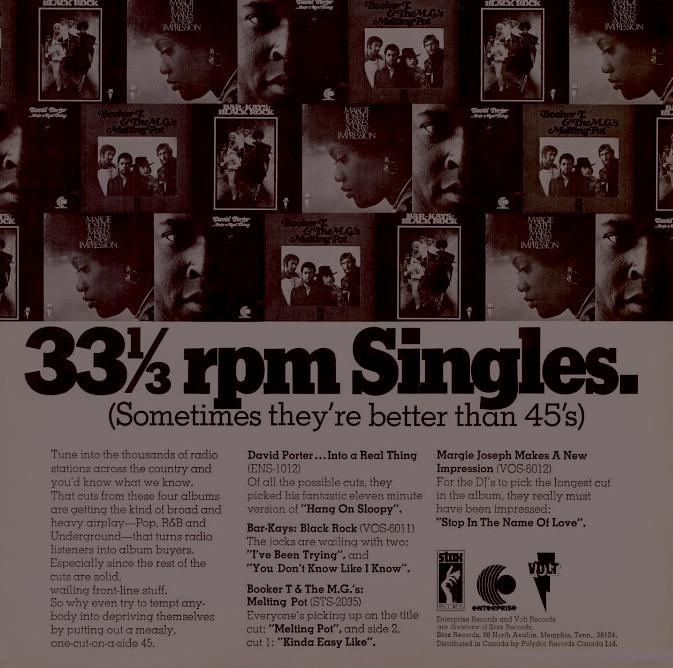
Margie Joseph's earliest recordings were done at the Muscle Shoals Sound Studio in 1967 and resulted in two OKeh 45s, out in December 1967 and in May 1968. They didn't chart but made enough noise to earn passing mention in Billboard. Later, after she had been picked up by Stax in 1969, she returned to Muscle Shoals in 1970 for another four songs which then found their way unto her first LP (Volt LP # 6012, 01/1971). And although her Muscle Shoals output was limited (and actually ended with her 1970 session), her name remained bound up with the »Muscle Shoals Sound Story«. This is attested, curiously, by an ad from September 1970 where Margie's name appears in the flattering company of the Rolling Stones, Sam & Dave, Solomon Burke, Mavis Staples, Odetta, Joe Tex, Aretha Franklin, Wilson Pickett and many others (see ad below). This ad was placed months before her first Volt LP was released.
Now, I never lost any sleep about why Margie's second LP was called Phase II, being her second LP and all. What I have never grasped so far is the pun or message, if there is any, of why her very first LP was entitled ... Makes A New Impression (for a pic of the cover, see yesterday's post). In any case, it seems that the LP was either at first (or alternatively as an afterthought) destined to be called Meet Margie Joseph, which apart from the nice initial alliteration would make some good sense for an artist's premiere album. However, only the labels show Meet Margie Joseph, while the sleeve has Makes A New Impression. So we are left to guess whether sleeve or labels were printed first (and, depending on this, whether Meet Margie Joseph was the original title or not; I guess it was).
Stax/Volt ad from Billboard, Jan 30, 1971
Not that it really matters, because she does make a pretty solid impression in any case. Andrew Hamilton called this first LP Margie's »most successful and aesthetically pleasing album« (AMG to Soul, p. 379). It famously contains the 10-minute monster track of »Stop! In The Name Of Love« preceded by a »Monologue: Women Talk«. It soon proved to be the LP's stand-out song, was quickly used for a Stax-Volt ad and finally released as a 45. I have to confess, it is not my kind of bag. And to the probable bewilderment of some among you, several other songs on this LP aren't my bag either. Basically all those which were recorded in the Memphis Stax Studios, with the exception of »Sweeter Tomor- row« (as heard on yesterday's post). Andrew Hamilton described the LP as being »a mixture of Stax and city slick R&B sounds«, but frankly, I would object that the Stax songs on this LP are the very epitome of everything I would call »city slick« ... and just about too slick for my modest taste at that.
Which leaves us, or me at least, with the tracks Margie Joseph recorded at Muscle Shoals. They are quite a contrast to the rest of the album. One of those, »Punish Me«, was released as a 45 (Volt # 4046) by Stax-Volt in September '70 in order to wax the floor for the coming album but it didn't succeed in doing so. (The result was that Margie's LP was then released without any hit single attached to it. The more astonishing that the album reached the Top Ten of Soul LPs and made it to #67 in the general Top LPs listing. But no, not astonishing; it's called quality. However, minds have been divided over this album.) Two other of the Muscle Shoals tracks are the songs I like most about this album. Dig them here:
Margie Joseph: »Same Thing« / »I'm Fed Up« from the Volt LP # 6012 (01/1971):
Most of you will have noted (or ordered) already, so it's probably somewhat late, and actually overdue, for me to remind you that the second volume of Bob McGrath's Soul Discography (G-M) (Eyeball Productions) has been published - not even recently, but several months ago. I always wanted to mention it here, because it really is a very welcome and most useful addition to the (not too numerous) research tools at our disposal. As this calls for a little celebration the obvious thing to do was to take my inspiration from the cover of the second volume and make it come alive musically (or rather vocally if you like).
Volt LP # VOS-6012
The cover image is taken (and laterally revers- ed) from Margie Joseph's first ever LP Makes A New Impression (Volt LP # VOS-6012, released in January 1971), so inspiration has to flow from there. Tonight I don't have the time to say much about Margie and her first album; suffice it to say that half of the songs of her first LP were recorded at Stax, the other half at the Muscle Shoals Sound Studios. I'll follow up her story tomorrow, or as Margie tells us: »(Everything Will Be) Sweeter Tomorrow« ...
Margie Joseph: »Sweeter Tomorrow« from the Volt LP # VOS-6012 (1971):
Yesterday we heard Steve Cropper and considered his Volt-album »With A Little Help From My Friends« from June 1969. Right at the same time, in the same month, another LP was released, Volt LP # VOS-6007, and Steve Cropper had his hand in this, too, this time as arranger and producer ... and as session musician of course, a fact I was about to omit because it's so evident in his case.
The album is simply called »Mavis Staples«. It simply shows the singer's face on the cover. It simply contains her singing. And what a voice it is! A deep, contralto marvel of a voice.
Mavis Staples was, as is probably well-known to everybody, a member of the Staple Singers, a gospel-folk-family-formation from Chicago, and this was her first solo effort. 1969 was her year: First, several duets were released which Mavis had recorded with Eddie Floyd and William Bell. These songs were released in spring 1969 as singles and little later on the LP »Boy Meets Girl«. Then, there was her first solo LP.
BILLBOARD, August 16, 1969 (detail)
During the second half of '69, Mavis soon became famous as a solo artist: In August, she performed at the »Soul Show«-concert at the side of Mahalia Jackson (see the photo; towards the left you can see Mavis's guitar-pickin' father »Pops« Roebuck). In November, she shared the stage of Harlem's Apollo Theatre with Miriam Makeba whom she admired greatly. A single was released in August '69 containing two songs of her new album, but it went nowhere. Apart from these songs, the album contains a number of cover versions (»Son Of A Preacher Man«, »A House Is Not A Home«, »You Send Me«), and among these also two tunes by Otis Redding: »Security« and »Good To Me«. You can listen to them below.
As said above, Steve Cropper produced Mavis's album. He left it to Mavis to chose the songs (»Most of those songs on that album are songs that I loved, from hearing them on the radio. ... I chose Son Of A Preacher Man because I was in love with a real son of a preacher man. Guess who it was? Cecil Franklin, Aretha Franklin's brother!«). But it was Cropper who suggested that she recorded some of Redding's tunes, and so Mavis opted for »Security« and »Good To Me«. About the recording of »Good To Me«, Mavis was to say later:
»I was kind of shaky, because back then, the family was still singing Gospel songs. I didn't know how the public was going to accept the fact that I was singing these secular songs. Doing that was a no-no. I didn't feel it in my heart that it was a no-no, so that's why I went on and did it, but Steve Cropper had to hold my hand on a lot of those songs, especially on Good To Me. I said to him "Ohh, this song could really be taken like you're having sex or something". Steve said "No, Mavis, think about it like the guy is just good to you. He comes home, he helps you at home and all that". We had conversations about a lot of that stuff.«
To my mind, the two Redding songs belong to the best pieces on the LP. Mainly, because the raucous and smoky, yet at the same time smooth and heartwarming voice of Mavis comes wonderfully to the fore here. You can hear that in the faster song, »Security«, but it is especially obvious in the slower »Good To Me«. And thus the very beginning of »Good To Me« not only fits the lover she addresses in the song, but could be said by everyone listening to Mavis singing: »I don't know what you got, baby, but sho' is good to me« ...
Mavis Staples: »Security« / »Good To Me« from the Volt LP # 6007 (1969):
* * *
The Gibson Interview: Mavis Staples Talks About Staple Singers Legacy (Russell Hall, January 14, 2009). Oh well, on the Rolling Stone list of »The 100 Greatest Singers of All Time« Mavis Staples has reached rank 56 ... and I certainly agree with her being among the 100 best singers of all time, although the list in itself seems ridiculous to me, to put it mildly. After all, we find there the likes of Bob Dylan and John Lennon among the Top Ten, lifelong torturers of their poor-timbred vocal chords ... which indicates that the list cannot be based on the respective singers' vocal talent, really. To conclude, here is a nice picture, taken from JET of October 9, 1969, p. 36:
R&B attracted a wider audience and influence and, ironically, it was young white kids in the 1940s and 1950s who, hearing R&B records, determined that they too would become musicians. Guitarist Steve Cropper once noted that, when he was growing up in the American South during the 1950s and he went to see visiting bands, the white members of the audience were required to watch the show from the gallery because segregration was still a fact of life. In later years he recognized that he could only get close to where the real action was by being a musician on the bandstand: there was no segregation among musicians themselves. That enthusiasm triggered the likes of Cropper and many others to become musicians in the first place (Hugh Gregory: The Real Rhythm and Blues, London 1998, p. 7).
»It was basically black music but some whites like Cropper, Stewart and Dunn helped perpetuate the music,« reflects Booker. »They were outcasts for that in a certain way. I think they were either ostracized or admired. (...) Cropper is an innovator, Cropper was the first of his kind,« continues Booker. »I had not heard a rhythm guitar player play what Steve Cropper played. It's quite a phenomenon to be the first. There was nobody like Steve in the South that I knew of - black or white« (Vron Ware, Les Back: Out of Whiteness: Color, Politics, and Culture, Chicago 2001, p. 246 f.)
When I came to Memphis and finally had my own radio, I used to listen to WDIA and at midnight they would play gospel music. That really turned me around. I mean I grew up in the church and heard a lot of a cappella music and stuff but I had never really heard black gospel and it just blew me away (Steve Cropper, quoted in Rob Bowman: Soulsville U.S.A. The Story of Stax Records, New York 1997, p. 21).
There are few persons around who haven't heard his music, yet few of them do know him: Steve Cropper. They probably didn't recognize him when he appeared with bushy beard and long hair in Blues Brothers. Steve (from Dora, Missouri) was session musician at Stax Records in Memphis and member of several instru- mental outfits: The Mar-Keys, Booker T & The MGs, The Bar-Kays. It has, hyperbolically, been said that Steve and his guitar are heard on 99% of all songs recorded at Stax during the 1960s, and it is but a small exaggeration.
The first hit which goes with his name was »Last Night«, in the summer of 1961, an instrumental of The Mar-Keys that still is known to almost everybody in our days. A short while after, in 1962, came the unforgettable »Green Onions« with Booker T & The MGs. (There is a nice recording of that song with Steve Cropper and Donald »Duck« Dunn from 2008, with superb sound!)
As a member of Booker T & The MGs (see the photo on the left) he already appeared on this blog. In the following years, during the 60s, Steve played on recordings of William Bell, Rufus Thomas, Albert King, Mable John, Sam & Dave, Eddie Floyd (»Knock On Wood«), Wilson Pickett (»In The Midnight Hour«), Otis Redding and Carla Thomas ... well, that list names more or less every hit singer whose name stands for the »Memphis Sound« of Stax ...
Steve was closely involved in the career of Otis Redding. He not only played at most of the latter's sessions, but also produced a number of Otis's songs (»Love Man«, »The Happy Song«). Together with Otis he was on the bandstand at the Monterey Pop Festival (June 17, 1967), and he played during the recording of Otis's and Carla's LP »King & Queen«. Eventually, he co-wrote with Otis's the mega-hit »Sittin' On The Dock Of The Bay« and received a Grammy Award for that in March 1969. After the turn of the 70s he moved away from Stax when he founded his own label »Trans-Maximus (TMI)« in Memphis (the distribution deal was made, little later, with mighty Columbia). And this label was, for some years at least, a success story (cf. BILLBOARD magazine's Memphis Special, June 03, 1972).
Volt LP # 6006 (1969)
In fact, Steve Cropper during his time at Stax published only one album under his own very name. He entitled it aptly, for a seasoned session musician, »With A Little Help From My Friends«, taking on the Beatles-tune that is also present, in an instrumental version, on the album. The LP, on Stax's sub-label Volt (VOS-6006), hit the market in June 1969. It contains, little surprisingly, only instrumentals, among them some compositions of Cropper, but mainly cover versions of known songs (»In The Midnight Hour«, »Funky Broadway« etc.). Steve Cropper was involved in the production of all these songs when they were recorded by their respective singers for the first time.
The general opinion concerning Steve Cropper's art of guitar playing is unanimous, in that everybody considers him, with good reason, a genius of sorts. Yet he is generally not seen as a guitar virtuoso. On the contrary, he is famous for his reluctant, sparingly intrusive, almost spartanic way of guitar playing: Quite obviously he was trying, successfully, to reach maximum effect with few but immediately striking licks or subtle but crucial variations in rhythm. This approach made him the perfect session musician: His play never dominates, does not distract from the singer and never ever buries the vocal lead. This »spartanic« approach nevertheless succeeds in providing just the right dose of musical grounding for almost every song, making it, by adding seemingly little, truly rich. You can hear that on most Stax recordings of the epoch. Steve Cropper himself was (and is, I guess) fully conscious of his approach and described it in his words as follows:
»A lot of guitar players play more like piano players. They play the whole picture all the way. Then they'd throw in a riff here and there. Lowman [Pauling] mainly just noodled rhythm and then, when there was a hole, man he'd just come out loud and just give you this big slingshot. I think that really influenced me. I think that's probably what developed my style in doing sessions: listening for holes in the singer so the licks I play are as important to the melody as the melody is to the licks I play, where one flows into the other rather than me sitting there trying to play guitar and stepping all over the singer« (quoted in Bowman, Soulsville U.S.A., p. 22).
Steve's »spartanic« approach also succeeded when he played with instrumental outfits, not the least because Booker T.'s hammond organ was, in character, often near to a singing voice, with Steve's guitar providing the necessary counter-points. What is more, Booker T.'s songs were in many cases rather »spartan« in themselves, and this played just in the hand of Steve's guitar-picking fingers. Unfortunately, it does not always work out so fine on Steve's 1969 LP. The reason for this is that here his guitar takes the melody lead, in lack of a singing voice. And in this case Steve's play proves to be ... well, too spartanic for my taste. Of course, all songs sound very professional, played by truly gifted musicians, but they are lacking ... how I'm gonna say this? ... the fire. This strikes me the more, the more dominant the singing voice is in the original song that we find covered here, e.g. in »Funky Broadway«. In other songs, faster ones and those more based on the orchestration, you are likely to notice it less, e.g. in »I'd Rather Drink Muddy Water«. Whatever. Maybe I'm wrong, or unjust. In any case, the album contains some pretty good songs. Listen here:
Steve Cropper: »Funky Broadway« / »I'd Rather Drink Muddy Water« from the Volt LP # 6006 (1969):
I am interested in the music, not in the relative rarity of discs. I also listen with great pleasure to Aretha Franklin, because she has the voice of the century. Music is no Faith and therefore has no heretics.
* * *
No music downloads on this site. All mp3s (with very few exceptions where noted) are ripped from original vinyl discs. If something on this blog is objectionable to anyone or should, for valid reasons, be re- moved from the net please let me know; it will be removed. And to reiterate: This is a non-profit blog.