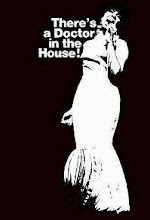
... tonight with Margie Evans and Delmar Evans (I put the second name twice because they're not related, really, except musicallywise).
They were simply billed as »Delmar and Margie« on Johnny Otis's 1970 Epic LP Cuttin' Up and they feature on Side 2 with two remarkable duets, one funky and close to the pulse of the beginning '70s, the other a remake of a tune from 1950. And guess what? They outdid themselves with the one and the other. Maybe this was the secret of Johnny Otis, arguably the most important single r&b producer and impresario of all times, that he was able to reassemble his »Johnny Otis Show« in the late '60s (with new personnel) and still hit the nerve of the time after he had been around on the r&b scene since the mid-'40s. No little achievement, indeed.
The first important result of his new Show was the Epic LP which came out in August 1970, just after the Johnny Otis Show had played the Monterey Jazz Festival. Delmar Evans and Margie Evans had been picked up by Otis to be part of his ensemble two years before, and while both can be heard as solo vocalists on various recordings (for Delmar, see also here), the Cuttin' Up LP has the two also duetting. Just some word on Margie Evans: She was born Marjorie Ann Johnson in 1940 and was basically discovered by Otis, as it were. She started singing backing vocals in the late '50s, but was then brought out as a solo voice by Otis; she then recorded from the 1970s through the 1990s and became mainly known among blues aficionados.
The two duets by Margie and Delmar are killer tunes. As said before, one is on the funky side, the other (»Double Crossing Blues«) classic r&b in a modern (and highly satisfying) garb. But both are equally compelling. Let's get to it!
Delmar and Margie: »Don't Stretch This Good Thing Too Far« /»Double Crossing Blues« from the Epic LP # 26524 (1970):
* * *
You may also listen to the original version of »Double Crossing Blues«, first released in 1950 (feat. the Johnny Otis Quintette with The Robins and Little Esther [Phillips] on Savoy # 731):
... that's what Mavis Staples said on stage at Seattle's Jazz Alley on March 6, 2010, and it's a quote from her father. Mavis spoke about the Staples meeting Martin Luther King in Montgomery, Al., for the first time and, in particular, about their song »Why (Am I Treated So Bad)?« More to the point, she quotes her father Roebuck having said to them after the meeting: »Listen, y'all! I like this man's message! ... And I think that if he can preach it, we can sing it.« Listen here what Mavis had to say ... I took it from the concert video posted over at Vimeo, and I very much thank the lady who shared it with us all! Thank you!
Mavis Staples Talks (March 6, 2010, Seattle):
You may also watch the full video here:
Now, Mavis is saying that her father penned the song »Why (Am I Treated So Bad)?« in 1960. Others have said (I don't know on what authority) that Roebuck was inspired to write the song when watching TV coverage of the forced integration of Arkansas's Central High School in Little Rock, back in 1957. I don't know whether this is correct or at what time the Staples first performed the song (they often played it at meet- ings when MLK was about to speak as he liked the tune so much ... Mavis explicitly refers to this in the above video). However, they first recorded it, according to Hayes-Laughton' Gospel Discography and for all we know, in spring 1966.
The Staples (Ebony, Sept. 1965)
(on stage at Philadelphia's Uptown)
Now, there's a rub here. The song was released first, it seems, in late 1965 or (more probable) in early 1966 on Epic # 9880. (The following nos. of Epic 45s, 9881 ff., were all released in January '66.) The several discographies for Epic Records differ as to the time of release and they also differ as to which song was the A-side. Unfortunately, I do not know this 45 version of the song (there is a photo of sleeve and label here, but no music ...). What I know is the version as we have it on the Staples' 1966 Epic LP # BN 26196. This LP takes its title from this very song, viz. »Why (Am I Treated So Bad)?«, and was released in May 1966. (Note: Some researchers were confounded by the fact that the 1991 Legacy CD by the name of Freedom Highway contains »Why (Am I Treated So Bad)?« and thus thought that the song was first released on the Staples' 1965 Epic LP # LN 24163 Freedom Highway, actually the recording of a live in-church session. Truth is, however, that the original Freedom Highway album does not include this song, while the CD by the same title features the very version of the Epic LP »Why?«, i.e. the one under discussion here.)
Ad from Billboard, May 7, 1966
Epic promoted the new album by an ad, head- lined: »The leading gospel-folk group of the college campus circuit with an album of most- requested songs!«. Billboard obligingly review- ed it one week later with the words: The family quartet is hard to top in this exceptional program of exciting and inspirational perfor- mances. Will soar in sales within the gospel field and easily spill over into the r&b field. Whether the material be sad or joyous, the group is equally brillant in its interpretations (BB, May 14, 1966).
Epic LP # BN 26196 (1966)
Listening to the LP version of »Why (Am I Treated So Bad)?« (you can do it below), you'll note the prelude by Roebuck Staples, serving as kind of an intro to the song. What this prelude does is setting the song's message in a specific context, and the context is openly and explicitly political, referring to the Civil Rights struggle: Those little children who can't ride the school bus because they're »of a different nationality« ... they weren't allowed to ride the bus ... and if you asked them about it they'd say: Why am I treated so bad? A song couldn't get much more of a protest song than this:
The Staple Singers: »Why (Am I Treated So Bad)?« from the Epic LP »Why« (1966):
The Staples did many a political song, as you all know; David Nathan in a '95 Bill- board article listed them, justly, among the »[r]ecording artists who helped provide lyrical ammunition in the struggle for civil rights« (Feb. 4, '95, page 28). However, »Why (Am I Treated So Bad)?« is not normally included in this category. We find no mention of it in Taylor Branch's monumental three-volume history of the Civil Rights Movement, nor is the song treated in even more relevant books like Peter Doggett's There's a Riot Going On (2007) or Dorian Lynskey's 33 Revolutions per Minute. A History of Protest Songs (2010).
Billboard, May 13, 1967
During 1966, the song steadily acquired more popularity, and in early 1967 several covers were released. Some of these (by the Cannonball Adderley Quintet, Bobby Powell and Brian Auger & Julie Driscoll) were very successful, and maybe none more so than the superb version of the Sweet Inspirations (giving them their first r&b Top 40 hit in summer '67). The Sweets »depoliticized« the song and changed the lyrics in order to achieve that: I'm all alone ... I'm gonna walk up to my baby's door, ask him why he don't love me no more ... he was wrong, said I was to blame, but I walk on in and love him just the same, though he treats me so bad ... So, obviously, we got a love song here. This is fine with me, but I cannot understand why we find the Sweet's version included on the 2006 Soul Jazz CD # 129 Soul Gospel Vol. 2 ...
In view of the success of their song, the Staple Singers in 1967 did a sensible thing (sensible, that is, in view of sales prospect): They re-released it on 45 (Epic # 10158A) in a version more appetible for the general, i.e. mainly the mainstream white market, skipping the politically charged prelude of Pops Roebuck, adding a horn section and in general giving the tune a more pop-oriented feel. They didn't change the lyrics, though. You can hear this 45-version of 1967 over at the Black Gold blogspot ... the song dented, for a week, the pop Hot 100 charts reaching # 95 at the beginning of June 1967 ... and it was, by now, more or less devoid of its original message.
* * *
Photo from the back cover of the Epic LP »Why«
By the way, the song »Why (Am I Treated So Bad)?« really stands out on Epic LP # 26196. The remaining nine songs are all done professionally, but are lacking variety: they follow the same arrangements, are instrumentated very similarly and (with one exception) have Roebuck as lead singer. So, being a huge fan of Mavis, there is not much of a treat for me here, and the single song featuring Mavis's lead voice is a boring ditty by the title of »Move Along Train«. All in all, I think it is fair to say that the album contains a lot of fillers, making it one of the least accomplished LPs of the Staples. To give you an idea how the nine songs apart from »Why (Am I Treated So Bad)?« sound like, I'd like to play the second song from the album, »King Of Kings«, actually the one which I like best among all the fillers. Here we go:
The Staple Singers: »King Of Kings« from the Epic LP »Why« (1966):
But no, I'm not goin' to have my day ruined by rumulating if Blogger.com will ever restore the contents it removed »temporarily« last week. On the contrary, I've got something to cheer me up ... it goes by the name of »Jody Miller's eyes«.
I already posted this last week (before it was put in the bin by Blogger). I then said that I was in a C&W-mood, or rather, in a specific »Jody Miller«-mood. Not the usual stuff, musicallywise, for this blog. But I'm not dogmatic about it. Thing is, some days ago I got a copy of Jody Miller's Epic LP # 30382 »Look At Mine« which was released in Dec. 1970. I knew the songs already and had seen the front cover of the album before, but what I didn't know was the back cover. And here it is, have a look:
Isn't it beautiful? Gosh. Jody could sing me the phone book of Boston in alphabetical order and I'd still get completely lost. And this terrific shot doesn't come without a reason. The album is entitled »Look At Mine«, same as the title track. If refers to the eyes, her eyes. Among other things. In any case, apart from celebrating Jody's eyes, it's a nice song. I've always liked the clever lyrics: Jody is praising her qualities to a guy who dates another girl, and whatever she mentions is then followed by the playful imperative »look at mine«! Here we go:
Jody Miller: »Look At Mine« from the Epic LP # 30382 (1970):
In December 1962, The Chiffons recorded »He's So Fine«. The single was released when other hits-to-be appeared on vinyl as well, e.g. »Hey Paula« (Paul & Paula) or »Our Day Will Come« (Ruby & The Romantics). On February 9, 1963, Billboard reviewed the song, as usual without making too many words:
»This all-girl group has a good sound and they show off their bright style with a flourish on this rhythmic waxing. It has a beat and it moves.«
Laurie # 3152 (Dec. 1962)
The song, written by Ronald »Ronnie« Mack (who passed away soon after), was released in December '62 on Laurie # 3152. The New York-based Laurie Records was in existence since 1958, but The Chiffons were their only successful black act. Before, they had had Dion & The Belmonts, then Gerry & The Pacemakers and The Royal Guardsmen (all of them British).
In fact, the Chiffons were the classical cinderella story the like of which we find often in the music business of the early 1960s: Mack heard the girls singing at their high school in the Bronx and as a result decided to become their manager, for little more than a few bucks. He contacted The Tokens from Brooklyn, who then produced some songs with the Chiffons in the Capitol Recording Studios, among them »He's So Fine«. (Others maintain that Mack first dealed with the Tokens over some songs and brought the Chiffons in later.) In any case, nobody got interested in what Mack had recorded. Especially »He's So Fine« was not considered by to possess any hit potential, and the boss of Capitol called the song »too trite and too simple«. The Tokens then knocked at the door of some nine or ten other record companies, but it was Laurie that went for it.
This made the day for the Chiffons, and for Laurie as well. The song became one of the most popular hits in 1963. Its intro viz. its chorus »Doo-Lang Doo-Lang Doo-Lang« has entered the hall of fame of catchy song lines and will be memorable for the rest of times. Legend has it that is was the recording engineer who came up with these nonsense syllables when the song was still in the making in the studio. On March 30, 1963, the song reached # 01 on the pop charts. Jay Warner neatly summed up the peculiar success story of the Chiffons and their unwanted hit song: »Throughout rock and roll history, vocal groups (especially the non-writing variety) have spent entire careers in search of hit-bound melodies and captivating lyrics. In a reverse of that equation, the Chiffons garnered their success because a hit song was in search of a group.« (American Singing Groups. A History from 1940 to Today, Milwaukee 2006, p. 343).
Billboard's Hot Hundred, March 30, 1963
Songfacts: »He's So Fine« entered the Billboard Hot 100 on Feb. 23, 1963 (# 87) / Cashbox Top 100 Singles (# 87) and remained # 01 for four weeks between March 30 and April 20 (in both Billboard and Cashbox). It was listed for the last time on June 1, 1963 (BB # 43, CB # 40). The song entered the r&b charts on March 2 and was at the top from April 6 to April 27.
Interestingly, »He's So Fine« also nicely illustrates the limited powers of prediction in the record industry. Thus in a commentary in Billboard (April 20, 1963) the song was singled out, among some others, in order to show that even the most astute A&R men weren't able to correctly foresee which songs will eventually make it to the top of the charts:
»Every week trade publications, a.&r. men, promotion men and others try to select the big money winners of tomorrow. We all know it's in the grooves - but who knows what grooves? The so-called experts feel that they can pick them, and then along comes something like 'Tom Dooley' a few years back ... or more recently an unknown group called the 'Chiffons' and 'He's So Fine,' and we all walk around scratching our heads.«
The song made the Chiffons, unknown to all until then, into the most popular girl group of 1963. (The rumour that the New York Chiffons were the same as some other »Chiffons« recording in California in around 1960 is unfounded, see is unfounded.) The New York Chiffons, that is The Chiffons, consisted of Judy Craig, aged 17 at the time and singing lead, Patricia Bennett (16), Barbara Lee (19) and Sylvia Peterson (17). Sylvia was »recruted« only a short while before recording »He's So Fine«.
The surprising success of their first single (and of several to follow in 1963) prompted Laurie to put out an album by the Chiffons as quickly as possible, and as was usual then this album was called after their biggest hit. So Laurie LP # 2018 came into frenzied existence. And although it is an album built around the success of one song, it actually does not contain only »fillers« for the rest but a number of nice and equally likeable songs.
Laurie LP # 2018
It goes without saying that the LP also contains the Chiffons' signature song, »He's So Fine«. And here it is:
The Chiffons: »He's So Fine« from the Laurie LP 2018 (1963):
Yes, it may be a simple song. But it kicks you off your feet all the same. That's the mystery behind it, and in some way the mystery behind some other seemingly trite girl-group songs of the epoch as well. That's why they have endured and every year appear on new samplers. And I'm not sure whether even the lyrics can be dismissed easily as »girl talk«. The unlikely authority of Iggy Pop, unlikely in this context that is, was quoted in Spin (November 2003, p. 60) as follows:
»During my formative years ('64-'66), I was into the American day-dream 'emotionalistic' approach to youth music, as exemplified by the girl groups. 'He's So Fine' is basically ghetto music - this guy she's talking about is not a Ph.D. He's not even nine-to-five - he's just five. (The Ronettes) 'Be My Baby' was another one. I remember being down in the basement in the 11th grade, having more of a sexual encounter than I'd ever had in my life, and I kept jumping up to put that single on again!«
What is more, the song did not escape the attention of professional music historians the like of Jacqueline Warwick who wrote:
»Indeed, "He's So Fine" depicts a gang of girlfriends whispering about a boy who has caught their eye, practically licking their lips as they look him up and down, and the "doo lang doo lang" refrain conveys a lustful appreciation far beyond the vocabulary of the prim middle-class teens ... With lead singer Judy Clay ... declaring "I don't know how I'm gonna do it, but I'm gonna make him mine" and itemizing the boy's charms to her appreciative backing vocalists, the song made it clear that girls were perfectly capable of taking an aggressive lead in romance.« (Girl Groups, Girl Culture. Popular Music and Identity in the 1960s, New York-London 2007, pp. 37, 199).
Given the song's success, also Dee Dee Sharp (of »Mashed Potatoes«-fame) recorded a version of it. This was done on March 19, 1963, in Philadelphia and released on her album Do The Bird (Cameo LP # 1050, 1963). However, her version is slower and decidedly turns the song into a soft-pop tune. Together with Dee Dee's much higher voice pitch and the mixed male-female backing vocals her version therefore seems flat and mainstreamed if compared with the Chiffons' edgier original. Well, listen for yourselves:
Dee Dee Sharp: »He's So Fine« (1963):
Clearly, there is much more groove in the original, and Judy Craig's deeper voice on the Chiffons' recording fits the song better.
In 1971, the song made its way again in the charts ... but this time it were the C&W charts! This came about because Jody Miller (of »Look At Mine«-fame) recorded the former girl-group song and turned it into a C&W song, released on Epic-Single # 10734. The classic Doo Lang Doo Lang Doo Lang at the beginning is dropped, and the part is now covered by a guitar intro. I like that version. It's not a close adaption, but really tries to give the song a new twist ... and succeeds. Jody performs it with the lyrical »sweetness« of C&W singers, and she certainly has a special talent for that. Her version peaked at # 05 of the C&W charts and made it to # 53 on the pop charts, nothing less:
Cody Miller: »He's So Fine« from the LP Epic # 30669 (1971):
The fact that Jody Miller included the song of a black girl group in her repertoire shows convincingly how fluid the demarcation lines between musical styles and listeners' groups had become (if ever there were any fixed demarcation lines, that is). We have many more examples for this, and also black singers moved into the C&W realm, notably Ray since Charles' »Modern Sounds« and then ever more frequently in the second half of the 1960s. Thus in 1968 we find Joe Tex recording »Green Green Grass Of Home« and fittingly including that song on his ambigously titled LP »Soul Country«.
For the record companies and retailer networks this blend of former more or less separate musical »provinces« proved somewhat of a challenge. (And I'm non going here into the interesting debate of whether the music industry artificially separated these provinces in the first place or whether they merely gave names to really distinct fields.) For example, those who stacked the jukeboxes had to have some clue as to what music would probably be requested in a certain place. Surely they couldn't fill the jukes with r&b titles in a hillbilly bar or with C&W titles in a supper lounge. But as musical styles increasingly flowed into each other, guessing the taste of the respective customers became more difficult. Thus a certain Henry Holzenthal, a jukebox programmer, was quoted by Billboard (Sept. 4, 1971, p. 37) with the following story:
»Holzenthal said the crossover among categories probably indicates jukebox patrons are "listening to music more than ever and are open to more music experiences. We've all but abandoned categorizing our jukeboxes." ... [Jody Miller's] "He's So Fine" was originally considered country by Holzenthal. "But one of our better lounges called up and asked for it. I would never have pro- grammed it there because I knew he (the lounge owner) wants no country."«
* * *
Oh well. Got to add another thing, for good measure. Most of you will have heard of it anyway. »He's So Fine« in the 1970s was object of a plagiarism suit, which then was lost by George Harrison, concerning his song »My Sweet Lord«. The details are known, and I don't find them sufficiently intriguing to repeat them here. Nevertheless, the judge ruled that Harrison had »plagiarized unconsciously«, which is about the most bizarre way of justifying plagiarism I ever heard of. Harrison paid more than half a million USD to those holding the rights of the Chiffons' original. Fact is that large parts of Harrison's »My Sweet Lord« sound exactly (and I mean exactly) like the Chiffons' tune. Only very blockheaded Beatles- or Harrison fans will seriously negate that »My Sweet Lord« is little else but another version of »He's So Fine« with changed lyrics. But this after-story must not detain us any longer, listen here and make your own judgment.
I am interested in the music, not in the relative rarity of discs. I also listen with great pleasure to Aretha Franklin, because she has the voice of the century. Music is no Faith and therefore has no heretics.
* * *
No music downloads on this site. All mp3s (with very few exceptions where noted) are ripped from original vinyl discs. If something on this blog is objectionable to anyone or should, for valid reasons, be re- moved from the net please let me know; it will be removed. And to reiterate: This is a non-profit blog.