... ah well, I am still thinking, with no little nostalgia, about my late summer trip to Greece ... while around here the golden leaves are falling on the ever colder ground and the sun, when she does appear through the misty haze of the autumn sky, struggles more and more every day to reach her meridian over the horizon. At night, the moon is often obscured by batches of dark clouds as if his silver disk is waylaid by a swarm of hungry bats. So best I can come up with today are two songs which dispel my gloomy autumn mood and bring back the memories of sunnier days ... and of places like this, on a lonely beach in southern Crete called Sweetwater:
(Click to enlarge)
When I looked through some of my records, summer songs proved less easy to find than I thought! At the end, I ended up with a version of Gershwin's classic »Summer- time«, by Brenda & The Tabulations (recorded in Philadelphia and released on their one-and-only Dionn LP # 2000 Dry Your Tears in May 1967). Following up their hit »Dry Your Tears«, Brenda & The Tabulations rushed out, as was common, an accompanying album which, for all the speed with which it was produced, contained many covers and known standards, among which the said song. A Billboard critic of the epoch (June 3, 1967 issue, p. 86) nevertheless stated that Brenda's mono version of »Summertime« gives an »excellent treatment« to the tune, so it did no go unnoticed. There will be some out there who have never heard Brenda's version before, and although I do not think that hers is the definitive version of that tune it strikes me as a particularly melancholic version, and the song in itself is essentially melancholic! (Thus it well fits my actual mood ...) Brenda's high-pitched voice, somewhat echoing and distant in the recording, confers an almost mystic atmo- sphere. And mind that at around 02:18 into the song, before the organ sets in, there is a noticeable break which must be due to bad cutting, I guess. In any case, it does not seem caused by the LP nor by the pressing.
As for the second tune, I took it from an album you all know, yet it arguably is - given that almost all songs from this album have become landmark recordings - the least remembered of them all: Aretha Franklin's »Hello Sunshine« from her 1968 Atlantic LP Now. The song was penned, in or little before '68, by King Curtis and Ron(ald/nie) Miller. As you know, Curtis was present in person at the December, 19, 1967 session which produced the track, and the backing vocals are due to none less than The Sweet Inspirations ... Like »Summertime«, »Hello Sunshine« is again a melancholic song, even if Aretha's room-filling powerhouse voice wasn't fitted to produce a version you could call »mystical«. As only she could (and, well, can), she effortlessly blasts the tune away into the blissful heaven of immortal recordings!
Brenda & The Tabulations: »Summertime« from the Dionn LP # 2000 (1967, mono) / Aretha Franklin (feat. The Sweet Inspirations): »Hello Sunshine« from the Atlantic LP # 8186 (1968):
... How It Would Feel To Be Free ... from Shirley Scott's 1969 LP Shirley Scott & The Soul Saxes (Atlantic SD 1532).
51 Years ago today, the Berlin Wall was built. Fortunately, it's been down for 23 years now and the world has become a better place. But let us not forget that others are still struggling to acquire their freedom ... in Syria, in Belarus, in Iran, in Alge- ria, in North Corea, in Cuba, in Ukraine ... and in some sense in Russia as well ... and not to speak of the social and racist barriers to freedom that exist throughout the entire world.
Atlantic SD 1532 (1969)
For the record: Shirley Scott's '69 album actually features six songs recorded in July 1969, all with the participation of saxo- phonists King Curtis, Hank Crawford and David Newman, hence the title. There is one title though (the one you can hear below) which was already recorded back in September 1968 ... and it's the only track on the LP without saxophone. Accompanying Shirley on the organ are Eric Gale (guitar), Jerry Jemmott (bass) and Bernard Purdie (dr).
Shirley Scott: »I Wish I Knew How It would Feel To Be Free« from the Atlantic LP # 1532 (1969):
After his fabulous success with »Mercy, Mercy« (feat. Jimi Hendrix on guitar) Don Covay was soon picked up by Atlantic. In February 1966, they put out his album See-Saw, the second on Atlantic but actually the first entirely produced and recorded under Wexler's supervision; it has acquired its place in the history of memorable covers, showing a decently dressed white girl in a wintery landscape on a see-saw ... so much for Atlantic's shrewd (if inherently racist) policy of how to sell the energy-loaded music of a black singer, tall, handsome and sexually attractive, to the mainstream market in mid-60s America.
Covay's initial time at Atlantic was not as successful as many had hoped for, the only hit in 1965-66 being the album's title song »See-Saw«. What most don't know, however, or do not care to remember, is that four of the album's 12 songs were written by Steve Cropper & Covay and recorded at Stax Studios in Memphis on 30 June '65: »See-Saw«, »I Never Get Enough Of Your Love«, »Iron Out The Rough Spots« and »Sookie Sookie«. (According to some, »Iron Out The Rough Spots« was recorded in a later session but this is almost certainly wrong.) The personnel playing in the June '65 session was actually made up of Booker T. & the MG's, together with other known Stax session musicians: Duck Dunn, Steve Cropper, Al Jackson, Booker T Jones, Wayne Jackson, Andrew Love and Floyd Newman. Hard to think of anything more »Stax« than this mix! And indeed, those four songs are about the best on this album which has its fair share of fillers; hear two of them below.
In the Stax studio: Jim Stewart, Don Covay, Steve Cropper, David Porter (right to left); photo from Rob Bowman's Soulsville U.S.A.
As is known, Atlantic brought on several occasions promising singers to Memphis, and for the use of the Stax studio and musicians Atlantic then split with Stax the publishing and Stax got a share of the sales from Atlantic product recorded in Memphis. Before Wexler headed to Memphis with Covay, Atlantic had recorded Wilson Pickett there. So towards the end of June, Covay appeared in the Stax Studio. Rob Bowman in Soulsville U.S.A. has some details about the Covay sessions (p. 62 f.); in particular he quotes Steve Cropper with the words:
I remember that Jim Stewart [the boss of Stax] called Jerry Wexler and said, 'Get Don Covay out of here. He's driving us nuts.' Don Covay was a little bit on the weird side. I loved Don to death. We get along great but I don't think Jim and them understood Don. He ... was kind of driving people bananas. ... He's kind of frantic when he makes decisions. He jumps from this place to that. You never know what he's gonna do next.
Bowman puts this a bit more neatly in saying that »Covay's high energy and extreme unpredictability were the antithesis of Jim Stewart's banker personality«.
Both Pickett and Covay were difficult to work with and their respective Stax sessions turned out to be rather turbulent. What is more, the Stax studio musicians started to rebel and Jim Stewart was likewise not gifted with undue patience. So after the Pickett and Covay sessions, Stax wouldn't let Atlantic stars record as often or as easily as before. However, the Covay sessions produced some prime Memphis soul from the first heyday of the legendary Stax sound.
Don Covay: »Iron Out The Rough Spots« / »Sookie Sookie« from the Atlantic LP # 8120 (1966):
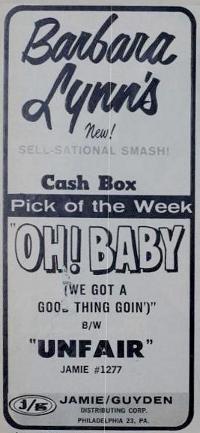
In early summer 1964, Barbara Lynn's infectious »Oh! Baby (We Got A Good Thing Goin')« was released. Now, some of you may not have heard the live version of that song recorded in the Uptown Theatre of Philadelphia on July 24, 1964 (from Atlantic LP # 8101). In fact, Barbara's live version is much rawer than the single version which was put out on Jamie ... without horn section the tune comes across in a considerably less polished way than the 45 version. Btw, Barbara is introduced by Jimmy Bishop.
Just the right track for a Monday night. Enjoy!
Barbara Lynn: »We Got A Good Thing Goin'«
from the Atlantic LP # 8101 (1964) (live):
Postscript
That night in Philadelphia Barbara Lynn performed two more songs which were recorded but unfortunately never released.
There is a nice summary of her career, by Michael Corcoran, here: True Heroes of Texas Music, Part II (you have to scroll down a bit).
And, why not, just let's have a photo of Barbara Lynn here, together with her guitar ... it is taken from the cover of Atlantic LP # 8101 and shows her, presum- ably, during the concert at the Uptown:
Two days ago Jimmie & Vella made their ap- pearance on this blog and I decided that they won't leave it, for the moment, without an encore. Now, since their '72 LP is a master- piece from beginning to the end, the choice of today's song was a hard one. Eventually I chose the most lyrical, poetical if you like, tune of the album, maybe also the one musically most accomplished. Its title is simply »Rain«, befitt- ing the seeming simplicity of the song. It runs for well over 7 minutes and was therefore never released as single. And, as you will hear, the song doesn't convey a mood normally associated with rain and downpour. On the contrary, I found it very con- sonant with the cloudless sky which today announced the beginning of spring over the town where I live. No more said. Be carried away ... and search out this album to listen to all its sonic jewels!
Jimmie & Vella: »Rain« from the Atlantic LP # SD 8301(1972):
Why they never made it completely eludes me: Between 1968 and 1981 they had three LPs out, plus several 45s, and all and everything they did is, in its very entirety, great artwork, starting from their '68 Imperial album and continuing in their following LPs. I am speaking of Jimmie & Vella Cameron, a husband & wife duo active from the late '60s. Often they have been categorized as »folk singers« but they actually transcend all categories by their sheer creativity and incredible musical feel.
In May 1972, their second (self-titled) LP was released, Atlantic # SD 8301. What a formidable effort, unjustly ignored in its time and by an ungrateful posterity! All the songs are originals; styles and moods flow from soft folk to what has been called »folk funk« ... and much more besides. If you have the chance, get this album for yourself, you won't regret it! There are sacred tunes on this LP (»To The Master Of Every King«), protest and freedom songs (»Lord Abide With Me«, »Then I Woke Up«, »Do You Really Know How I Feel«), melancholic love songs (»Just Hasn't Been The Same«, »Rain«) and don't-know-what-to-call-them tunes with a heavy beat like »Chica Boom«. At the Soundboutique blogspot, there is a very considerate and rather enthusiastic review of Jimmie & Vella's work. Let me quote some passages here (and I very much agree with what the author is saying):
Success might have eluded them, but milestones are what they left us on all three of these LP's. They bounced around on a different label for each decade (...). In 1971 Jimmie and Vella expanded and deepened their sound with 'Jimmie And Vella' released on Atlantic Records. They turned away from commercial stresses, explored more folky grooves and wrote about social issues and injustice. In 'Lord Abide With Me' they came with a heavy gospel and revolutionary feel. This 'self-titled' LP is a fine crafting and example of 'hippie soul' or 'folk funk'. At times laid back and delicate and at other times empowering, passionate and furious. Just a well rounded work.
Atlantic LP # SD 8301, gatefold sleeve (inside)
Jimmie & Vella's Atlantic LP features several songs in the 6 or 7-minute range, and each of these is a masterpiece. However, each a bit too long for today's post. So I chose two of the shorter tunes, »Just Hasn't Been The Same« and »Chica Boom«. They perfectly illustrate the range of what you can, musicallywise, expect from this LP. And if you get taken away by listening to Jimmie & Vella, you're not the first! So beautiful ...
Jimmie & Vella: »Just Hasn't Been The Same« / »Chica Boom« from the Atlantic LP # SD 8301 (1972):
For the record: The album was recorded at the Electric Lady Studios, NYC, in August 1971, with the exception of »Chica Boom« (rec. at Island Studios, London, UK); producer: Ralph Moss. The song »Chica Boom« was also released on Atlantic # 45-8277 (to no effect whatever chartwise).
Today some more saxophone on this blog! Played by Clarence Wheeler, who in 1972 recorded his Atlantic album The New Chicago Blues (Atlantic LP # SD 1636, released in January 1973).
ad from Jet magazine, Feb. 22, 1973
Although entitled The New Chicago Blues, there is little on this album that would qualify as »blues« in the more conventional sense; most of the tunes on this LP are actually jazz numbers. Two songs, however, stand out: »Oblighetto« featuring Buddy Guy & Junior Wells, and »How Could I Let You Get Away«, featuring Brenda Lee Eager & Peaches as background vocal group. It's just the right song for a relaxed evening (in case your life offers any of those, mine does rarely ...).
»How Could I Let You Get Away« was recorded at Paragon Studios, Chicago, on Sept. 19, 1972. Brenda Lee Eager was at that time still teamed up with Iceman Butler (before they broke up, with considerable noise, in autumn 1973). »Peaches« was a female quartet orga- nized by Jerry Butler whose line-up consisted of Brenda Lee Eager (billed separately), Carolyn Johnson, Diedra Tig and Mattie Butler (Butler's youngest sister). The names are quoted in an article in JET; over on Sir Shambling I found the following: »David Cole ... kindly writes to say that in his interview with Brenda Lee Eager she gave the names of the women in Peaches as Mattie Butler (Jerry's sister), Diedre Tigs and Carolyn Johnson. Davie Gordon has written to confirm the group members and by reference to an interview with Jerry Butler in Blues & Soul in 1972 adds that Butler said ""I formed the group about two years ago because I found I needed to use background singers all the time and that if I were to use the same girls all the time I could create a definite sound."«
A number of known session players took part in recording The New Chicago Blues; the group normally appeared as »The Enforcers«. I'd like to single out here organist Sonny Burke and bass player Louis Satterfield who in the '60s was one of the musicians associated with »The Chess Sound«. (You can hear him also on the Checker albums of the Meditation Singers.)
Clarence Wheeler (feat. Brenda Lee Eager & Peaches): »How Could I Let You Get Away« from the Atlantic LP # SD 1636 (1973):
Esther Phillips lets her hair down once more on this blog! And she did it back in January 1970 when she recorded her live album Burnin' Live at Freddie Jett's Pied Piper, L.A. (Atlantic LP # SD 1565). The album was released in August '70 after some overdubs (flute, trumpet and tenor sax) had been added in New York. The album was both listed on the Best Selling Jazz and Soul LPs charts; it stayed for some 6 months on the Soul LPs charts (beginning Nov. 14, 1970) and peaked at # 07 in January 1971.
From Billboard, Sept. 5, 1970, p. 72
The LP suscitated many reviews and comments in the contemporary press, and her frequent live performances in late 1969 and early 1970 were covered regularly in the California newspapers. (The back cover of the Burnin' album shows facsimiles of three such reviews plus short liner notes by singer Carmen McRae.) Even Ebony Magazine (in the December '70 issue, p. 28) run a review.
Ad from Ebony, Dec. 1970 issue
Interestingly, the variety of songs on the album made the critics differ as to which songs they preferred ... the Billboard writer singled out »Cry Me A River Blues«, while Carmen McRae in her liner notes chose to mention as favorites »Don't Let Me Lose This Dream« and »Please Send Me Someone To Love«. Nice thing is that you can hear the latter song (a Percy Mayfield composition) over on BB's Magic Jukebox blogspot. The Ebony writer preferred to call attention to Esther's version of »I'm Gettin' 'Long Alright«, and this is just fine with me. So get ready for a 6-minute version of that tune! Actually, the song starts only at about 02:10 into the recording, after Esther has done some introductory talking ... I do most of my blues songs for the ladies because we always have the blues, you see ...
Esther Phillips: »I'm Gettin' 'Long Alright« from the Atlantic LP # SD 1565 (1970):
AND ... I couldn't resist the temptation to post another recording of this song along with Esther's live version of it. It's a raw-cut, almost archaic version recorded by the Raelettes (with Ray Charles on the piano) which has never stopped haunting me. Compared to Esther's rather jazzy version (which is marvelous in its own right) you get here the modern version of somewhat like a hollering worksong of old, stripped bare to the basic harmonies and the insisting rhythm. Man, it tears me apart every time I hear it!
The Raelettes (feat. Ray Charles): »I Get Along All Right« from the Tangerine LP # TRCS 1511:
Note: On Tangerine LP # 1511 (Souled Out) the song title is given as »I Get Along All Right«. On the single release (TRC # 984, April 1968) of the same recording the title runs »I'm Gett'n Long Alright«.
C.C.Rider. Everyone from Leadbelly to the Grateful Dead has performed "C.C. Rider," but the question remains: Who was C.C. Rider?
The song is listed as "traditional," meaning no one knows who wrote it. During the Civil War, C.C. stood for Cavalry Corporal. Riding is probably the most common metaphor for sexual intercourse in the blues. The rider is a sexual partner, a steady lover. Was a woman singing to her soldier lover in "C.C. Rider"?
On the other hand, both male and female blues singers have sung "C.C. Rider." This makes sense, given that in African American usage, "rider" may be used to mean a lover of either sex - and it makes the soldier theory rather interesting.
(Debra DeSalvo: The Language of the Blues from Alcorub to Zuzu, New York 2006, p. 34 f.)
C.C. Rider broke a pattern for Chuck. Until that time he had only recorded songs of his own. C.C. Rider is a traditional folk song whose authorship is obscure. It has been a favorite of many great blues singers, including Ma Rainey, Lil Green and Bea Booze, all of whom recorded it. Chuck's adaptation is his own and is striking in the originality of its styling.
(From the notes on the back cover of Atlantic LP 8018 by Guy Remark)
"C.C. Rider" became a triumph of production technique for Jerry Wexler. ... This was one of the best records of its time, not really rock 'n' roll or rhythm and blues but an inspired mood that drew from both styles and also from conventional popular music.
(Charlie Gillett: The Sound of the City. The Rise of Rock and Roll, new ed. New York 1996, p. 71)
Baker reached way back to the repertoire of the "Mother of the Blues," Ma Rainey, for the classic "See See Rider." Many young listeners must have as- sumed - as I did at the time - that it was a new song.
(Chip Deffaa: Blue Rhythms. Six Lives in Rhythm And Blues, New York 2000, p. 193)
For the record:
Chuck Willis: »C.C. Rider«. Recorded Jan. 31, 1957, in New York. First rel. on Atlantic # 1130 in March '57, the tune first charted in April, eventually reaching #1 r&b (BB) and #12 pop. Released on Atlantic LP # 8018 (Chuck Willis: King Of The Stroll) in late March 1958. Personnel included Gene Barge (tenorsax), Phil Kraus (marimbas) and Jesse Stone (arr/cond). In July, the album had passed the half- million sales mark; Chuck Willis died only two weeks after its release. BB Review Spotlight: Watch this one. Willis exhibits his usual sock show- manship and drive on "C.C. Rider," a great old blues with a haunting arrangement.
Atlantic LP # 8071 (cover)
LaVern Baker: »See See Rider«. Recorded Sept. 26, 1962, in New York. First rel. on Atlantic # 2167 in Nov. 1962, the tune charted first in Dec., eventually reaching #9 r&b and #34 pop. It was to be the last of LaVern Baker's songs in the r&b Top Ten ever. Released on Atlantic LP # 8071 (See See Rider) in late Dec. '62 or early '63 (copyright on the back cover says 1962). BB 4-star-review: The old blues-standard is handed a wild, swinging, middle tempo rea- ding. The tune is handled in a modern groove with smart backing ...
*** BONUS SONG added March 31, 2012 ***
A smooth, jazzy-mellow reading of »C.C. Rider« from King Curtis' Atco LP King Size Soul (1967), recorded in Memphis, July 4, 1967 (yeah, they were working that day...). I don't know whether this album version is the same as the one released on Atco # 6711 in 1969.
King Curtis & The Kingpins: »C.C. Rider« from the Atco LP # SD 33-231 (1967):
After her untimely death in August '84, Esther Phillips was buried in an unmarked pauper's grave in Compton, California. It took a benefit concert in April '85 to procure her mortal remains another resting place that would have, at least, her name on it. Herman Lubinsky of Savoy Records had seen her in 1949 in a L.A. amateur night and signed her right away. Johnny Otis, Greek by race but black of soul, produced her; aged 13, she was billed as »Little Esther«. It then happened that she had a r&b # 01 hit with her single »Double Crossing Blues« in spring 1950. She was the youngest female artist to achieve this, and this record has held ever since.
I am very happy that the name of Esther Phillips finally appears in this blog. Where to start? It took me a long while thinking about how to introduce her to my blog. There's so much to say about her. She was a strong personality, keeping her wits ready and never shy to have her say; she put the fist on the table if need be. But she was weak as well, succumbing again and again to devilish king heroin. The sad truth is that her strength was her weakness, and her weakness kept her strong.
She is the great underrated voice of 20th century music. If you heard her voice once you're not likely to ever forget it. There are obvious parallels in her life and art to Billie Holiday, Dinah Washington and Nina Simone, but Esther Phillips never reached, in the public imagination, their fame. That ain't right.
As I said, I got to make a start somewhere. Her 50s singles, her Lenox smash, her Atlantic sides, her short stint with Roulette, her fantastic and immortal Kudu recordings? Whatever. Let's start today with the last # 01 hit Esther Phillips had in any chart, »Release Me«. Arguably, it's her most famous song until today, although many wouldn't know the singer. It has become one of those »oldies but goodies« which flow from loudspea- kers in elevators and supermarkets (and Atlantic as early as 1967 marketed this song as a »vin- tage classic«, and in Dec. '68 the song appeared on the Original Sound sampler »Oldies But Goodies«). The tune also is more than a little atypical for what Esther would record during most of her career. Yes, her voice is here, in this song, you couldn't confound it. And yes, it's hell of a song. But it's the one song I wouldn't have chosen to build her fame. Alas, it can't be helped: great part of the fame Esther Phillips enjoys today is still bound up with this song.
»Release Me« was, well, released in October 1962 on the Lenox label. Having been a C&W hit for Ray Price in 1954, Esther's version shot up the charts and prompted Billboard to publish her »Artists' Biography« in the November 24, 1962, issue (p. 10). Lenox Records in itself was a curious business, since it had been established, as it were, for Esther Phillips. Behind it were Lelan Rogers and Bob Gans. Both were impressed with the recent successes of Solomon Burke and Ray Charles who took C&W tunes into the r&b field, and with Esther they intended to do the same. And they did.
Recorded in Nashville and backed by the Anita Kerr Singers (they are credited prominently on the back cover of Lenox LP # 227), Esther produced with »Release Me« the most soulful C&W-song ever. But C&W it remains, and it's funny to see in retrospect how a perspicacious Billboard critic arrived at saying that »it's a ballad somewhat in the country vein« (Oct. 13, '62, p. 40). Certainly somewhat! And along with the success of the single release of »Release Me« came the (obvious) idea to put out an album centered around that song. This LP, Lenox # LX 227, was then released in January 1963. On the back cover of the LP is a long excerpt from the November 17, 1962, issue of Music Reporter which provides many details about Esther's Nashville recordings for the LP. You can read it below (scroll down to the end).
Ad from Billboard (January 26, 1963)
First of all, Little Esther had to have another name for she was little no longer. Yet in order not to give up the resonance of »Little Esther« one retained the »Little« but put it into quotation marks. Newly fashioned was, however, the second part of her name: Phillips. As often reported, Esther had taken it from a billboard advertising Phillips 66 gasoline at a gas station in Houston. She had adopted that fake family name (her real one was Jones) already when she was gigging in Houston and thus before being signed by Lenox; but it was on the Lenox sides that »Phillips« for the first time appeared officially.
Aptly, the cover shows the title of Esther's recent hit in big letters and bears below it the subtitle »Reflections of Country and Western Greats«. This was certainly meant to remind the buyer of Ray Charles's LP »Modern Sounds in Country & Western Music«. What, however, the specification »Reflection 1« in the left lower part of the cover was meant to indicate I do not know. Was there to be another LP? Anyhow, there was no follow-up and Lenox, for all the initial success they had had, claimed bankruptcy before 1963 was over. Inevitably, a greater and financially more potent label stepped in at this point and preyed on the carcass of Lenox. Atlantic bought up all the Lenox masters and took over Esther Phillips as well. In February 1964, Esther was signed to Atlantic,with Jerry Wexler and the Ertegun brothers happily smiling for the event (photo from Billboard, February 8, 1964):
Atlantic then tried different things with Esther, seemingly without concept. They pushed her away from C&W-flavored r&b and eventually plunged her into the MOR- pool. They did two LPs with her, producing the weakest sides of Esther Phillips's entire career with Beatles covers and insipid answer songs. But I won't go into Esther's Atlantic period here. What needs to be said, though, is that the Atlantic makers were at their wits' end regarding Esther in 1966. She was obviously unhappy with the stuff she was given to sing, and her performances showed. After she had appeared at the 1966 Newport Jazz Festival in July, this is what a critic had to say:
»Esther Phillips, who can sing such great blues, followed and it was immediately discernible that this was not her night. Not that she didn't sing the blues well (her unnecessary pop tunes suffered from the faulty intonation, however), but she was backed atrociously by a trio that showed an amazing lack of familiarity with the kind of music she has performed so well over the years« (Billboard, July 16, 1966, p. 38).
What is more, she was back on heroin and wouldn't get off it during the following years. Atlantic at this point remembered the Lenox masters and put them out again on an Atlantic LP. This album was entitled The Country Side Of Esther Phillips and actually a re-issue of Lenox LP # 227; only the sequence of songs was changed. It was, for all marketing purposes, sold as a seemingly newly recorded LP and was as such received in much of the contemporary press. Only a little note on the back cover said »The selections contained in this LP were previously issued on the album "Release Me" on Lenox Records.« It was to be Esther Phillips's last Atlantic studio LP (and it wasn't even that!) for many years.
Here is the song. The first version is ripped from the Lenox LP # 227 (mono). The second version is of my own making: I mixed the two mono recordings from Lenox LP # 227 and Atlantic LP # 8130 and produced kind of a fake stereo version. Sounds nice, doesn't it?
Esther Phillips: »Release Me« from the Lenox LP # LX 227 (1963, rec. 1962):
And as one song seems a bit poor for this lengthy post, you can hear »No Headstone On My Grave« in the following. It was penned by Arkansas-born country singer (and Elvis's buddy) Charlie Rich and is about the bluesiest tune to be found on Lenox LP # 227. Thus it was an obvious choice for this blog. But there's more to it: Reportedly, it was this very song which Kenny Rogers (the C&W singer) heard in a Houston club back in 1962, sung by Little Esther. Kenny then told his brother Lelan (also »Leland«) about it. Lelan Edward Rogers then got interested in Esther and eventually set up Lenox Records with Bob Gans. The rest is history. Saddest thing is, however, that this song sounds right only from the lips of Esther Phillips, as she got no headstone at first. Sometimes you just wouldn't like songs to come true.
Esther Phillips: »No Headstone On My Grave« from the Lenox LP »Release Me!« (1963):
* * *
Notes from the back cover of Lenox LP # 227 / Excerpts from the November 17, 1962, issue of Music Reporter. By Nola Jaye:
NASHVILLE.
It was 3 a.m. and as the recording session moved to towards its fourth hour, 23 musicians and singers milled quietly about the microphone and sound-screen jungle. There was no talking (...). There was an atmosphere of reverence and respect seldom seen. The crew listened to the final note of the playback of the song just recorded. Then, everyone applauded.
Everyone but the short, solidly built negro girl in the gray flannel slacks. The applause was for her.
The dramatic reaction was a spontaneous tribute to the 26-year old singer known to the world of show business as 'Little' Esther. She is one of the hottest singing properties in the country and the applause came halfway through a seven hour recording session for her first Lenox Records album.
That session has already carved a niche in Music City as a new born legend. The musicians and the Anita Kerr Singers are still talking about the spunky singer's refusal to take rest periods and how she cut one song after another with almost flawless perfection. There were few retakes as Esther recorded 10 sides [that is, all songs of the LP except »Release Me«].
A songwriter with five BMI awards to his credit called the session 'The most enjoyable night of my life ... I was exhausted when I walked in but she made me forget whether it was day or night.'
A publishing company rep with 20 years in the trade called it, 'The greatest album I have ever heard recorded.'
Bass man Bobby Moore exclaimed, 'Little Esther picks up where others end.'
The whole story of the session is loaded with the kind of dramatics that would make Hollywood script writers flip in wide-screen, technicolor somersaults.
First, the star, 'Little' Esther, walked into the session in the wake of a hit-wave that ended thirteen years without a hit for her. The gifted singer's 'Release Me' in Lenox Records passed the 200,000 sales mark the afternoon of that session. (...)
In real movie style, Esther was belting out blues six nights a week in Texas oil towns for $75 a week. One night, while Bob Gans (...) was in Houston, Lelan Rogers took him to see and hear Esther's performance. Gans was so impressed he signed her on the spot, and within weeks she waxed the old Ray Price C & W spell-binder, 'Release Me.' Tradesmen figure it is possible for this tune, which into the top 40 of the Big 100 in just three weeks, to become the number one record in the nation.
Bob Jennings, of Four Star Sales, says he can't get over the 'Little' Esther LP session. 'Musicians hear so much here,' he explained, 'that nothing moves them. And, some of these people had started working on other sessions at 9 a.m. the day before ... it was 3 a.m. and they laid aside their instruments and applauded.'
Nashville's number one nighttime pop deejay, Audie Ashworth of WKDA, said: 'She worked so steady and sung so hard ... she's got to be a great talent. And those arrangements ... I've never seen or heard anything like it.' (...)
Esther took the praise in stride with a beaming, winning smile. At one point, after finishing an applause winning performance of Hank Williams' C & W evergreen, 'I Can't Help It,' a musician remarked, 'Esther, that was out of this world.'
She shook her head, smiled wistfully and said, 'That Mr. Williams is too tough for little Esther to cut.'
Esther Phillips presents this album to you with all her heart and soul - particularly the latter.
I didn't plan to write a fourth »Sweet Inspiration« today, but then it just happened. It doesn't really connect, chronologically, to the previous posts, but that can't be helped as well. We'll come to that. Today, I wanted to draw your attention to a recent music documentary which features, among others, the Sweet Inspirations. Directed by Victor Mignatti, it was released a few months ago and is available now on DVD. Check it out here (click on the banner):
Many interesting things there and, most relevant for our purposes, an interview with Estelle Brown (read it also here).
* * *
from left: Cissy, Myrna, Estelle, Sylvia
While you're checking out that page you can stay tuned in here and listen to the most successful (chartwise!) song the Sweet Inspirations ever recorded. It is entitled, with just a little lack of fantasy, »Sweet Inspiration«. The song was recor- ded in Memphis on August 24, 1967 (see also below) and first released on their self-titled Atlantic LP (# SD 8155). However, the song wasn't at first put out as a single. On the contrary, Atlantic opted that this tune would be only their third single (Atlantic # 2476), released in spring '68. It then rocketed to #5 r&b and, likewise remarkable, to #18 pop.
Part of the success of this song might have been its distinctly C&W flavor, cer- tainly the most countryish song the Sweets ever recorded (not in the middle part, though). It is often reported, and can therefore be taken at face value, that Elvis had become aware of the Sweets via this tune. Being himself much inclined to C&W harmonies, Elvis had taken a liking to this song and, according to Myrna Smith, he even performed the tune during one of his shows: »It was later on that we discovered how much Elvis liked our song Sweet Inspiration and that that was the catalyst. ... One night he even surprised us by singing our song Sweet Inspiration on stage. We didn't know that he knew it. Elvis just broke into it and so we started singing background and he was singing lead and we were shocked. It sounded good« (read the whole interview here). And if you were ever in doubt why Elvis liked the Sweets' »Sweet Inspiration«, listen to his »Suspi- cious Minds« (recorded some 17 months later in the very same recording studio!) ... or rather, you don't have to listen to »Suspicious Minds«, you'll hear it right here in the first bars:
The Sweet Inspirations: »Sweet Inspiration« from the Atlantic LP # SD 8155 (1967):
* * *
»Sweet Inspiration« was penned by Dan Penn and Spooner Oldham (officially, and as noted on the back cover of the LP, Wallace Daniel Pennington and Dewey Lyndon Oldham). Peter Guralnick in his book Sweet Soul Music (New York 1999) tells the story of how the song was recorded in Memphis (pp. 297, 299):
»In August of 1967 Jerry Wexler had booked the American studio for the Sweet Inspirations, with Tom Dowd producing. ... It was a hot summer's day, the session hadn't been going very well ... "I had worked with the Sweet In- spirations with Aretha,", says Spencer Oldham, "and gotten to know 'em and loved the way they sung, so I couldn't wait for them to get a record on their own. So I went to the session that night at Chips's [i.e. Chips Moman's Ameri- can Sound Studio]. I don't think I was on the session for some reason; I don't know why, maybe I'd been out of town.
But anyway Dan [Penn] was sitting there, and we were watching all this go down, and they did two songs - awful stuff - and my heart started sinking, and I said to Dan, 'Let's go next door and try to write a song.' [p. 299] We star- ted walking upstairs, and he said, 'I ain't got no ideas,' and I said, 'Let's just take off on that 'sweet inspiration,' and we hit the old guitar, and we come back down there in a little while, and they were still moaning and groaning. And we played it to 'em ..., about the second time Dan ended up on the board, and I was playing guitar."
"You know," says Dan, taking up the story, "I think it was one of the high- lights of my career. Just as we bring our little tape down and the Sweet In- spirations fell in love with it, and all the musicians are going nuts, them stupids called a damn lunch break. Right in the middle of our song. And Spooner had this damn lick down so good the musicians wouldn't even go eat, they wouldn't leave because they knew by what was happening we could just cut it. And the girls were already singing it. And I'm standing there watching all this shit going down. ... I did my mix on the first take, and when they come back from lunch, I said, 'Boys, we done cut you a record."
The record made #5 on the soul charts, and Jerry Wexler asked Spooner for a third of the royalties, since he had given the group its name. What were the writers' reactions? "We didn't comment," says Spooner with his dry chuckle.«
For the record: Atlantic LP # SD 8155 was manufactured and scheduled for release in late '67 but was, for all we know, only shipped in February '68. Trade magazines are aware of the album only after this date.
Ren Grevatt was ranting, in April '61, about the girl singers who so much as dared to put their names on the Hot 100 list while even enjoying, »interestingly enough«, their first hits (see previous post). He singled out some of those phenomena and mentioned Carla Thomas and Mary Wells, among others. Now, he couldn't have in- cluded Barbara Lewis in his list, because her first-hit chart entry was still two years away (famously enough, it was »Hello Stranger« in spring 1963).
And Barbara Lewis certainly was a phenomenon! Her hobbies were drawing, painting, writing and singing folk songs (!), according to Billboard's »Artists' Biographies« (May 18, 1963, page 12), and she composed numerous songs and played several instru- ments, guitar and piano among them. (Billboard got that much right but gave a wrong birth date, the correct one being Feb. 9, 1943 ...). However, in her versatility and in being an instrumentalist and composer besides being a singer Barbara Lewis reminds me much of another »chick artist« who made herself a name at around the same time: Barbara Lynn. (Ask the higher powers whether the similarities of their respective names are pure coincidence!). Although Lynn, Texas-born, was the grittier singer, both her and Lewis started their promising careers on one huge hit and were never again able to repeat that initial success. And Lewis was taken over by Atlantic from a local Detroit label right at the beginning, while the New York label invested in Lynn only from 1967 onwards. However, similarities aplenty!
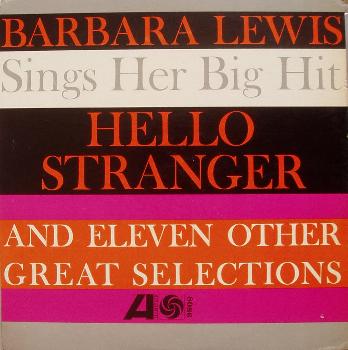
Lynn first climbed the charts in June '62 with her classic »You'll Lose A Good Thing« shortly after Lewis had her first single out on Atlantic (# 2141: »My Heart Went Do Dat Da« / »The Longest Night Of The Year«); Atlantic had bought the master from Karen (owned by Lewis's manager Ollie McLaughlin) when the original 45rpm (Karen # 313) sold strongly in Detroit. In July '62, Barbara Lewis recorded another single in Chicago, »Gonna Love You Till The End Of Time« w/ »My Mamma Told Me« (Atlantic # 2159). Her second single didn't chart either, but the next one would: »Hello Stranger«, Lewis's signature tune and arguably one of the best-known songs of the '60s. The exceptional success of this song (r&b # 1, pop # 3) then prompted Atlantic to release Lewis's first album in July '63. It was the classic trick of putting an album out in the wake of one big hit, and the cover does advertise this fact in desirable clarity.
Yet this LP is not the typical »first album« and it does not offer one hit plus eleven fillers. For once, all twelve songs on the album are self-penned (»This album could easily be called Barbara Lewis sings Barbara Lewis, but we are calling it Hello Stranger since this was the smash hit which so recently made the name of Barbara Lewis known from coast to coast« wrote Ollie McLaughlin on the back cover. And, he goes on to say, »All of the songs in this album were written by Barbara Lewis, which is unusual for someone at the age of nineteen ... Barbara was inspired at a very early age and began writing songs at the age of nine. She now has more than thirty to her credit«). Moreover, the LP does include her former singles released in '62.
Side 1 contains, therefore, her second Atlantic single, »Gonna Love You Till The End Of Time« w/ »My Mamma Told Me«. When it was first released, Billboard (Sept. 8, '62) awarded it only a 3-star review and saw but »moderate sales potential« in these tunes. When the LP was out, however, »My Mama (!) Told Me« was listed among the »top tracks«. »The album is filled with much ... soft, lyric quality with a dash of beat here and there as well« (Billboard, Aug. 3, '63).
Well, there is more than just a »dash of beat« in »Gonna Love You Till The End Of Time« and »My Mamma Told Me«. They are no great songs, admittedly, but they are not near as »poppy« as many others of Barbara's tunes; Atlantic would soon push her towards pop-soul but it's not yet evident in these songs. Instead, they sound conspic- ously like several other dance tunes of the epoch. Little Eva's »Loco-motion«, Dee Dee Sharp's »Mashed Potato Time« (and follow-up songs like »Gravy (For My Mashed Potatoes)« or the Marvelettes' »Too Strong To Be Strung« and »I'm Hooked« come to mind, all from 1962. »The Loco-motion« and »Mashed Potato Time« were big hits in early summer '62, and Lewis's own songs were recorded in July '62 in Chicago ... But I don't want to insinuate plagiarism here, far from it. It was this music that was in the air. And that's exactly what I like so much about Barbara's songs: if ever you were looking for signature tunes for the summer months of '62 you can't go wrong with these two:
Barbara Lewis: »My Mamma Told Me« / »Gonna Love You Till The End Of Time« from the Atlantic LP # 8086
Jerry Leiber has died, aged 78. The sad news has been known for some days now.
His is a name that needs no introduction, and so I won't give any. Just some words about his early years.
He grew up in Baltimore, and his first language was Yiddish. His neighborhood was mainly Polish and Italian, with many Jews and blacks around. Jerry was one of the »Jewboys«. Aged 12, he moved to L.A. with his mother and sister. All was to begin there, and it was there that he teamed up with Mike Stoller. They had their first record out in 1951.
In memoriam of Jerry Leiber I thought I might play today three songs: words by Jerry, music by Mike. The framed photo above shows them both seated at the piano; standing behind, Jerry Wexler from Atlantic (2nd from left) and the Coasters.
Actually, Leiber & Stoller did not produce many songs over the decades, but almost all of them charted. Two of the most famous, and most widely covered over the years, are »Kansas City (Here I Come)« and »Hound Dog«. Equally popular are some tunes they wrote (or co-wrote) for the Drifters during the '60s, such as »On Broadway«.
Kansas City. One of their first songs, written in 1952 for Little Willie Littlefield. Here, you can hear the version of Shirley Ellis, from her 1965 LP »The Name Game« (Congress # CGL-3003, mono). In order to fit her »female version«, the lyrics were changed to »... they got some crazy little fellows there and I'm gonna get me one« (instead of »they got a crazy way of loving there and I'm gonna get me some«).
Shirley Ellis: »Kansas City« from the Congress LP »The Name Game« (1965, mono):
Hound Dog. This song was penned in 1953 for »Big Mama« Thornton. There are quite a few anecdotes about how this happened and what the chemistry was like between the singer and Jerry. According to Jerry, the song had »a country-funky feel« (Jerry Leiber & Mike Stoller, with David Ritz: Hound Dog. The Leiber and Stoller Autobio- graphy, London - New York 2010, p. 62). Infamously, the song's lyrics, much to the dismay of Leiber, were changed substantially in order not to offend the white public when the song was re-recorded by a Tupelo-born celebrity. It was this version by Elvis that made the song worldfamous. The original lines, as written by Jerry, run »... quit snooping 'round my door. You can wag your tail, but I ain't gonna feed you no more«, and appeared in Elvis's version as »... crying all the time. You ain't never caught a rabbit and you ain't no friend of mine«. Jerry later said: »To this day I have no idea what that rabbit business is all about. The song is not about a dog ... Elvis's version makes no sense to me, and, even more irritatingly, it is not the song that Mike and I wrote« (Hound Dog, p. 94). Yet he also acknowledged that the tremen- dous sales success of Elvis's »Hound Dog« »took the sting out of it«, that is, he accepted the garbled lyrics, went along with it and cashed in on the credits. After
all, Jerry Leiber was a song-seller, not a moralist. In the following, you can hear
the rather unlikely cha cha cha-version of the song as recorded by Betty Everett in October 1963. Good thing is that Betty's version has the original lyrics. The song title is given as »Hounddog« on the cover, as »Hound Dog« on the label of Side 1.
Betty Everett: »Hound Dog« from the Vee-Jay LP # 1077 (second release) »It's In His Kiss« (1964):
On Broadway. One of the best-known songs of the Drifters. This tune was originally composed by Barry Mann and Cynthia Weil. Mann had it conceived as »a Gersh- winesque kind of melody« (Ken Emerson: Always Magic in the Air. The Bomp and Brilliance of the Brill Building Era, London - New York 2005, p. 137), and Weil added the lyrics because she was infatuated with Broadway. However, the song eventually wasn't satisfying. So in January 1963, Mann & Weil took the song to Leiber & Stoller. They re-wrote it to a great extent, thus earning their credits. The version you can listen to in the following was recorded in the Uptown Theatre of Philadelphia on July 24, 1964, and released on Atlantic LP # # 8101 (Saturday Night At The Uptown) later that year. It certainly is the most unusual version of the song you are likely to hear: apart from the excitement of the crowd, the song is done »properly« in the first part, but gradually slips into an ad-hoc group improvisation in the second part. During their performance, the Drifters at one point change »Broadway« into »Broad Street«, »in honor of the Philadelphia thoroughfare« as the notes on the back cover duly remark.
The Drifters: »On Broadway« (live) from the Atlantic LP »Saturday Night At The Uptown« (1964):
I am interested in the music, not in the relative rarity of discs. I also listen with great pleasure to Aretha Franklin, because she has the voice of the century. Music is no Faith and therefore has no heretics.
* * *
No music downloads on this site. All mp3s (with very few exceptions where noted) are ripped from original vinyl discs. If something on this blog is objectionable to anyone or should, for valid reasons, be re- moved from the net please let me know; it will be removed. And to reiterate: This is a non-profit blog.