In the September 2, 1967, issue of Billboard, »Lucky In Love« was predicted to reach the Hot 100. Alas, the reviewer was wrong and the song didn't chart eventually. Anyway, my favorite tune of this 45 is the B side. Enjoy!
The only 45 by Fontella Bass to get both sides into the charts. On the other hand, »I Surrender« was the last of Fontella's songs ever to enter the Hot 100.
The A side entered the Hot 100 on March 26, 1966, at #84 and peaked in May at #78. Strong airplay was reported from Detroit, St. Louis and Los Angeles in April. The tune reached #33 in the R&B Top 40 in May 1966.
The B side entered the R&B Top 40 on April 23, 1966, peaking at #31.
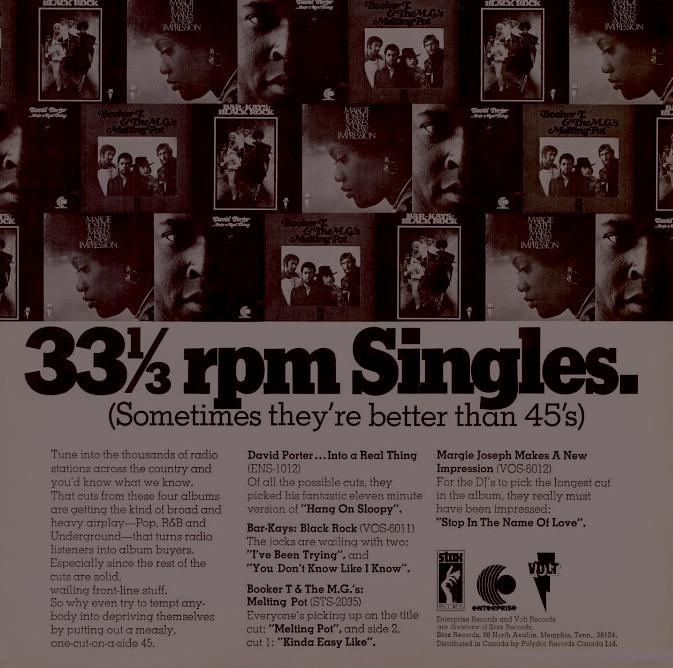
Margie Joseph's earliest recordings were done at the Muscle Shoals Sound Studio in 1967 and resulted in two OKeh 45s, out in December 1967 and in May 1968. They didn't chart but made enough noise to earn passing mention in Billboard. Later, after she had been picked up by Stax in 1969, she returned to Muscle Shoals in 1970 for another four songs which then found their way unto her first LP (Volt LP # 6012, 01/1971). And although her Muscle Shoals output was limited (and actually ended with her 1970 session), her name remained bound up with the »Muscle Shoals Sound Story«. This is attested, curiously, by an ad from September 1970 where Margie's name appears in the flattering company of the Rolling Stones, Sam & Dave, Solomon Burke, Mavis Staples, Odetta, Joe Tex, Aretha Franklin, Wilson Pickett and many others (see ad below). This ad was placed months before her first Volt LP was released.
Now, I never lost any sleep about why Margie's second LP was called Phase II, being her second LP and all. What I have never grasped so far is the pun or message, if there is any, of why her very first LP was entitled ... Makes A New Impression (for a pic of the cover, see yesterday's post). In any case, it seems that the LP was either at first (or alternatively as an afterthought) destined to be called Meet Margie Joseph, which apart from the nice initial alliteration would make some good sense for an artist's premiere album. However, only the labels show Meet Margie Joseph, while the sleeve has Makes A New Impression. So we are left to guess whether sleeve or labels were printed first (and, depending on this, whether Meet Margie Joseph was the original title or not; I guess it was).
Stax/Volt ad from Billboard, Jan 30, 1971
Not that it really matters, because she does make a pretty solid impression in any case. Andrew Hamilton called this first LP Margie's »most successful and aesthetically pleasing album« (AMG to Soul, p. 379). It famously contains the 10-minute monster track of »Stop! In The Name Of Love« preceded by a »Monologue: Women Talk«. It soon proved to be the LP's stand-out song, was quickly used for a Stax-Volt ad and finally released as a 45. I have to confess, it is not my kind of bag. And to the probable bewilderment of some among you, several other songs on this LP aren't my bag either. Basically all those which were recorded in the Memphis Stax Studios, with the exception of »Sweeter Tomor- row« (as heard on yesterday's post). Andrew Hamilton described the LP as being »a mixture of Stax and city slick R&B sounds«, but frankly, I would object that the Stax songs on this LP are the very epitome of everything I would call »city slick« ... and just about too slick for my modest taste at that.
Which leaves us, or me at least, with the tracks Margie Joseph recorded at Muscle Shoals. They are quite a contrast to the rest of the album. One of those, »Punish Me«, was released as a 45 (Volt # 4046) by Stax-Volt in September '70 in order to wax the floor for the coming album but it didn't succeed in doing so. (The result was that Margie's LP was then released without any hit single attached to it. The more astonishing that the album reached the Top Ten of Soul LPs and made it to #67 in the general Top LPs listing. But no, not astonishing; it's called quality. However, minds have been divided over this album.) Two other of the Muscle Shoals tracks are the songs I like most about this album. Dig them here:
Margie Joseph: »Same Thing« / »I'm Fed Up« from the Volt LP # 6012 (01/1971):
Most of you will have noted (or ordered) already, so it's probably somewhat late, and actually overdue, for me to remind you that the second volume of Bob McGrath's Soul Discography (G-M) (Eyeball Productions) has been published - not even recently, but several months ago. I always wanted to mention it here, because it really is a very welcome and most useful addition to the (not too numerous) research tools at our disposal. As this calls for a little celebration the obvious thing to do was to take my inspiration from the cover of the second volume and make it come alive musically (or rather vocally if you like).
Volt LP # VOS-6012
The cover image is taken (and laterally revers- ed) from Margie Joseph's first ever LP Makes A New Impression (Volt LP # VOS-6012, released in January 1971), so inspiration has to flow from there. Tonight I don't have the time to say much about Margie and her first album; suffice it to say that half of the songs of her first LP were recorded at Stax, the other half at the Muscle Shoals Sound Studios. I'll follow up her story tomorrow, or as Margie tells us: »(Everything Will Be) Sweeter Tomorrow« ...
Margie Joseph: »Sweeter Tomorrow« from the Volt LP # VOS-6012 (1971):
After his fabulous success with »Mercy, Mercy« (feat. Jimi Hendrix on guitar) Don Covay was soon picked up by Atlantic. In February 1966, they put out his album See-Saw, the second on Atlantic but actually the first entirely produced and recorded under Wexler's supervision; it has acquired its place in the history of memorable covers, showing a decently dressed white girl in a wintery landscape on a see-saw ... so much for Atlantic's shrewd (if inherently racist) policy of how to sell the energy-loaded music of a black singer, tall, handsome and sexually attractive, to the mainstream market in mid-60s America.
Covay's initial time at Atlantic was not as successful as many had hoped for, the only hit in 1965-66 being the album's title song »See-Saw«. What most don't know, however, or do not care to remember, is that four of the album's 12 songs were written by Steve Cropper & Covay and recorded at Stax Studios in Memphis on 30 June '65: »See-Saw«, »I Never Get Enough Of Your Love«, »Iron Out The Rough Spots« and »Sookie Sookie«. (According to some, »Iron Out The Rough Spots« was recorded in a later session but this is almost certainly wrong.) The personnel playing in the June '65 session was actually made up of Booker T. & the MG's, together with other known Stax session musicians: Duck Dunn, Steve Cropper, Al Jackson, Booker T Jones, Wayne Jackson, Andrew Love and Floyd Newman. Hard to think of anything more »Stax« than this mix! And indeed, those four songs are about the best on this album which has its fair share of fillers; hear two of them below.
In the Stax studio: Jim Stewart, Don Covay, Steve Cropper, David Porter (right to left); photo from Rob Bowman's Soulsville U.S.A.
As is known, Atlantic brought on several occasions promising singers to Memphis, and for the use of the Stax studio and musicians Atlantic then split with Stax the publishing and Stax got a share of the sales from Atlantic product recorded in Memphis. Before Wexler headed to Memphis with Covay, Atlantic had recorded Wilson Pickett there. So towards the end of June, Covay appeared in the Stax Studio. Rob Bowman in Soulsville U.S.A. has some details about the Covay sessions (p. 62 f.); in particular he quotes Steve Cropper with the words:
I remember that Jim Stewart [the boss of Stax] called Jerry Wexler and said, 'Get Don Covay out of here. He's driving us nuts.' Don Covay was a little bit on the weird side. I loved Don to death. We get along great but I don't think Jim and them understood Don. He ... was kind of driving people bananas. ... He's kind of frantic when he makes decisions. He jumps from this place to that. You never know what he's gonna do next.
Bowman puts this a bit more neatly in saying that »Covay's high energy and extreme unpredictability were the antithesis of Jim Stewart's banker personality«.
Both Pickett and Covay were difficult to work with and their respective Stax sessions turned out to be rather turbulent. What is more, the Stax studio musicians started to rebel and Jim Stewart was likewise not gifted with undue patience. So after the Pickett and Covay sessions, Stax wouldn't let Atlantic stars record as often or as easily as before. However, the Covay sessions produced some prime Memphis soul from the first heyday of the legendary Stax sound.
Don Covay: »Iron Out The Rough Spots« / »Sookie Sookie« from the Atlantic LP # 8120 (1966):
Folks, there'll be no fussing around today because I'm pretty tired. Just two plain old classics, »I'm Satisfied« and »Something You Got« by Maxine Brown & Chuck Jackson. Famously, »Something You Got«, recorded in NYC in February 1965, was rushed out in March or early April and proved to be their biggest hit (r&b # 10) ever. »I'm Satisfied«, released later that year on Wand # 1109, didn't chart. In order to capitalize on the success of »Some- thing You Got«, Scepter put together (and in July released) an entire album (Wand LP # 669) which at least had the memory word »Something« in its title.
The strategy worked better than expected but eventually backfired: at the end of August '65 only »something« had caught the general attention, with Billboard announcing the LP wrongly as »Say Something« (see excerpt). So it was, it seems, something like a »Something Something« album. In the meantime, Maxine Brown was pictured in the contemporary press together with -- no, not Chuck Jackson but Jackie Wilson! (See the photo from Jet magazine, July 29 issue, below).
Chuck Jackson & Maxine Brown: »I'm Satisfied« / »Something You Got« from the Wand LP # 669 (1965):
His greatest victory is the humility he was strong enough to learn and share in the second part of his life. This makes him a hero if ever there was one.
Today's tribute song »Boxer« comes from Carolyn Franklin. The song was the A-side of her first 45-release (which didn't chart) and then featured on her first LP, Baby Dynamite! (released in May 1969).
Carolyn Franklin: »Boxer« from the RCA LP # LSP-4160 (1969):
Some weeks ago, in November, I played two songs from Stax's double album Boy Meets Girl, this final LP experience of soul duets. However, among the plethora of duets which Stax was experimenting with in 1968 and 1969 one singing pair is, conspicuously, missing from the said LP set, viz. the pairing up of Judy Clay and William Bell. And yet this duo proved to be most successful Stax came up with during the late '60s.
Judy Clay we met on this blog as part of the Drinkard Singers, way back in the '50s. She then stayed with several labels until 1967 when she recorded her first 45 for Stax. Roughly at the same time, she teamed up with Billy Vera (on Atlantic). And finally, in spring '68, she recorded her first two songs with William Bell which were released as Stax # 0005 in July, »Private number« with flip »Love-Eye-Tis«. The A-side of this single proved to be the biggest hit of her entire career.
Rob Bowman in his Soulville U.S.A. has told the story of »Private Number« in detail (see pp. 152 f.). Like »Love-Eye-Tis«, the song was written by William Bell (based on a personal experience) and then worked out, musicallywise, with Booker T Jones. Both planned that Otis & Carla should record the song but the untimely death of Otis put an end to that. According to Bell, quoted by Bowman, it was then by chance that Clay and Bell recorded this song, mainly because both happened to be in the studio at the same time: »She completed the session early and she needed something to record. So we said, 'Give us an hour.' We sat there and completed 'Private Number' in the studio.« Anyhow, Bell was still thinking at that point to give the song to Judy, but then someone suggested that Bell's vocals should be added to Judy's demo. »Neither one of us had any idea that it was gonna be a duet« said Bell later.
Supposed that this story is true, there would've been thus no »grand« strategy at Stax, at least not yet at this point, to find a post-Otis/Carla duet. Rather it all happened by accident. But, if »Private Number« came about coincidentally as a duet, »Love-Eye-Tis« in all probability did not (Bowman is silent on this point). After all, they needed a B-side for »Private Number«. The A-side has remained the famous song of that 45, but I don't like it at all: it's too poppish for my taste and lacks the right hook. So only thing I gonna play here is the B-side which has some semblance of Memphitian origins left in it. As Bowman further explains, all newly numbered Stax singles from May '68 onwards (i.e. nos. 0001 ff.) were cut on the freshly acquired Scully 8-track recorder. I personally think that this hasn't increased sound quality compared to the earlier recordings. And we can hear on Stax # 0005 what we cannot but notice also in numerous recordings on the Boy Meets Girl album: the voices are mixed way too much in the background. They just don't stand out properly, lack force and get sub- merged by the bass line - it's a pity. Listen here:
Judy Clay & William Bell: »Love-Eye-Tis« on Stax # 0005B (1968):
Why is it that so many of Tina Turner's songs seem to possess such a strong auto- biographical undercurrent? Is it that I am looking for it in her songs when in case of others I wouldn't? But then, why do I seem to hit on something every time I'm looking for it?
From Jack Robinson's photosession, 1969 (look it up here)
Spring 1969. The Turners have out their first Minit 45 (# 32060), released in March. As for their career, 1969 was a good year: they were playing Vegas now and getting paid more than ever; Ike was enjoy- ing his lush life and before the end of the year they were touring with the Rolling Stones. For the Blue Thumb label, they recorded two bluesy LPs that wouldn't go far saleswise but show Ike & Tina doing something different. They re-released their A&M album River Deep, Mountain High and increasingly started to cover songs made famous by others (»With A Little Help From My Friends«, »I've Been Loving You Too Long«, »Come Together« etc.). And Tina came to develop her ill-famed X-rated stage antics (watch Tina in action over here, from the Stones documentary Gimme Shelter). Little mattered it then that in April they had their Los Angeles home burglarized, with items worth $70,000 and their car part of the booty.
On the personal level though, things had gone from bad to worse. Tina had her stomach pumped clear of 50 valiums after she had discovered that Ike had fathered a child with her friend Ann Thomas and after Ike had started to treat her ever more violently. »Yes it finally got to the point where I was ready to die. ... I felt like I could not take any more. ... And that's when I started to hate Ike Turner. ... [W]ith the women, and the beatings, I had started losing that love for Ike. And now, after the pills and the hospital, I was starting to hate him« said Tina in her autobiography (I, Tina, p. 144 + 148).
From Jack Robinson's photosession, 1969
Now, Minit # 32060 was out in March. It features a com- bination of two songs, »I'm Gonna Do All I Can (To Do Right By My Man)« on the A-side and »You've Got Too Many Ties That Bind« on the B-side. And these two songs being put together on one 45 does raise some questions.
The first tune, »I'm Gonna Do All I Can (To Do Right By My Man)«, was penned by country musician and producer Wayne Carson. It's one of those husband & wife songs, crammed with that kitschy marital and ultimately depressing devoteness lyrics so typical of the C&W scene ... he's the only real thing that ever happened to me ... He can make me be good, he can make me change my ways, do the things a good woman should and I'm gonna make him happy each and every day. I'm gonna do all I can to do right by my man, to be the kind of woman he wants me to be ... Ike couldn't have cared less. The song made it to #98 pop in May '69.
Let's turn to the B-side, Johnny Northern's & Jimmy Bailey's »You've Got Too Many Ties That Bind«. As to Tina's performance, this B-side is much stronger than the A-side. And what a contrast! Listen to Tina singing ... Every time in my life when things begin to glow, there comes a change and back downhill I go ... Every time when happiness comes my way, along comes misery and destroyed my whole day ... I once was blind but now I can see, I can see, oh yes I can see - that there's too many ties that binds (!) ... I cross my heart, hope to die, each time I think about my life, I wanna cry. That's why I'm singin' there's too many ties that bind. Too many, too many ties ... Phew! Ike couldn't have cared less. But how must Tina have been feeling when singing these lines? And how to reconcile the two songs?
From J. Robinson's photosession, 1969
However, things are a little more complicated still. The labels of Minit # 32060 on both sides give Ike Turner and Willie Mitchell the production credits. It is unknown at what time »I'm Gonna Do All I Can« was recorded. But it is known that the B-Side, »Too Many Ties That Bind«, was recorded years earlier and actually released for the first time in 1964 on Sonja # 5000. On the Sonja 45, only Ike Turner is credited and the song title appears as »Too Many Ties That Bind«. Ana-B (from The Singing Bones blogspot) told me that what you hear on Sonja # 5000 is not just the same song, but the exact same recording we find on the Minit B-side. So, essentially, the newer side, »I'm Gonna Do All I Can«, was in 1969 pressed with the older recording. Moreover, this also explains the curious fact why the song on the Minit (re-)release was re-titled »You've Got Too Many Ties That Bind« even though the lyrics of the song do not feature the words »you've got«. Ana-B pointed out that Sonja # 5000 was probably an early Willie Mitchell production and that he got the belated credit on the Minit single. She also hinted me at John Ridley's Page where you'll find a review of Sonja # 5000 (the gist of it is quoted below in the comment section).
So what are we making of the Minit single? Musically, we have Tina singing two heartrending ballads here. Conceptually, we have a plea of marital thankfulness and an outcry of utter desperation, an explosive mix. Are they expressing just the same, after all? If looking at Tina's troubled life in and around 1969 and how she dealt with it this doesn't seem farfetched. But the B-side was recorded years before, and maybe also the A-side was not really a recent recording. So why put out both songs in 1969 (apart from the convenient fact of recycling, in part, older material)? I have no obvious answer to this. In fact, I am musing about this without truly knowing whether Tina's private life had any part in why these tunes were released in 1969. On the other hand, can you listen to these songs and be convinced, in earnest, that her private life had nothing to do with it? They just so closely reflect, in all their contrasting message, Tina's state of mind in 1969. And what she told in her auto- biography about the events in late 1968 and early '69 just so closely mirrors the lyrics of the B-side ... but she kept on holding up the facade and was stuck with Ike (that's where the A-side comes in) ...
For the record: »I'm Gonna Do All I Can (To Do Right By My Man)« never appeared on an album at the time (the Turner's only Minit LP being Live In Person). The song was first released in the '80s on LP and was afterwards included in CD packages of the Minit r&b output (one recently re-issued). »You've Got Too Many Ties That Bind« appears on a 1991 Japanese CD (TOCP-6597) which has all the Minit sides and is actually entitled You've Got Too Many Ties That Bind.
Ike & Tina Turner: »I'm Gonna Do All I Can (To Do Right By My Man)« / »You've Got Too Many Ties That Bind«
on Minit # 32060 (1969):
Speaking so much of The Staples lately and pondering which duets to chose for today's post left me, really, no choice but to take the marvelous Stax 2-LP album »Boy Meets Girl« from the shelf. In the second half of the '60s, mixed duets were high on the agenda of record producers. Motown's Marvin Gaye was paired up with three female artists, and Stax climbed the charts with Otis & Carla. After Otis's tragic death, Stax joined Judy Clay and William Bell (while Atlantic had Judy out together with Billy Vera). But in 1969, Stax produced what is, arguably, the ultimate duet experience on vinyl, viz. the above-mentioned double album »Boy Meets Girl«.
We have 22 songs here and 7 artists, 4 male and 3 female. One song, the opener of the first LP, is sung by all, the remaining 21 are mixed duets. We have 10 different combinations, one of these 4 times, two of them 3 times, four of them 2 times and three duets just once. Two female artists (Mavis & Carla) are present in 10 duets, one (Cleotha) in only 1, whereas among the males we find the first (William Bell) doing 9 duets, the second (Eddie Floyd) 6 duets, the third (Johnnie Taylor) 4 duets and the fourth (Pervis Staples) 2 duets. Only one of the male artists (Pervis) has only one female duet partner (Carla), while Cleotha has but one song and thus is easy to calculate. Mavis and Carla are present with the same number of duets (10), but Carla has one more partner (Pervis) while Mavis has more duets than Carla with the same partner (William Bell). Eddie Floyd is the only one among the male artists to sing with all three female artists. I guess some mathematically minded and mechan- ically gifted geek could construct a nice Rubik's Cube from that. I, who am neither so minded nor gifted, have to do with the music.
Stax STS 2-2024 front cover
Robert Christgau wrote a critical appreciation of this album (and by so doing also spoke about the role of duets in late '60s black music in general), read it here (a review orig. publ. in the NYT, June 22, 1969). I do not agree with everything he says, but he's certainly right in assuming that Stax was looking for a new duet to repeat the success of the Otis & Carla formula: »Somewhere among the permutations there's just gotta be another Otis & Carla.« He then concludes that there wasn't. A look at the chart success and the sales figures for this album seem to confirm Christgau's view: The album, released in July '69, stayed for some weeks in the lower 40s of the 50 Top r&b LPs charts; of course, being a two-record package it was a costly item and I don't know whether Stax possibly sold it at the price of one LP. However, five singles were released from this album and none did chart.
I personally find that this LPs offer many a remarkable song. And there is the additional advantage that you can hear many different voices in different combinations, making the two LPs sort of a vocal lab. Below, you can hear Mavis Staples & Johnnie Taylor with »That's The Way Love Is« (never released on 45). Mavis has just one duet with Johnnie on this album and I somehow feel that they should have done more. And their voices are mixed not only much up-front (in contrast to several other pieces on this album) but also into different channels. Second duet is Cleotha Staples & Eddie Floyd with »It's Too Late«. I have to admit that this tune is not up my alley, nor is the arrangement. But, hey, there are so few recordings of Cleotha singing a prominent part so I just thought I'd owe her that for all what she did with the Staple Singers. But it's not only that: she really got a beautiful, almost lyrical voice. You kind of feel, though, that she's not used to sing »on her own«, as it were, and she seems to hold back a lot, shyly, giving her vocal performance too little force and ... confidence? behind it (especially if contrasted with Eddie's professional and self secure performance). And she's more at home in the higher registers, but still. Was I being unjust? Listen for yourself:
Mavis Staples & Johnnie Taylor: »That's The Way Love Is« (from STS 2-2024A, 1969) /
Cleotha Staples & Eddie Floyd: »It's Too Late« (from STS 2-2024B, 1969):
POSTSCRIPT:
This Stax 2-LP album was never re-issued on CD in its original form. Several songs are contained on a 2009 compilation entitled »Boy Meets Girl: Classic Soul Duets«. Mavis & Johnnie's duet »That's The Way Love Is« is added as bonus track on the 1993 CD re-issue of Mavis Staples's first two Stax albums »Only For The Lonely« (CD # STA 88012).
On a CD review page, I found the following quote from Mavis Staples:
»Man, that was a looong time ago«, Mavis laughed. »'Boy Meets Girl' was an album compiled of all of the female and the male Stax people. I don't recall much of it, but I do remember singing with William Bell, because they played the song we did, 'Strung Out', quite a bit on the radio.«
* * *
Tracklist of the original 2-LP album (songs marked with (*)asterisks were released as Stax 45s at the time):
LP 1 (STS 2-2024A)
A1 Staples, Carla Thomas, William Bell, Eddie Floyd: Soul-A-Lujah (*)
A2 Mavis Staples & William Bell: I Ain't Particular
A3 Carla Thomas & Johnnie Taylor: Just Keep On Loving Me (*)
A4 Mavis Staples & Eddie Floyd: Ain't That Good (*)
A5 Carla Thomas & William Bell: I Can't Stop (*)
A6 Mavis Staples & William Bell: I Thank You
B1 Mavis Staples & William Bell: Love's Sweet Sensation (*)
B2 Carla Thomas & William Bell: I Need You Woman (*)
B3 Mavis Staples & Eddie Floyd: Never, Never Let You Go (*)
B4 Mavis Staples & William Bell: Hold On This Time
B5 Mavis Staples & Johnnie Taylor: That's The Way Love Is
LP 2 (STS 2-2024B)
A1 Carla Thomas & Eddie Floyd: It's Our Time
A2 Carla Thomas & Pervis Staples: It's Unbelievable (How You Control My Soul)
A3 Mavis Staples & Eddie Floyd: Piece Of My Heart
A4 Mavis Staples & William Bell: Leave The Girl Alone
A5 Carla Thomas & Pervis Staples: I'm Trying
A6 Carla Thomas & Eddie Floyd: Don't Make Me A Storyteller
B1 Mavis Staples & William Bell: Strung Out (*)
B2 Carla Thomas & Johnnie Taylor: My Life (*) B3 Cleotha Staples & Eddie Floyd: It's Too Late
B4 Carla Thomas & Johnnie Taylor: I've Just Been Feeling Bad
B5 Carla Thomas & William Bell: All I Have To Do Is Dream
***
POSTSCRIPT 26th February 2013
Today, I received the following sad notice:
Cleotha »Cleedi« Staples has passed away at the age of 78 in her Chicago home on the morning of February
21, 2013. God rest her soul.
She was the eternal talent: Billboard called her »young & talented« from around 1968 to 1972, and in 1973 she retired from secular music. A reborn Christian, Ella Wash- ington (Cobbs) said »Like I'm not putting down R&B, soul or whatever you want to call it, but gospel is so much more meaningful ... I'm not saying anything bad about rock, it was good to me, but it was all My Baby Left Me, Another Man's Wife and so on. It kind of lost relevance for me anyway.«
Ella Washington & John Richbourg (both photos from BB, Dec. 21, 1968)
BB Nov. 23, 1968, p. 29
From 1967 to 1972, Ella Washington's career was bound up with Sound Stage 7 and J.R. Enterprises. The latter was the production company of Nashville's WLAC DJ John Richbourg; he produced most of the Sound Stage 7 singles in the late 1960s and »discovered« Ella after she was brought to his attention by Paul Kelly. In 1968, Ella charted for the first and only time during her career with »He Called Me Baby« (which was to become her signature song). The song was a remake of the Harlan Howard tune »She Called Me Baby«, a C&W staple recorded by Patsy Cline and others. Billboard noted that Ella had »resouled« this song (April 19, '69, p. 51) and they even devoted an entire artice in the C&W section to the fact that several Howard tunes »went R&B« (April 12, '69, p. 42). As it is, Ella's »He Called Me Baby« is considered one of the great country soul records. The success of this song (# 38 r&b in early '69) prompted the release of an LP, Sound Stage 7 # SSS-15007 (August 1969).
The self-titled LP came with a funky cover, but actually offers mainly a superb panorama of deep southern soul, mostly in the ballad-vein. Billboard's critic was much taken in with Ella's »overdue debut album« and demanded »the major market treatment« (Aug. 9, 1969). This didn't happen, although it's hard to see, in retrospect, why. Sound Stage 7 tried to push the album by putting out singles even after the LP release, so that eventually nine of the 12 LP tracks were available on 45 in 1969. However, the LP went largely unnoticed at the time.
Photos from the back cover of her self-titled SS7 LP: Ella Washington at the recording studio,
to the left with Allen Orange & Bob Wilson, to the right with John Richbourg.
The mono mixes of all recordings we find on this LP were re-issued in 2008 on the Soulscape CD # SSCD 7014, together with the other SS7 recordings (some hitherto unissued) and a fine booklet by John Ridley (see his webpage here). My LP (a promo copy) has the stereo mixes, so it nicely supplements the CD. The obvious choice of what I would be posting tonight from this LP are two songs, viz. »Sit Down And Cry« (a Clyde Otis tune) and »All The Time« (a Mel Tillis tune). First, these two wonderful songs were never released as 45s. Second, and more importantly, they are just plain great soul ballads and very much define the best of what Ella was recording in the late '60s ... or rather, what any female artist was recording, really.
Ella Washington: »Sit Down And Cry« / »All The Time« from the Sound Stage 7 LP # 15007 (1969):
* * *
NOTE. For more information on John Richbourg, read also Nelson George's thoughtful remembrance in Billboard's »The Rhythm & The Blues« column in the April 19, 1986, issue (page 27).
I was almost blind and deaf for a few days. Thanks God not literally, but near so. Thing is, my computer had been bucking since Sunday, then spasmodic- ally refused normal service during the following days and finally was down on Thursday. It was a shocking exper- ience. Not much damage was done, because I was prepared and had all the important stuff secured on other devices and HDs. But shocking was the experience of being cut off from the world - and not only from the world, but from most of your music, your photos and what not. It's like somebody robbed your home. However, I got back to normal now and a known Japanese company pocketed some of my hard-earned money.
* * *
Actually, this blog calls for a little celebration today, this being the 100th post. I won't celebrate much, though, just a little. (I'm still recovering, after all.) So there are two v e r y s e n s u a l songs for a Saturday night ... for one, Mary Love's hot close-mover from 1966 (released in May or early June). »Move A Little Closer«, in fact only the B-side of Modern # 1020, took her to #48 r&b in August '66 and since then many (predominantly male?) listeners to rapture. Mary Love Comer has for- saken the secular music business in 1986 and became an evangelist (see her webpage here). For all I know she's not happy with some songs she recorded back in the '60s, particularly this one. (That's what I heard, anyway.) On the other hand, it was included on a number of more or less recent samplers and, more importantly,
on Mary Love's authorized »anthology«, the Kent CD Now And Then from 1994.
The second song is Etta James's version of Randy Newman's 1969 tune »Let's Burn Down The Cornfield«, taken from her wonderful 1974 Chess LP (fittingly entitled Come A Little Closer ... a nice coincidence!). Nobody has ever figured out what the song's really about, but physical contact between lovers does play an important part. And Etta James's »sultry« version (Billboard's words, not mine, but I agree) doesn't leave any doubt as to that.
Mary Love: »Move A Little Closer« on Modern # 1020 (1966) /
Etta James: »Let's Burn Down The Cornfield« from the Chess LP # CH 60029 (1974):
Recently, in another blog (here: Catch That Train And Testify!), the question of the mutual influence and the relations between country and soul was touched upon. This finally made me spin Maxine Weldon's first album today, after I have been thinking for weeks now to post something about her. Maxine Weldon is a singers' singer, no doubt. She could sing it all, and she did. First problem though, this made her difficult to handle for the music industry when the pro- motion & sales responsibles wouldn't know whether to put her into the soul, jazz, blues or still another field. Second problem, she didn't record much. Most of her career she was busy gigging and touring, starting 1967 in California. Before that she had been performing in Hawaii for some 2 years, then moved to Japan and Seoul. But only when she came back to California, her career began in earnest. You can read a detailed account of her life and career here. I cannot add anything to what you find there.
Mainstream LP # MRL 319 Right On was her first album. 1970 is commonly given as its release date, but for all I know it was only released in 1971; the recording sessions, however, took place in '70. Maxine's debut album is little-known today, although there seem to be no valid reasons for this: apart from Maxine's stellar performance you will note that the tunes are wonderfully arranged and lavishly orchestrated; special praise certainly merits the horn section. Even the Billboard critic was looking for superlatives when he wrote the following (July 3, 1971): There is a fresh feeling here. One which is seldom heard from a female vocalist. No Aretha, No Nina Simone. All Maxine Weldon and a voracity and attack of a fresh new singing sensation.
Mainstream LP 319 back cover
So what about soul and country? Well, listening to Maxine's debut LP you'll find that a number of songs are much in the country vein, with some folksy undertones. And it's less in the instrumentation or the arrangements, more in the choice of songs (that is, in the harmonies) and the inflection of Maxine's voice. Other songs, however, are clearly in the r&b mould, with funky undertones. So I posted two songs each below that to me seem typical for both trends. The interesting thing is that the tunes are arranged similarly in regard to orchestra- tion - and of course the vocalist is the same -, but the overall effect of the respect- ive tunes is quite different. This is some sign showing the genius of the arranger! (For the record, it was Artie Butler's creative work).
Interesting also that Maxine Weldon didn't live in the South. She was born in Oklahoma but at an early age moved with her family to Califor- nia; and she even spent most of the '60s outside the States. Thus hers is not the bio- graphy of, say, Denise LaSalle who was reared on C&W radio in Mississippi or that of many others growing up around Memphis, Nashville, Macon or New Orleans. But, and this is the marvel of it, you cannot hear that on her debut album. I first put the tunes that are on the countryish-folksy side: Bob Dylan's »It Ain't Me Babe« and »Tomorrow On My Mind«. And we also have the near-country-version of Loretta Lynn's »Johnny One Time« on this LP which I didn't include below. Then, there are the r&b viz. soul tunes, »Right On« and Joe Cocker's 1969 »Feeling All Right«:
Maxine Weldon: »It Ain't Me Babe« / »Tomorrow On My Mind« from the Mainstream LP # MRL 319 (1971):
I didn't plan to write a fourth »Sweet Inspiration« today, but then it just happened. It doesn't really connect, chronologically, to the previous posts, but that can't be helped as well. We'll come to that. Today, I wanted to draw your attention to a recent music documentary which features, among others, the Sweet Inspirations. Directed by Victor Mignatti, it was released a few months ago and is available now on DVD. Check it out here (click on the banner):
Many interesting things there and, most relevant for our purposes, an interview with Estelle Brown (read it also here).
* * *
from left: Cissy, Myrna, Estelle, Sylvia
While you're checking out that page you can stay tuned in here and listen to the most successful (chartwise!) song the Sweet Inspirations ever recorded. It is entitled, with just a little lack of fantasy, »Sweet Inspiration«. The song was recor- ded in Memphis on August 24, 1967 (see also below) and first released on their self-titled Atlantic LP (# SD 8155). However, the song wasn't at first put out as a single. On the contrary, Atlantic opted that this tune would be only their third single (Atlantic # 2476), released in spring '68. It then rocketed to #5 r&b and, likewise remarkable, to #18 pop.
Part of the success of this song might have been its distinctly C&W flavor, cer- tainly the most countryish song the Sweets ever recorded (not in the middle part, though). It is often reported, and can therefore be taken at face value, that Elvis had become aware of the Sweets via this tune. Being himself much inclined to C&W harmonies, Elvis had taken a liking to this song and, according to Myrna Smith, he even performed the tune during one of his shows: »It was later on that we discovered how much Elvis liked our song Sweet Inspiration and that that was the catalyst. ... One night he even surprised us by singing our song Sweet Inspiration on stage. We didn't know that he knew it. Elvis just broke into it and so we started singing background and he was singing lead and we were shocked. It sounded good« (read the whole interview here). And if you were ever in doubt why Elvis liked the Sweets' »Sweet Inspiration«, listen to his »Suspi- cious Minds« (recorded some 17 months later in the very same recording studio!) ... or rather, you don't have to listen to »Suspicious Minds«, you'll hear it right here in the first bars:
The Sweet Inspirations: »Sweet Inspiration« from the Atlantic LP # SD 8155 (1967):
* * *
»Sweet Inspiration« was penned by Dan Penn and Spooner Oldham (officially, and as noted on the back cover of the LP, Wallace Daniel Pennington and Dewey Lyndon Oldham). Peter Guralnick in his book Sweet Soul Music (New York 1999) tells the story of how the song was recorded in Memphis (pp. 297, 299):
»In August of 1967 Jerry Wexler had booked the American studio for the Sweet Inspirations, with Tom Dowd producing. ... It was a hot summer's day, the session hadn't been going very well ... "I had worked with the Sweet In- spirations with Aretha,", says Spencer Oldham, "and gotten to know 'em and loved the way they sung, so I couldn't wait for them to get a record on their own. So I went to the session that night at Chips's [i.e. Chips Moman's Ameri- can Sound Studio]. I don't think I was on the session for some reason; I don't know why, maybe I'd been out of town.
But anyway Dan [Penn] was sitting there, and we were watching all this go down, and they did two songs - awful stuff - and my heart started sinking, and I said to Dan, 'Let's go next door and try to write a song.' [p. 299] We star- ted walking upstairs, and he said, 'I ain't got no ideas,' and I said, 'Let's just take off on that 'sweet inspiration,' and we hit the old guitar, and we come back down there in a little while, and they were still moaning and groaning. And we played it to 'em ..., about the second time Dan ended up on the board, and I was playing guitar."
"You know," says Dan, taking up the story, "I think it was one of the high- lights of my career. Just as we bring our little tape down and the Sweet In- spirations fell in love with it, and all the musicians are going nuts, them stupids called a damn lunch break. Right in the middle of our song. And Spooner had this damn lick down so good the musicians wouldn't even go eat, they wouldn't leave because they knew by what was happening we could just cut it. And the girls were already singing it. And I'm standing there watching all this shit going down. ... I did my mix on the first take, and when they come back from lunch, I said, 'Boys, we done cut you a record."
The record made #5 on the soul charts, and Jerry Wexler asked Spooner for a third of the royalties, since he had given the group its name. What were the writers' reactions? "We didn't comment," says Spooner with his dry chuckle.«
For the record: Atlantic LP # SD 8155 was manufactured and scheduled for release in late '67 but was, for all we know, only shipped in February '68. Trade magazines are aware of the album only after this date.
Hi there! Today is another »Fontella day« ... don't know why, but it feels like it to me. First of all, I wanted to share a wonderful rare picture with you. I took it from the St. Louis Blues Society's »Bluesletter« (autumn 2004, vol. 14, no. 46). It shows a very young Fontella Bass with the Oliver Sain Revue, probably in late 1961 or early 1962 (Oliver Sain is 3rd from left). This was right at the onset of her career when she performed mainly in the St. Louis area. Oliver Sain was then for many years the main responsible for Fontella's career, and in 1963 he teamed her up, for some few recordings, with Ike & Tina Turner (read more here).
In June 1964, Sain had Fontella audition at Chess Records, and this eventually resulted in a contract. As is known, the first Chess (actually Checker) recordings issued in late '64 and spring '65 were two singles by Fontella Bass together with Bobby McClure. The first single (A-side »Don't Mess Up A Good Thing«) was an unexpected success and reached #5 r&b; Oliver Sain and his Orchestra was still involved at this point.
However, Fontella hit it big with her first solo effort: »Soul Of The Man« / »Rescue Me« (Checker # 1120), released in September 1965. Today, »Rescue Me« ranks as one of the most popular r&b classics of the '60s. At the time, however, »Rescue Me« was at first not per- ceived as the charting song of that single. Billboard in the Sept. 4, 1965, issue listed »Rescue Me« as the flipside and only reviewed »Soul Of The Man«. Now, this song was penned by noone else but Oliver Sain; you can hear it below in the album version.
The extraordinary success of »Rescue Me« (r&b #1, pop #4), making it one of the most popular tunes of winter '65, prompted Chess to rush an album out, looking for the quick buck in the wake of Fontella's stellar rise in the charts. Now, this album was recorded in Chicago's Ter Mar Studios in November 1965 and released some three months later in Feb. 1966. I'm speaking of Checker LP # 2997 The 'New' Look, of which I'm lucky enough to possess the original mono pressing, with the rare red and black »checkered« label (this label was used for only about five Checker LPs).
If ever there was an album built around one hit then this is it. Without any pretence at putting it somewhat diplomatically, the notes on the back cover of the LP (written by Marshall Paul of Chess) state this fact quite clearly:
One Saturday, in August, 1965, Fontella Bass was sitting in the Chess rehear- sal studio along with two of Chess's top writer-producers, Carl Smith and Reynard Miner. They were 'fooling around' with some new material when Phil Wright, one of the Chess arrangers, happened to drop in, and the result of this four-way jam session was the birth and finalization of Fontella's top hit, "Rescue Me".
When an artist has a hit single record, it is common practice in the record business to rush an album containing the hit tune into production. After the great success of "Rescue Me", it was decided that Fontella Bass should record an album. We took some of the great songs of the last few years and added Fontella's fantastic style along with the Chess Sound.
What is the Chess Sound? The Chess Sound is - Reynard Miner and Leonard Casten on piano, Maurice White on drums, Louis Satterfield on bass, Pete Cosey and Bryce Roberson on guitar, Sonny Thompson on organ, and Gene Barge as leader of the horn section, along with the production of Carl Smith and Reynard Miner under the supervision of A&R Director, Billy Davis, and Phil Wright's arrangements.
We knew that the combination of Fontella's great voice and soulful style with the fantastic Chess Sound that the above musicians, producers and arrangers make possible would jell into an 'out of sight' album.
[Note: Names as spelled on the original back cover]
If you wanted to have an album out fast, this was the obvious thing to do. Just look for proven standards that are easy to come by, put up some new arrangements and on you go. In Fontella's case, her first album thus contained the two songs of her most successful single (»Rescue Me« and »Soul Of The Man«) plus ten bonus songs, as it were. Among these, we have Maxine Brown's »Oh No Not My Baby«, Martha & The Vandellas' »Come And Get These Memories«, Ruby & The Romantics' »Our Day Will Come«, Carla Thomas's »Gee Whiz« and Barbara George's »I Know (You Don't Love Me No More)«. All of them nice songs, certainly, and rigorously on the pop-side of r&b. Fontella performs these tunes nicely, and they've been nicely arranged as well, even though I wouldn't say that Fontella's cover versions justify the album's title A New Look because, after all, the tunes sound in all cases very similar to the origi- nal versions. Fontella's voice does make a difference but the instrumental arrange- ments are conventional throughout and the arrangers didn't dare to really come up with truly novelty versions. However, the LP proved a success, reaching #6 of the top selling r&b albums charts in April 1966. In the US, the LP was sold with a whip- slinging Fontella on the cover (I don't know what the significance behind this is), while the UK issue actually shows a very beautiful, close-up portrait shot. Would that I had the UK issue as well!
Checker LP # 2997 (1966, mono)
Among all the poppish tunes on the album there are two songs that come closer to the earlier Chess recordings by Fontella because they are on the bluesy side. They highlight the fact that this was the kind of music Fontella's style was best-suited for. Chess didn't care about that much, as this LP amply demonstra- tes, and I think it has done Fontella's career no good in the long run. Only when she returned to gospel in the '70s she finally came back to what she should have continued back in the mid-'60s: putting her formidable vocal artistry to work in slower, soulful, bluesy tunes. And I am not alone in thinking this, because several others have singled out »Soul Of The Man« and »I'm A Woman« (along with »Rescue Me«) as the outstanding tracks on Fontella's Checker LP. I won't disagree.
As said above, »Soul Of The Man« is an Oliver Sain-composition, so it's one of two »Fontella originals« on this album; »I'm A Woman« was penned by Leiber & Stoller and merely covered by Fontella. Yet both admirably performed ... listen:
Fontella Bass: »Soul Of The Man« / »I'm A Woman« from the Checker LP # 2997 (1966, mono):
I am interested in the music, not in the relative rarity of discs. I also listen with great pleasure to Aretha Franklin, because she has the voice of the century. Music is no Faith and therefore has no heretics.
* * *
No music downloads on this site. All mp3s (with very few exceptions where noted) are ripped from original vinyl discs. If something on this blog is objectionable to anyone or should, for valid reasons, be re- moved from the net please let me know; it will be removed. And to reiterate: This is a non-profit blog.