Last Thursday, actually Nina Simone's 80th birthday, I tossed about in my sweaty bed, driven from one edge of the frame to the other by feverish dreams, when damp showers and drizzling snow finally had knocked my immune defenses down (There more so as I just had returned from a 6-days trip to Rome). Friday seemed better, but the weekend had me down again. Now, over those last days I had ample occa-
sion to meditate whether it would still make sense to post something in honor of Nina Simone ... and this in turn led me to think about the value of anni- versaries in general. My conclusion was that Nina really doesn't need any special remembrance. As she is present in the hearts and minds of so many, one day is as good as any other. So today be it.
I don't remember where I read that somebody characterized Nina Simone as »undefinable«. It sounds like a non-description, as something said for want of better terms, but if you think about it for a second or two it might just turn out to be the greatest compliment any artist could ever hope to receive. (For my part, I tried to come up, before my inner eye, with artists I wouldn't know how to define for their sheer breadth of achievement and talent, and I couldn't come up with more than a handful.)
(Click to enlarge)
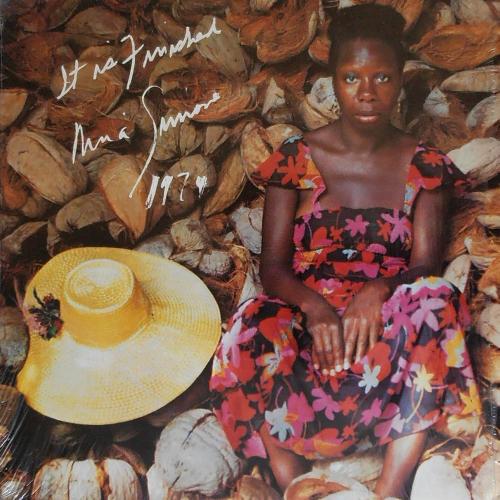
What would do justice to Nina in a special (if belated) anniversary post? First, recalling to mind, once again, her most troubling and indeed thoroughly haunting LP cover, viz. that of her last RCA album released in 1974 (but recorded in '73). And it's not the title (It Is Finished), for all its sinister undertone, that I find most disturbing. It is rather the way she poses and stares right in your eyes: innocent yet menacing, stubborn yet weak, resigned yet provocative, gloomy yet radiant with inner strength, human yet strangely outworldly, in a colorful summer garb with a bright straw hat yet sitting among dried-out and dis- carded coconut shells as if before a heap of skulls. I don't know why but the whole composition strikes me as Van-Goghesque for the importance it gives to color over matter and for the fact of how the simplicity of shapes and expression lays bare the underlying complexity of sentiment and life.
Second, the LP that comes under this cover is a string of masterpieces from the beginning to the end. But there is one song in particular which translates the visual art of the cover shot into a magical sound experience. The song is called Dambala (after a Voodoo deity; the song was written and first performed by Bahamas-born musician Exuma in 1970). I personally feel that this song comes nearest to summing up Nina's being (if that were ever possible). And it shows her, by the way, as the great great pianist she was. And a lot things more. Thanks for everything, Nina! Nina Simone: »Dambala« from the RCA LP It Is Finished (1974):
Recently there were musings in the blogosphere about the possible connections between acquiring a taste for a certain singer and the gustatory sensation created by high-quality (and, incidentally, high percentage) brewings (read more here). I've been thinking a little bit further along these lines and was hit, while doing so, by the following ad, published in the December 1967 issue of Ebony magazine:
At first, I tried to submit the message of this ad to the ongoing state of my reflec- tions about the subject outlined above ... but I didn't find it helpful after all. While the first note and you know it's Nina is most certainly true (and the first sip and you know it's Champale might be as well, even in the negative and not intended sense!), I can't bring myself to see any connection between Nina and the advertised bever- age except one of complete antagonism: Champale is sort of a beer made to look like wine and tasting like neither of them; to dazzle the customer it is sold in a champagne-like bottle. Nina, on the contrary, is the original songstress of the 20th century, not a mixture of anything, never appearing differently from what she is, and certainly not sold in a deceiving package. I guess she's the very opposite of everything Champale evokes in my mind. (I can add, for the sake of pedantry, that the ad shown above is missing from the Champale advertisement webpage.)
So this thread leads nowhere, really. At least not as long as I don't switch to thinking about which beverage makes for the most unlikely comparison with a singer's art and being. Which maybe, only maybe, could be the winning strategy in the case of Nina, for she can't be compared with anyone or anything! So like in modern theologi- cal reflection about God, which for want of applicable affirmative terms ended up as a negative theology (being only able to say what God is not), we might, in Nina's (less than divine but still out-of-this-world) case appreciate the idea of a wholly negative admiration by affirming what she is not. To conclude this, she certainly isn't anything like Champale.
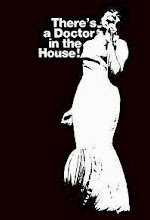
But of course Nina had her own negative theology! And this is brought out in perfection by Nina's medley of George Harrison's (well, sort of) »My Sweet Lord« and her adaption of David Nelson's poem »Today (Is A Killer)«. The piece fills the entire side 1 of her LP Emer- gency Ward! (RCA # LSP-4757, out in Oct. '72). It was recorded live in concert, the exact locality and date are unknown (at least to me); the choir you hear in the recording is the Bethany Baptist Church Junior Choir of South Jamaica, New York. The entire medley being too long to be played here in full, you can hear an extract of about half its length, basically the centre piece:
Nina Simone: »My Sweet Lord« / »Today Is A Killer« (extract !) from the RCA LP # 4757 (1972):
His greatest victory is the humility he was strong enough to learn and share in the second part of his life. This makes him a hero if ever there was one.
Today's tribute song »Boxer« comes from Carolyn Franklin. The song was the A-side of her first 45-release (which didn't chart) and then featured on her first LP, Baby Dynamite! (released in May 1969).
Carolyn Franklin: »Boxer« from the RCA LP # LSP-4160 (1969):
I was travelling lately (and leaving this blog somewhat orphaned), but apart from being a professional necessity it also went along well with some sidekick hobbies of mine. When in Vienna recently, I went to one of the most furnished shops for classical music on CD which is situated not far from the State Opera. I left the shop with a brandnew 12 CD box released by SonyClassical. (It's actually not yet out in the US and seems to be released solely in the UK so far). I'm speaking of The Complete Collection of Song and Spiritual Albums by Leontyne Price. For as little as $35 you get here the re-issues of 9 RCA LPs, originally released bet- ween 1955 and 1974 plus 3 CDs from the '90s (including older recordings).
Leontyne Price, May 1958
Most of the albums contained in this CD box cover classical material, mainly Kunstlieder (by Richard Strauss, Robert Schumann, Samuel Barber, Gabriel Fauré, Hugo Wolf and others) and several opera arias; two of the LPs are live recitals from Carnegie Hall. However, three CDs are re-issues of Price's spiritual albums released between 1962 and 1971, and it's to those that I would like to draw your attention. Said albums are:
Swing Low, Sweet Chariot: Fourteen Spirituals (RCA LP # 2600), 14 songs recorded at Manhattan Center NYC, Dec. 1961, and released in August 1962.
My Favorite Hymns (RCA LP # 2918), 12 songs recorded at Calvary Episcopal Church NYC, April 1966, and released in November 1966.
I Wish I Knew How It Would Feel To Be Free (RCA LP # LSC-3183), 15 songs recorded at RCA Studio A Nashville, April 1970, and released in January 1971.
Moreover, the Carnegie Recitals recorded in 1965 and 1996 comprise several gospel songs as well, e.g. »This Little Light Of Mine«, »He's Got The Whole World In His Hands« and »Right On, King Jesus«.
Leontyne Price (oil on canvas by Bradley Phillips,
National Portrait Gallery, 1963)
Each of these Sacred Albums is interesting in its own right. The first, Swing Low Sweet Chariot, was recorded when Price's career was about to reach global fame. The cover is graced by one of the portrait paintings which were done of Leontyne Price in the early '60s (see below), and in the liner notes (written by Price) we read: »I have chosen in this album some of the songs dearest to my heart and to those of my parents and friends back home. I remember hearing and singing some of them as a child either in church, sometimes at school, and very often from my mother, who sang or hum- med them as she did her work around the house.« Yet the songs as you hear them on this LP are very far from any downhome style; on the contrary, the lush arrange- ments transformed them into symphonic pieces of operatic gospel arias deluxe: dramatic horns and strings, a Verdi-like wall-of-sound, the entire package.
The songs on the second album, My Favorits Hymns, are much closer to a, well, churchy style of the dignified, hymnic kind. There is a large boys choir, and a stately organ dominates the musical hue. The third album finally, I Wish I Knew How It Would Feel To Be Free, is still entirely different. There is some Odetta-feel to the songs here, much simplicity and downhome purity. And we now have a clear political message as well. To tell you the truth, I prefer the last album above the others.
Now, as we are speaking about a recent release available on CD, I cannot play entire songs here. What I can do is provide sort of a teaser of what you may expect if buying this CD box. So you can hear in the following 50-second-extracts from three songs, each one taken from one of the Spiritual albums: »My Soul's Been Anchored In De Lord« (1962), »What A Friend We Have In Jesus« (1966) and »I Wish I Knew How It Would Feel To Be Free« (1971):
Welcome back to my little (hi)story of the Sweet Inspirations! We have reached the third part ... and are still far away from the actual story of the Inspirations, that is, the Inspirations as they became known to the world from 1967 onwards. But as their history is deep-rooted, there is history before history here. And the story I am continuing here does concern one member of the Inspirations-to-be, namely Emily »Cissy« Drinkard, better known as Cissy Houston (and mother of Whitney).
RCA Victor # LPM 1856 (1958)
I am sorry to say that also today we won't proceed much and the story of the Inspirations will cover many future installments. The reason for that is that today's post features, again, the Drinkard Singers. There is little else to tell you apart from what I said in another post, so you've got to look it up there. But the Drinkards well merit a second post. Last time you could hear them as recorded at the 1957 Newport Jazz Festival. As the story goes, their performance impressed RCA's Herman Diaz Jr. enough to offer them a contract. In April 1958, the Drinkards thus recorded the first studio album of their own. It was given the (from an outsider's perspective) slightly disturbing title »A Joyful Noise«; on the other hand, the term »joyful noise« was (and still is) a common metaphor for sacred music and thus more than fitting. In addition, the LP was graced with a joyous cover: You can see the whole group in action and full attire, with Judy Guions (who sang lead on most songs) up front. (Cissy Drinkard [Houston] is second from left.)
It is a very accomplished gospel album, though, and somehow you feel that here is a family singing. The LP, released in November '58, received a benevolent, if as usual generic-sounding, review in Billboard (Nov. 24, p. 30): The Drinkards are seven - five fems [!] and two men, who know their way around gospel material ... wonder- ful selections, all of which are offered with great zest, verve and devotion. Judy Guions takes the driving lead in many cases and she's highly effective. ... A fine entry for the market. (A nice example of Billboard-prose!) However, in general this is correct, and Judy Guions deserved to be singled out.
More interesting, and to the point, is what we are offered on the back cover of the album. The back cover notes were written by Joe Bostic who had taken the Drinkards under his wing, mainly at the instigation of Mahalia Jackson; Bostic was at the time (i.e. in 1958) gospel music director of WEVD radio and WNTA-TV, New York. Here is the gist of what he wrote for the RCA album:
The seven singers and musicians who comprise the Drinkard Singers are, with one exception, all brothers and sisters. The exception is hard-driving Judy Guions, the youngest member of the troupe. Judy is the adopted daughter of Lee Warrick, oldest sister and leader of the group.
The hallmark of this exceptional singing ensemble is tremendous power and drive coupled with infectious, bouncy rhythmic ideas. The group's versa- tility enables it to sing many types of songs, but their forte is novel arrange- ments of standard spirituals. ...
In gospel music circles the Drinkard Singers are recognized as "singers' singers." Although they live all in Newark, New Jersey and are products of that city's Southside High School, their deep feeling for folk music and their religious conviction can be traced to their family heritage. ... The Drinkard Singers enjoyed a modest popularity in their New Jersey environs, until they were discovered by the great Mahalia Jackson when she heard them on a small Newark radio station. Miss Jackson immediately brought them to my attention and I promptly engaged them as regular fixtures of my weekly TV gospel show. They were later presented at Carnegie Hall along with Miss Jackson, and it was at her suggestion that the Drinkards were invited to participate at the 1957 music festival in Newport. Their instantaneous suc- cess at the festival resulted in their being signed on the spot by Herman Diaz, Jr., for RCA Victor. This album is the outcome of that action and Mahalia Jackson's continuing co-sponsorship.
The songs were recorded in Webster Hall, NYC, April 1958. And Bostic was right in many a respect: The songs on this album are infectious and well-arranged, and the Drinkards certainly are versatile. Therefore it was hard to select two songs from this album. In the end I opted for two spirituals. The first, »One Day«, because it is unknown to me except from this LP. There are other tunes called »One Day« but they are not identical with the song the Drinkards recorded as far as I could establish; also the lyrics are plainly different. I am grateful to any of you for more information about this song. I chose the second song, »After It's All Over«, because it shows most clearly how the Drinkard Singers were able to render known standards in a fresh way and make these songs their own. This second tune was composed by Alex Bradford in 1953 and recorded by several other known gospel groups, e.g. the Roberta Martin Singers. The Drinkard Singers, in any case, did a great job with both songs! Listen here:
The Drinkard Singers: »One Day« / »After It's All Over« from the RCA LP »A Joyful Noise« (1958):
I am interested in the music, not in the relative rarity of discs. I also listen with great pleasure to Aretha Franklin, because she has the voice of the century. Music is no Faith and therefore has no heretics.
* * *
No music downloads on this site. All mp3s (with very few exceptions where noted) are ripped from original vinyl discs. If something on this blog is objectionable to anyone or should, for valid reasons, be re- moved from the net please let me know; it will be removed. And to reiterate: This is a non-profit blog.