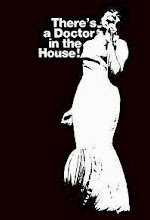
On the day 45 years ago, The Supremes Live at the Talk of the Town was aired tonight on British TV. The post-Flo Supremes had opened in London's Talk of the Town on January 22, 1968. It was part of a tour through Europe (not their first) which took them to Cannes, Paris, Milan, Hamburg, Amster- dam, Stockholm and, well, London. After their 22 January concert, Diana Ross, Mary Wilson and Cindy Birdsong (not in the photo) were immortalized by a press photographer when Paul McCartney showed up and said hi (... and fittingly the #1 pop song in January 1968 was the Beatles's »Hello Goodbye«!); you can find a larger version of this pic in the February 10 issue of Billboard.
Now, let's pause for a moment and think what was going on in the heads of the persons on the photo. The Supremes had, just before they departed for Europe, stayed in sunny Mexico to deliver their pathetic contribution to an episode of Ron Ely's Tarzan. The episode in question was called The Convert and was aired in the US on January 12, 1968; you can watch it on YouTube. In that episode, the Supremes appear as three nuns and merrily chant a few churchy tunes, e.g. »Michael Row The Boat Ashore«; their boat capsizes because their singing irritates a touchy hippo (can't blame it) and all three are getting a jungle bath before being valiantly rescued by Tarzan. They then act their lordly way through the dire episode to conclude it with shouts of Hallelujah and a lot of hand-clapping.
Motown's admittedly clever publicity idea to insert the Supremes, whose record sales were slacking in late 1967, in a noted TV series was deemed interesting enough to warrant a fully-fledged coverage of their »Swinging Dramatic TV Acting Debut« in JET (issue of January 18, 1968, p. 60 ff.). The JET piece came with a centerfold pic of the Supremes »cooling off ... after a hot day's work in the jungle« (see it here), and there were also a number of pics showing the nuns from Detroit at work ...
(From JET, January 18, 1968, issue, p. 60)
The unlikely nuns then exchanged their modest attire for sequined dresses, flashy elbow gloves and tippy heels, boarded a plane and eventually run into Paul McCartney, or vice versa. What mood was he in? Well, right on 22 January, the new Apple office had opened in London, ushering in the last phase of the Beatles epic. Spiritually, he may have been preparing for his imminent trip to India where he was to study Transcendental Meditation (from mid-February onwards); eventually, he became bored and returned home, although he later claimed that TM »has helped him personally« (see quote here). Before he boarded his plane, he had taken part in shooting a small part for the Yellow Submarine movie and also recorded »Lady Madonna«.
Motown LP # MS 676 (08/1968)
The Supremes meeting Paul McCartney were thus a truly bizarre match. Let's hope that Paul, who reportedly attended the Talk of the Town concert of the Supremes before meeting them afterwards, was too distracted by the Apple launch and the India follies of his buddies to listen closely to what the Detroit ladies were offering on stage. However, Berry Gordy saw to it that the public was, in August 1968, endowed with a live LP which brought the musical enrichment of the British Isles as enacted by the Supremes into the home of unfortunate record buyers. In any case, the LP is one of the best live recordings to come out of Motown, although the measuring standards are poor. Diana and the Supremes did what they could best: trying to make forget the public by their lively appearance that vocal art was an alien concept to their lead singer. Unfortunately this strategy doesn't work on vinyl.
But London survived the Supremes, I guess. And there is still much talk of the town going on there, after all. The Supremes, first medley from the Motown LP # MS 676 (1968):
Dear friends of this blog, I've been ill for a week or so and am right now about to recover. Of course these things happen to you when you least need them, e.g. in the week between Xmas and New Year's Eve. Did some cursin'.
Motown (CAN) LP # M 832V1 (1975)
Luckily I pulled myself together just in time to prepare this year's last blog post. Since some time now I've had in mind that the 31st of December needs something funky, and not just funky but F-U-N-K-Y ! And here one of JB's funky divas enters the stage: Yvonne Fair. in 1974, she recorded a handful of gritty funk tunes every one of which is a true ear bone shatterer. By 1974, Yvonne had been in the business since a long time. From 1963 onwards she was part of the James Brown Revue, and in 1965 she gave birth to JB's daughter Venisha. In the later '60s, Chuck Jackson brought her to Motown, but her first (and only) album only appeared in late spring 1975. Before that she regularly performed as an opening act for the likes of Stevie Wonder and Marvin Gaye until in June '74 her first solo single (on the Motown label) hit the Soul charts. That first made her name known to a larger public and she was now noticed by JET: ... a honey peach of a girl ... she may look like an overnight hit, but she has been working and waiting for this break more than 10 years (August 1 issue, p. 60).
In '74 and early '75, Motown released three 45s of Yvonne Fair, and all the sides are included in her LP. These are actually the funky tunes on this album, while most others are in the ballad- ish vein (»It Should Have Been Me«); there's also a nice version of »I Know (You Don't Love Me No More)«. The aggressively sexist (yet intended anti-sexist) bitch concept of her fabulous album stands in a row of similar LPs of black female r&b singers in the post-Pam Grier era, culminating in Denise LaSalle's infamous The Bitch Is Bad album in 1977.
So let's move on to Yvonne's funky sides, one or two more than usual in this blog. But that's fine for today. The tracks are ripped from the LP but they were originally released on her three (and only) Motown 45s. Real killer-tunes! The latter two are probably well-known to most of you, the first two maybe not so. Happy New Year Y'all!
Yvonne Fair: »Love Ain't No Toy« / »Walk Out The Door If You Wanna« from the LP The Bitch Is Black (1975):
»Let Your Hair Down« / »Funky Music Sho Nuff Turns Me On« from the LP The Bitch Is Black (1975):
* * *
In case your head is clear tomorrow and you'd like to read more about Yvonne Fair, you can go here (in Italian) and here (in French).
... ehm, well, today with another slummy piece of »did-they-really-print-that?«-Billboard prose. It comes from the issue of April 17, 1961, page 2. Responsible for this »if-it's-not-satire-then-what-is-it?«-gem of musical writing
was columnist and Billboard associate editor Ren Grevatt:
To tell the truth, I have no idea of what he meant. Is there a racist slant in it? ... you couldn't even call it a mere slant if it were true, though. WTF is he trying to say?
Is there some innocouos joke I didn't get? From the rest of his article it becomes clear that he didn't like »chick artists«. (Due to Freudian aberration and assonance
I was about to type »he didn't lick chick artists«, but that might be quite wrong.) There are several »chicks« mentioned by name, so who are the »sickly variety« among them? What a shit!
However, in the continuation of the same article, on page 35, there is another remarkable passage which I'd like to share with you. Grevatt (who seems to have been obsessed with that argument) writes:
For a long time now, many rocking pop discs have been noted for what has been called the "yeah yeah" girl's chorus chant, usually backing up a male vocal. This has also been called the hormonal sound.
Hmm. Hormonal sound. Finely said, I should remember it.
Mary Wells is among those mentioned by our brave »hey-I'm-funny-why's-nobody-laughing?«-Billboard staff writer. Truly funny thing is that hers was a female voice backed up by a male chorus chant. Call that a hormonal sound. And she gives it right back at him:
Mary Wells: »Laughing Boy« from the Motown LP # 611 (Recorded Live On Stage) (1963):
I am interested in the music, not in the relative rarity of discs. I also listen with great pleasure to Aretha Franklin, because she has the voice of the century. Music is no Faith and therefore has no heretics.
* * *
No music downloads on this site. All mp3s (with very few exceptions where noted) are ripped from original vinyl discs. If something on this blog is objectionable to anyone or should, for valid reasons, be re- moved from the net please let me know; it will be removed. And to reiterate: This is a non-profit blog.