Last Thursday, actually Nina Simone's 80th birthday, I tossed about in my sweaty bed, driven from one edge of the frame to the other by feverish dreams, when damp showers and drizzling snow finally had knocked my immune defenses down (There more so as I just had returned from a 6-days trip to Rome). Friday seemed better, but the weekend had me down again. Now, over those last days I had ample occa-
sion to meditate whether it would still make sense to post something in honor of Nina Simone ... and this in turn led me to think about the value of anni- versaries in general. My conclusion was that Nina really doesn't need any special remembrance. As she is present in the hearts and minds of so many, one day is as good as any other. So today be it.
I don't remember where I read that somebody characterized Nina Simone as »undefinable«. It sounds like a non-description, as something said for want of better terms, but if you think about it for a second or two it might just turn out to be the greatest compliment any artist could ever hope to receive. (For my part, I tried to come up, before my inner eye, with artists I wouldn't know how to define for their sheer breadth of achievement and talent, and I couldn't come up with more than a handful.)
(Click to enlarge)
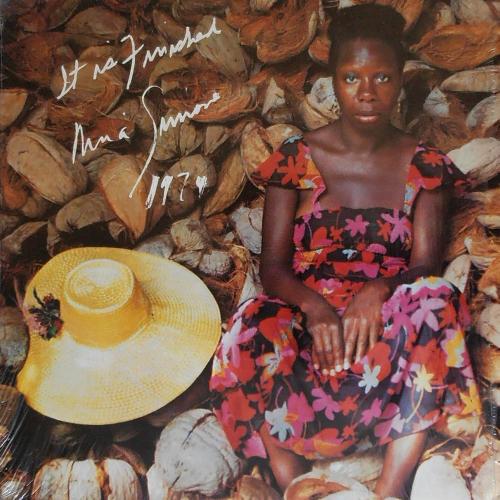
What would do justice to Nina in a special (if belated) anniversary post? First, recalling to mind, once again, her most troubling and indeed thoroughly haunting LP cover, viz. that of her last RCA album released in 1974 (but recorded in '73). And it's not the title (It Is Finished), for all its sinister undertone, that I find most disturbing. It is rather the way she poses and stares right in your eyes: innocent yet menacing, stubborn yet weak, resigned yet provocative, gloomy yet radiant with inner strength, human yet strangely outworldly, in a colorful summer garb with a bright straw hat yet sitting among dried-out and dis- carded coconut shells as if before a heap of skulls. I don't know why but the whole composition strikes me as Van-Goghesque for the importance it gives to color over matter and for the fact of how the simplicity of shapes and expression lays bare the underlying complexity of sentiment and life.
Second, the LP that comes under this cover is a string of masterpieces from the beginning to the end. But there is one song in particular which translates the visual art of the cover shot into a magical sound experience. The song is called Dambala (after a Voodoo deity; the song was written and first performed by Bahamas-born musician Exuma in 1970). I personally feel that this song comes nearest to summing up Nina's being (if that were ever possible). And it shows her, by the way, as the great great pianist she was. And a lot things more. Thanks for everything, Nina! Nina Simone: »Dambala« from the RCA LP It Is Finished (1974):
Several weeks ago I started playing songs by the marvelous Sister Lucille Pope, and you'll find information about her (if needed) and further links in a November post. I'm happy to continue today honoring her music because she's just so plain great a singer! After she and the Pearly Gates left Chess, they started to record for Nash- boro and this produced in 1974 a remarkable album, Our Silver Anniversary (Nash- boro LP # 7140) (look over at Red Kelly's Holy Ghost blogspot for a very personal appreciation of that album). Two songs from that LP were released as a single, on Nashboro # 1008, »99½ Won't Do« and »Somebody's Gone«. The first song, a well- known traditional, comes along in Lucille Pope's soulful version with much r&b feel, and her space-filling voice renders this version truly particular. The tune on the B-side is a sad song, kind of ballad-like, and not really a spiritual. It got a very personal message and speaks about the experience of loss and solitude ... here is someone speaking while looking back at life and the people once around. As such, the song reminds me much of what Gladys McFadden (of the Loving Sisters) was recording around the same time ... Happy Sunday all!
For the record: The songs were produced (and this means also arranged) by Shannon Williams of Nashboro and recorded at Nashville's Woodland Studios. And let's not forget to mention that the band is up to Lucille Pope's great performance!
The right thing to do on a day like this (I'm busy!!) is to play two songs about which, unfortunately, I can't tell you much. I'm speaking of »Help Me Lift Jesus« and »Heaven Knows I Tried« as recorded by »Rev. J.T. Bell & The Soul Shouting Weeks Sisters of Mullins, S.C.« (according to the billing on the label) and released on HSE # 443, sometime in or around 1974. The label of the HSE single also states that the songs were recorded at Jadel Studios in Marion, S.C. (10 miles from Mullins); sister Nancy Hamilton is credited with the arrangements & lead vocals. Rev. Bell, contrary to the billing, has only some shouting parts on both sides, with the actual singing being done by Nancy Hamilton & the Weeks Sisters.
The Weeks Sisters appear on later HSE releases (and LP covers) as »Week Sisters« (e.g. on HSE # 466 or on the covers of HSE LPs # 1491 and # 1513). About the latter LP (they did three in all with HSE) you'll find some information over at Just Moving On; there's also a list of the group's personnel. There's something about the Week Sisters on the Get On Down ... blogspot, and the B-side of HSE #443 (»Heaven Knows I Tried«) appears in a WFMU playlist from earlier that year. And I love that B-side! A pity only that the recording (and pressing?) quality of the HSE single is poor ... and my copy of it is in a very good general condition.
Rev. J.T. Bell & The Soul Shouting Weeks Sisters of Mullins, S.C.:
»Help Me Lift Jesus« / »Heaven Knows I Tried« on HSE # 443 (c.1974?):
I was almost blind and deaf for a few days. Thanks God not literally, but near so. Thing is, my computer had been bucking since Sunday, then spasmodic- ally refused normal service during the following days and finally was down on Thursday. It was a shocking exper- ience. Not much damage was done, because I was prepared and had all the important stuff secured on other devices and HDs. But shocking was the experience of being cut off from the world - and not only from the world, but from most of your music, your photos and what not. It's like somebody robbed your home. However, I got back to normal now and a known Japanese company pocketed some of my hard-earned money.
* * *
Actually, this blog calls for a little celebration today, this being the 100th post. I won't celebrate much, though, just a little. (I'm still recovering, after all.) So there are two v e r y s e n s u a l songs for a Saturday night ... for one, Mary Love's hot close-mover from 1966 (released in May or early June). »Move A Little Closer«, in fact only the B-side of Modern # 1020, took her to #48 r&b in August '66 and since then many (predominantly male?) listeners to rapture. Mary Love Comer has for- saken the secular music business in 1986 and became an evangelist (see her webpage here). For all I know she's not happy with some songs she recorded back in the '60s, particularly this one. (That's what I heard, anyway.) On the other hand, it was included on a number of more or less recent samplers and, more importantly,
on Mary Love's authorized »anthology«, the Kent CD Now And Then from 1994.
The second song is Etta James's version of Randy Newman's 1969 tune »Let's Burn Down The Cornfield«, taken from her wonderful 1974 Chess LP (fittingly entitled Come A Little Closer ... a nice coincidence!). Nobody has ever figured out what the song's really about, but physical contact between lovers does play an important part. And Etta James's »sultry« version (Billboard's words, not mine, but I agree) doesn't leave any doubt as to that.
Mary Love: »Move A Little Closer« on Modern # 1020 (1966) /
Etta James: »Let's Burn Down The Cornfield« from the Chess LP # CH 60029 (1974):
Remember Al Bundy's motto »Sunday Funday«? Well, I can't say that of today, unfortunately. Sky's grey, climate's goin' wild and my nose's runnin'. So what about today's post? I try to make the best of it.
United Artists LP # UA-LA203-G (1974)
I'd like to speak about an album that left me puzzled. Its title is »The Gospel According to Ike And Tina«. What Gospel could that possibly be? one might ask. Somebody on the net put it thus: »Tina Turner singing Gospel music?!!!« Very tricky question, this one. A tentative answer must come in two parts.
First: We cannot judge the religious senti- ment of individuals. On the face of it, Ike (son of a Baptist minister) certainly didn't come across as a model believer, and looking at how he behaved towards others (and towards Tina in particular) must leave us sceptical of whether he had understood even the most basic precepts of Christian teaching. However, it might be objected that he was too weak a person to live a righteous life, and it has been correctly remarked that God doesn't love sin but he still loves the sinner. So be it, and let's leave it that for Ike is no longer among us. Judgment is pending.
And Tina? She's a hard one, too. As a child she grew up in a Baptist and Pente- costal context. The services of the latter she found »more exciting«, but she didn't really connect to the worship. »I knew I could never be part of that religion« she said. »But for a little girl, those sanctified services were something to see« (quoted in her autobiography I, Tina, p. 17). She was impressed by the music and dancing that was going on, yet later in life she also said that she was really singing »Baptist and blues«. During her '60s career, there were little, if any, signs of outward affil- iation to any church. And as she was more and more criticized for her too blatantly sexy and provocative stage appearance towards the end of the decade acceptance of her person in church circles was nil. Her private life was always troubled, though, and Tina was later to state: »I had always held on to the Bible and the things I'd learned as a little girl ... And I prayed every night, you can believe that« (I, Tina, p. 171). Then, famously, she got introduced to Nichiren Buddhism, and although it is impossible to say exactly when it must have happened sometime around the time Ike & Tina recorded their gospel-album (in October-November 1973), possibly even before that. Officially (or semi-officially) she's been counted a Buddhist since 1975.
And another point worth considering: Does it need religious convictions to sing gospel? Or even to like gospel as music? Is it something intrinsically Christian, closed to other religious approaches, or to non-religious-minded people for that matter? Another tricky question that will get many answers according to whom you ask. I leave it open but would, in any case, not favor any answer that starts with a categorical yes or no. However, leaving this question open leads us conveniently on to the second part.
* * *
Second: In 1974, the boom of everything that could be labeled »soul-gospel« or even »pop-gospel« was at its very height. Myriads of acts, from both the gospel and secular fields, ventured into this realm, and a large group of former »secular« soul singers, having lost both the public and most of the independent record companies in the early '70s, went gospel. In token that this development did not pass unnoticed by the music industry, the Grammy Academy was handing out awards in the category »Best Soul Gospel Performance« since 1969 (Ike & Tina's 1974 album was shortlisted for this Award but didn't win it), and Billboard adopted the category »Soul Gospel« in autumn 1973. Aretha Franklin's return to Gospel in 1972 was of momentous importance, and many others, not the least among them the Staple Singers and Andrae Crouch, had prepared this trend. Nina Simone, who was, I believe, sincere to the bone and never did something with the exclusive aim of pleasing either the public or her label, released »The Gospel According To Nina Simone« (Stroud LP # 1006) in 1973. Then, when the soul gospel train was rollin', Ike & Tina jumped on it, a little belatedly, in 1974.
This, at least, is the less sympathetic interpretation of why they recorded a gospel album. Given that during these years they struggled hard but (with the exception of »Nutbush City Limits«) mostly in vain to put their name back on the charts it seemed a good idea to switch to soul gospel for a change. In a kinder mood, however, we could equally conclude that at this point in their checkered career the duo was ripe for gospel. Tina certainly was, in a sense. After all, I am still puzzled of what lies behind that album, really.
* * *
Let's talk about the LP and the music. The album was hyped by United Artists with a fullpage-ad in Billboard (May 25, 1974). The accompanying text does suggest that Ike & Tina were playing around with some gospel tunes in the studio, then realized how »uplifting and exciting« it was and finally went about producing this album. Well, I'm not convinced. And much of my credulity is shattered by what we find at the bottom of the ad: »Been to church lately?« What a stupid slogan: Congrats to the promotion & sales guy at UA for having come up with this! Certainly he hadn't, lately.
Then let's have a look at what the Billboard critic had to say about this album:
»... this gospel LP is a strong and successful attempt to bring the commercial world of soul music to the church. Not the church to soul music as is usually the case. The weakest point in the LP is Ike's vocalizings. Otherwise the pro- duct makes lots of sense for all the energy and urgency of the Turner's music is aptly put to use on this their first LP of gospel tunes. There is enough church choir sounds behind the instruments ot take us all on a religious trip.« (April 27, 1974, page 53).
This critic must have been a close relative of the UA sales manager. Apart from that I don't get the point fully of what he meant by bringing soul to church and not vice versa, he felt enough uplifted by what he had heard to get the swoop of a religious trip. That it had little to do with traditional religion, however, was not lost on him as becomes clear from his final advice for record dealers: »This is commercial, not pure gospel, so it can be stocked with the Turner's other soul products.« What sort of reasoning is this? It seems that the reviewer was, after all, aware that this wasn't a LP a record dealer would like to put under the eyes of the gospel buying public. And what does it tell us about the reviewer's religious trip? Was it to be a »commercial« one, not »pure gospel«? Ike could have given him some useful advice for that!
* * *
As to the music, yes, Ike's singing is pitiful. He just hadn't a voice for it and should probably never have attempted it. Of his three songs, »Father Alone« (the opening song) stands out as the most miserable performance, as he clumsily talks his deep voice through to the final bar. Two songs, »Amazing Grace« and »When The Saints Go Marching In«, are duets of Ike & Tina. The remaining five songs featuring Tina (& the Ikettes) alone are much better, as Tina never did something really bad. However, to me she sounds very professional and it's not easy to tell how much she was into it. On the stylistic side, the entire LP repeats the by then well-known formula of heavily synthesized uptempo funkrock as we know it from Ike & Tina's preceding LPs »Let Me Touch Your Mind« and »Nutbush City Limits«. To be truthful, I have become somewhat bored of that sound which, with too sparse variation, tends to become easily tedious (what might be called the James-Brown-effect ... no offense!). It bores me, up to a point, throughout the entire album. And historical hindsight helps us to see that Ike & Tina were near the end of their common way. They did not, as is known, part on musical grounds. It finished in 1976 when Tina, with blood on her clothes and sunglasses to cover her swollen eyes, presented herself at the reception of the Dallas Ramada Inn and pleaded for a room, although she hadn't any money to pay for it. But it did also finish because, musically, they were stuck. Blame for this most often went to Ike who wasn't a 100% gifted composer anyway and towards '74 finally run out of his creative wits.
Solid cuts on this gospel album, featuring Tina, are »Walk With Me Lord«, »Nearer The Cross« and »Our Lord Will Make A Way«. You can hear them in the following. My personal favorite is »Our Lord Will Make A Way«, the very epitome of a synthesized-funk-soul-gospel tune, Turner style. Happy Funday!
Ike & Tina Turner and feat. The Ikettes: »Nearer The Cross« / »Our Lord Will Make A Way«
from the United Artists LP »The Gospel According To Ike And Tina« (1974):
Today with a superb, rare album from summer 1974 ... The Sisters And Their Sons ... that is, The Loving Sisters from Arkansas together with their offspring:
ABC-Dunhill / Peacock LP # PLP-59204 (1974)
The Loving Sisters are Gladys McFadden, Loraine (sic) Leeks, Josephine Dumas and Ann James (all called »Williams« originally), accompanied on this LP by their respective sons George Williams, Larry James and Leonard Givens (the spelling of the names according to the back cover; there are different spellings around in other sources!). Gladys McFadden was the driving power behind the Loving Sisters: She not only produced this album, but also sings lead and wrote all the songs. You can find her on Facebook.
**Update May 2012:Read more about the members, the family and the early history of the Loving Sisters here. **
The first song which you can hear in the following is inspired by Psalm 34:4 (»I sought the LORD, and He heard me, and delivered me from all my fears«). It is a very beautiful tune, and the lead-voice of Gladys McFadden blends nicely with the accompa- nying voices. This does create a certain call-and-response-effect, even though the song is no call-and-response-song in the proper sense ...: »I Sought The Lord«. This song was in its time also released as single (ABC-Peacock # 20005):
The Loving Sisters (feat. Gladys McFadden): »I Sought The Lord« from the ABC-Peacock LP 59204 (1974):
Who knows the Loving Sisters, nowadays? Yet they already had a long history, back in 1974: Founded in the 1950s by Gladys Givens McFadden, the group first played locally in Arkansas. In 1962 they were given a recording contract by Dan Robey, president of Peacock. During the Civil-Rights-struggle the Loving Sisters were active in and around Little Rock, stood on stage together with Martin Luther King Jr. and toured with C.L. Franklin (Aretha's father). There is a (unfortunately rather low-quality) video of one of their shows on Youtube.
In the 1970s, the Loving Sisters became known for their »soul-gospel«, the like of which you can hear on this album. Gladys McFadden said:
»I wrote almost everything that we ever sang ... A lot of what I wrote would fit into today's music. It had a rock flavour, but the words were gospel. We wrote according to our environment, but ABC didn't really know what to do with a gospel artist. ... People are still trying to find our music. (quoted in Bil Carpenter, Uncloudy Days, p. 258)«
Without doubt their 1974 album is as good as anything that was released in the fields of gospel and soul during the 1970s! And this brings us to the highlight of the LP: »I Can't Feel At Home« - funky, soulful, bluesy ...! In contrast to the song you could hear before Gladys McFadden is in this tune accompanied only by male voices. But this was just the right decision for this truly hypnotic groove song:
Gladys McFadden & The Loving Sisters's Sons: »I Can't Feel At Home« from the ABC-Peacock LP 59204:
* * *
BILLBOARD, July 6, 1974, p. 49
* * *
Late-night Postscript: Arkansasonline published on May 13, 2010, a long and detailed article about the Loving Sisters and the achievement of Gladys McFadden. For our purposes, the following passages are relevant:
Signed by Peacock Records in the early 1960s, the women recorded 10 albums and garnered a Grammy nomination over the years. They performed across the nation. They marched with Martin Luther King Jr. “We would always sing. We would march on the front lines,” McFadden recalls. “We were young and courageous, fearless and all those things.” The Loving Sisters sizzled on stage, singing about the Lord like sanctified Supremes. “I think to my taste, the Loving Sisters were the last great group of the golden age” of gospel music, says Anthony Heilbut, author of The Gospel Sound.
McFadden wrote much of their music and took charge during concerts. “She was so scrappy. Such a nice little fighter on the floor,” Heilbut recalls. “She would sing, she would preach, she would croon. She’d go up and down the aisles. She’s very graceful.” The records are hard to come by these days, although copies pop up on eBay from time to time. McFadden says she’s lost all but one of her 10 albums; a friend borrowed the LPs and then lost them, she explained.
Carpenter says McFadden and the Loving Sisters are some of the pioneers of gospel music who deserve to be remembered and honored. “They’ve gone through a whole lot in their career but haven’t received the recognition they deserved,” he said. “They laid the foundation for today’s gospel stars.”
I am interested in the music, not in the relative rarity of discs. I also listen with great pleasure to Aretha Franklin, because she has the voice of the century. Music is no Faith and therefore has no heretics.
* * *
No music downloads on this site. All mp3s (with very few exceptions where noted) are ripped from original vinyl discs. If something on this blog is objectionable to anyone or should, for valid reasons, be re- moved from the net please let me know; it will be removed. And to reiterate: This is a non-profit blog.