... tonight, I updated some older posts (one of them substantially) because I came across new material that couldn't be ignored. So there is no time left to write anything new ... to make the best of it, I simply post one of those songs which, many years ago, opened my way into the soul universe. It has remained one of my favorite songs and I still consider it one of the greatest tunes ever recorded. And as with many of O.V. Wright's songs, it has memorable lyrics ... just think of »if I get lonely, I can spin the nickel – th'nail won't spin« ... has there ever been said some- thing remotely comparable to express utter destitution? ... from 1971 O.V. Wright: »A Nickel And A Nail« on Back Beat #622A (1971):
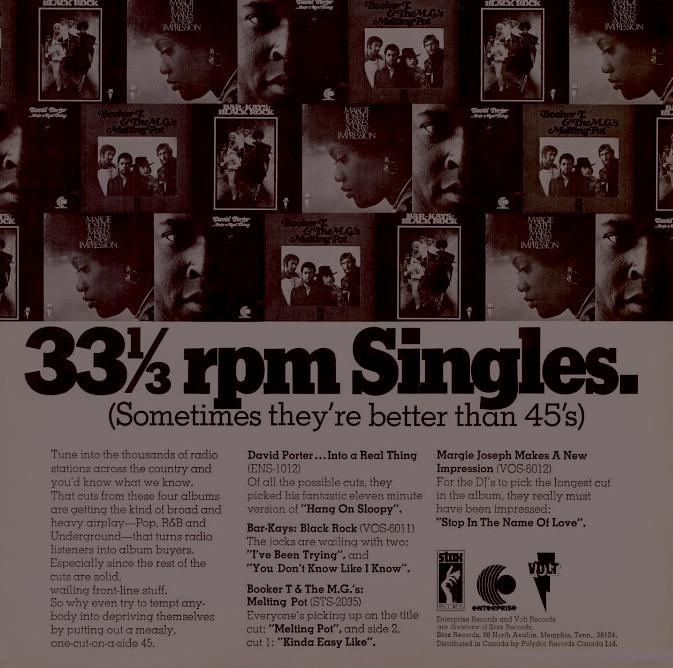
Margie Joseph's earliest recordings were done at the Muscle Shoals Sound Studio in 1967 and resulted in two OKeh 45s, out in December 1967 and in May 1968. They didn't chart but made enough noise to earn passing mention in Billboard. Later, after she had been picked up by Stax in 1969, she returned to Muscle Shoals in 1970 for another four songs which then found their way unto her first LP (Volt LP # 6012, 01/1971). And although her Muscle Shoals output was limited (and actually ended with her 1970 session), her name remained bound up with the »Muscle Shoals Sound Story«. This is attested, curiously, by an ad from September 1970 where Margie's name appears in the flattering company of the Rolling Stones, Sam & Dave, Solomon Burke, Mavis Staples, Odetta, Joe Tex, Aretha Franklin, Wilson Pickett and many others (see ad below). This ad was placed months before her first Volt LP was released.
Now, I never lost any sleep about why Margie's second LP was called Phase II, being her second LP and all. What I have never grasped so far is the pun or message, if there is any, of why her very first LP was entitled ... Makes A New Impression (for a pic of the cover, see yesterday's post). In any case, it seems that the LP was either at first (or alternatively as an afterthought) destined to be called Meet Margie Joseph, which apart from the nice initial alliteration would make some good sense for an artist's premiere album. However, only the labels show Meet Margie Joseph, while the sleeve has Makes A New Impression. So we are left to guess whether sleeve or labels were printed first (and, depending on this, whether Meet Margie Joseph was the original title or not; I guess it was).
Stax/Volt ad from Billboard, Jan 30, 1971
Not that it really matters, because she does make a pretty solid impression in any case. Andrew Hamilton called this first LP Margie's »most successful and aesthetically pleasing album« (AMG to Soul, p. 379). It famously contains the 10-minute monster track of »Stop! In The Name Of Love« preceded by a »Monologue: Women Talk«. It soon proved to be the LP's stand-out song, was quickly used for a Stax-Volt ad and finally released as a 45. I have to confess, it is not my kind of bag. And to the probable bewilderment of some among you, several other songs on this LP aren't my bag either. Basically all those which were recorded in the Memphis Stax Studios, with the exception of »Sweeter Tomor- row« (as heard on yesterday's post). Andrew Hamilton described the LP as being »a mixture of Stax and city slick R&B sounds«, but frankly, I would object that the Stax songs on this LP are the very epitome of everything I would call »city slick« ... and just about too slick for my modest taste at that.
Which leaves us, or me at least, with the tracks Margie Joseph recorded at Muscle Shoals. They are quite a contrast to the rest of the album. One of those, »Punish Me«, was released as a 45 (Volt # 4046) by Stax-Volt in September '70 in order to wax the floor for the coming album but it didn't succeed in doing so. (The result was that Margie's LP was then released without any hit single attached to it. The more astonishing that the album reached the Top Ten of Soul LPs and made it to #67 in the general Top LPs listing. But no, not astonishing; it's called quality. However, minds have been divided over this album.) Two other of the Muscle Shoals tracks are the songs I like most about this album. Dig them here:
Margie Joseph: »Same Thing« / »I'm Fed Up« from the Volt LP # 6012 (01/1971):
Most of you will have noted (or ordered) already, so it's probably somewhat late, and actually overdue, for me to remind you that the second volume of Bob McGrath's Soul Discography (G-M) (Eyeball Productions) has been published - not even recently, but several months ago. I always wanted to mention it here, because it really is a very welcome and most useful addition to the (not too numerous) research tools at our disposal. As this calls for a little celebration the obvious thing to do was to take my inspiration from the cover of the second volume and make it come alive musically (or rather vocally if you like).
Volt LP # VOS-6012
The cover image is taken (and laterally revers- ed) from Margie Joseph's first ever LP Makes A New Impression (Volt LP # VOS-6012, released in January 1971), so inspiration has to flow from there. Tonight I don't have the time to say much about Margie and her first album; suffice it to say that half of the songs of her first LP were recorded at Stax, the other half at the Muscle Shoals Sound Studios. I'll follow up her story tomorrow, or as Margie tells us: »(Everything Will Be) Sweeter Tomorrow« ...
Margie Joseph: »Sweeter Tomorrow« from the Volt LP # VOS-6012 (1971):
The Phillippian Gospel Singers, from the cover of their Jewel LP # 0042 God Counted The Cost (which is the only photo of them known to me):
Five persons here. However, the indications on the back cover of the Jewel LP give the names of two male singers, Henry Lee Brown and Melvin Wilder, and of four female singers: Eddie Mae Jackson, Patricia Davis, Betty Neely and LaVerne Morris. So this makes six persons, one more than seen in the photo, and all of whom you can hear in at least one track of the album. However, I have no idea who the persons are on the photo above, but of course it's a fair guess that the two men standing are H.L. Brown and M. Wilder. Seven songs on the LP are credited to H.L. Brown, another two to M. Wilder (see the track list below).
According to the notes on the back cover, Melvin Wilder organized the group, »some eight years ago«. As the Jewel LP was released in late 1970 or early 1971, this points to 1962. This also matches the fact that in 1962 they recorded a 45 for Nashboro (# 749). Apart from this, I do not know anything about this group; nor could I identify any of its members. Help needed!
In order to facilitate further research I repro- duced in the following the track list plus info from the back cover of the Jewel LP:
A1 »The Christian Army« (H.L. Brown), feat. Eddie Mae Jackson
A2 »God Counted The Cost« (H.L. Brown), feat. Henry Lee Brown
A3 »It's Time To Live Holy« (H.L. Brown), feat. Patricia Davis
A4 »The Solid Rock« (H.L. Brown), feat. Betty Neely
A5 »No Condemnation« (H.L. Brown), feat. LaVerne Morris
B1 »What Would You Give« (H.L. Brown)
B2 »I Want To Live So« (M. Wilder), feat. Melvin Wilder & Betty Neely
B3 »I Believe That He Will« (H.L. Brown), feat. Henry Lee Brown
B4 »I've Had My Share« (E. Jackson), prob. feat. Eddie Mae Jackson
B5 »Meeting Tonight« (M. Wilder), feat. Melvin Wilder
You can hear two songs from this album below. The first song, »The Solid Rock«, takes the lyrics from the known Baptist hymn »My Hope Is Built On Nothing Less (Than Jesus’ blood and righteousness)«, written by Edward Mote (1797-1874). However, the melody deviates from the known hymn, and the song is credited to H.L. Brown. Lead voice is by Betty Neely.
The second song, »I've Had My Share«, is credited to »E. Jackson« what certainly stands for Eddie Mae Jackson. And the lead vocals must be hers as well (though not stated) as becomes clear from a comparison with her performance of the first song on the A side. This song seems to be an original on this album; I couldn't track the lyrics anywhere else.
»The Solid Rock« (lead vc. Betty Neely) / »I've Had My Share« (lead vc. E.M. Jackson) from the Jewel LP # 0042 (1971):
I was travelling lately (and leaving this blog somewhat orphaned), but apart from being a professional necessity it also went along well with some sidekick hobbies of mine. When in Vienna recently, I went to one of the most furnished shops for classical music on CD which is situated not far from the State Opera. I left the shop with a brandnew 12 CD box released by SonyClassical. (It's actually not yet out in the US and seems to be released solely in the UK so far). I'm speaking of The Complete Collection of Song and Spiritual Albums by Leontyne Price. For as little as $35 you get here the re-issues of 9 RCA LPs, originally released bet- ween 1955 and 1974 plus 3 CDs from the '90s (including older recordings).
Leontyne Price, May 1958
Most of the albums contained in this CD box cover classical material, mainly Kunstlieder (by Richard Strauss, Robert Schumann, Samuel Barber, Gabriel Fauré, Hugo Wolf and others) and several opera arias; two of the LPs are live recitals from Carnegie Hall. However, three CDs are re-issues of Price's spiritual albums released between 1962 and 1971, and it's to those that I would like to draw your attention. Said albums are:
Swing Low, Sweet Chariot: Fourteen Spirituals (RCA LP # 2600), 14 songs recorded at Manhattan Center NYC, Dec. 1961, and released in August 1962.
My Favorite Hymns (RCA LP # 2918), 12 songs recorded at Calvary Episcopal Church NYC, April 1966, and released in November 1966.
I Wish I Knew How It Would Feel To Be Free (RCA LP # LSC-3183), 15 songs recorded at RCA Studio A Nashville, April 1970, and released in January 1971.
Moreover, the Carnegie Recitals recorded in 1965 and 1996 comprise several gospel songs as well, e.g. »This Little Light Of Mine«, »He's Got The Whole World In His Hands« and »Right On, King Jesus«.
Leontyne Price (oil on canvas by Bradley Phillips,
National Portrait Gallery, 1963)
Each of these Sacred Albums is interesting in its own right. The first, Swing Low Sweet Chariot, was recorded when Price's career was about to reach global fame. The cover is graced by one of the portrait paintings which were done of Leontyne Price in the early '60s (see below), and in the liner notes (written by Price) we read: »I have chosen in this album some of the songs dearest to my heart and to those of my parents and friends back home. I remember hearing and singing some of them as a child either in church, sometimes at school, and very often from my mother, who sang or hum- med them as she did her work around the house.« Yet the songs as you hear them on this LP are very far from any downhome style; on the contrary, the lush arrange- ments transformed them into symphonic pieces of operatic gospel arias deluxe: dramatic horns and strings, a Verdi-like wall-of-sound, the entire package.
The songs on the second album, My Favorits Hymns, are much closer to a, well, churchy style of the dignified, hymnic kind. There is a large boys choir, and a stately organ dominates the musical hue. The third album finally, I Wish I Knew How It Would Feel To Be Free, is still entirely different. There is some Odetta-feel to the songs here, much simplicity and downhome purity. And we now have a clear political message as well. To tell you the truth, I prefer the last album above the others.
Now, as we are speaking about a recent release available on CD, I cannot play entire songs here. What I can do is provide sort of a teaser of what you may expect if buying this CD box. So you can hear in the following 50-second-extracts from three songs, each one taken from one of the Spiritual albums: »My Soul's Been Anchored In De Lord« (1962), »What A Friend We Have In Jesus« (1966) and »I Wish I Knew How It Would Feel To Be Free« (1971):
Come on, let's hype the Staples for another day! (Not that they needed it, though) Just a funky message song for today, considering our lousy times and all. This comes from their best Stax LP (that's what I think, anyway), released in March 1971. Those among you who find the machine-gunned intro somewhat silly or down- right cruddy, wait for the song to take off! After all, it's Mavis administering the ear drops to you here. And that says something.
The Staple Singers: »This Is A Perfect World« from the Stax LP # STS-2034 (1971):
Recently, in another blog (here: Catch That Train And Testify!), the question of the mutual influence and the relations between country and soul was touched upon. This finally made me spin Maxine Weldon's first album today, after I have been thinking for weeks now to post something about her. Maxine Weldon is a singers' singer, no doubt. She could sing it all, and she did. First problem though, this made her difficult to handle for the music industry when the pro- motion & sales responsibles wouldn't know whether to put her into the soul, jazz, blues or still another field. Second problem, she didn't record much. Most of her career she was busy gigging and touring, starting 1967 in California. Before that she had been performing in Hawaii for some 2 years, then moved to Japan and Seoul. But only when she came back to California, her career began in earnest. You can read a detailed account of her life and career here. I cannot add anything to what you find there.
Mainstream LP # MRL 319 Right On was her first album. 1970 is commonly given as its release date, but for all I know it was only released in 1971; the recording sessions, however, took place in '70. Maxine's debut album is little-known today, although there seem to be no valid reasons for this: apart from Maxine's stellar performance you will note that the tunes are wonderfully arranged and lavishly orchestrated; special praise certainly merits the horn section. Even the Billboard critic was looking for superlatives when he wrote the following (July 3, 1971): There is a fresh feeling here. One which is seldom heard from a female vocalist. No Aretha, No Nina Simone. All Maxine Weldon and a voracity and attack of a fresh new singing sensation.
Mainstream LP 319 back cover
So what about soul and country? Well, listening to Maxine's debut LP you'll find that a number of songs are much in the country vein, with some folksy undertones. And it's less in the instrumentation or the arrangements, more in the choice of songs (that is, in the harmonies) and the inflection of Maxine's voice. Other songs, however, are clearly in the r&b mould, with funky undertones. So I posted two songs each below that to me seem typical for both trends. The interesting thing is that the tunes are arranged similarly in regard to orchestra- tion - and of course the vocalist is the same -, but the overall effect of the respect- ive tunes is quite different. This is some sign showing the genius of the arranger! (For the record, it was Artie Butler's creative work).
Interesting also that Maxine Weldon didn't live in the South. She was born in Oklahoma but at an early age moved with her family to Califor- nia; and she even spent most of the '60s outside the States. Thus hers is not the bio- graphy of, say, Denise LaSalle who was reared on C&W radio in Mississippi or that of many others growing up around Memphis, Nashville, Macon or New Orleans. But, and this is the marvel of it, you cannot hear that on her debut album. I first put the tunes that are on the countryish-folksy side: Bob Dylan's »It Ain't Me Babe« and »Tomorrow On My Mind«. And we also have the near-country-version of Loretta Lynn's »Johnny One Time« on this LP which I didn't include below. Then, there are the r&b viz. soul tunes, »Right On« and Joe Cocker's 1969 »Feeling All Right«:
Maxine Weldon: »It Ain't Me Babe« / »Tomorrow On My Mind« from the Mainstream LP # MRL 319 (1971):
Jewel LP # 0048 (The Meditation Singers: Change Is Gonna Come) (1971)
Last Sunday I promised to post some more songs from the Meditation Singers' 1971 LP Change Is Gonna Come. This post was sche- duled for yesterday, but you know how things are. So, today is fine as well.
Today's selections are the two songs »Getting High On The Lord« and »That's My Child«. The first tune was decreed to be one of the standout tracks on the album by a Billboard critic, and this isn't far off the mark. It was also released on Paula # 356 and on Jewel # 167 (devotional series). This funky track is basically an instrumental with a chorus line. Equally minimalistic are the lyrics which take up the song's title in so many few words:
I know what you goin' through,
I know what you need
Get addicted to the Holy Ghost power
It will set you free
That is some message! The second tune, »That's My Child«, has a dramatic begin- ning and Mrs. Rundless hollering and shouting to a frenzy beat. It can't get much funkier than that. The song is a mother's plea, or rather a mother's rage and outcry. Very forceful message as well here. Let me just add that both songs were penned by Andre Williams, as was the entire album except Sam Cooke's »A Change Is Gonna Come«. Listen here:
The Meditation Singers: »Getting High On The Lord« / »That's My Child« from the Jewel LP # 0048 (1971):
This is, for the time being, the next to last post featuring the Meditation Singers. You can hear them today and, God willing, next Wednesday. But not to worry: I kept one of the highlights of my little series for the great finale. You're in for a rare Funk Gospel treat!
Remember Ralph Bass? The producer and A&R director at Chess who, among much else, supervised the Meditation Singers' Checker LP # 10044 (The Bad Apple) (see the previous posts:
here and here). Well, he said the following in a Billboard interview (Oct. 12, 1968, p. 88): »The message of 'gos-pop' is that there is more to gospel than just finding solace in the church. This follows the same message of Martin [Luther] King, who was fighting for a new way of life.« He was putting that credo into practice at Chess, not the least with the Meditation Singers. But their way did not end at Chess. In autumn 1971, the Meditation Singers moved on to Stan Lewis's Jewel/Paula Records (Shreveport, La.). On Jewel, they had two albums out, the second of which already featured in this blog (here). However, the true gem of their Jewel output is their first album entitled Change Is Gonna Come (Jewel # LPS 0048). It was released in October '71, some forty years ago to this day.
Jewel # LPS 0048 (1971)
While with Jewel, the Meditations went beyond what they had recorded for Chess, and that is saying something. Their sound became still grittier and funkier. Clearly, they went with the times and from »gos-pop« to funk gospel. »Times has brought about a change, y'all«: The line above, apt title of today's post, is from a song on the Meditation Singers' first Jewel LP, »Trouble's Brewin'«. Together with several memorable recordings by the Loving Sisters from Arkansas, the first Jewel LP by the Medi- tation Singers is just about nothing short of the very definition of funk-gospel. As it is, they were helped in achieving that by the famous Detroit-based r&b producer, arranger, composer and, well, singer Andre »Mr. Rhythm« Williams. (There is much to know about Andre Williams, but best read his 2001 interview first.)
Williams penned all but one song of the Medita- tion Singers' first Jewel LP and produced the album as well. As for the Medita- tions themselves, we have to go with the photo from the cover: seated in the center is Earnestine Rundless, behind her to the left is Marie Waters; at the right margin we see Patricia Lyles. One of the other two singers should be Donna Hammonds, though I'm not sure which. The second is unknown to me. There's a high soprano lead voice in some songs that sounds very young; maybe it's her (and, I'd say, the second from right on the photo?). According to the information on the back cover, the songs were recorded at United Sound Studios, Detroit. Strange thing is that on the back cover we also find a highly emotional text written in the first person but signed »The Me- ditation Singers«. Can't make much sense of that!
Whatever. Let's get down with it! This superb LP contains so many songs worth hearing that I post only part of them today; the others will follow. First, there are two utterly funky pieces to start with: »Trouble's Brewin'« and »Good Old Gospel Music«. They'll sweep you off your feet right away. In addition, they're graced with significant lyrics that dwell on social and political issues. But in the end, it all comes down to the groove: I wonder, do you feel it?
I wanna ask you one more time: Do you feel it? Oh yeah. The more you saying it: Do you feel it? Oh y'all. I wonder, do you feel it?
The Meditation Singers: »Trouble's Brewin'« / »Good Old Gospel Music« from the Jewel LP # 0048 (1971):
* * *
It's not all about heavy gospel funk on this album, however. We also have the title track, Sam Cooke's »A Change Is Gonna Come«. And I'm sure you'll agree with me that it's one of the best versions of this song ever recorded. The arrangement is complex and innovative, and there are several lead voices woven in. Jewel sensed the beauty and sales potential of that version and released it on the subsidiary Paula # 356. They were right about the beauty. Happy Sunday all!
The Meditation Singers: »A Change Is Gonna Come« from the Jewel LP # 0048 (1971):
Saturday Funk comin' up. Once again from GWP. Two songs, one true gritty sister funk, the other more »poppy and bobby« but still »catchy« (as Ady Croasdell put it).
What you see is the cover of GWP's first volume of Soul, Black & Beautiful, released in 1971 (GWP LP # ST 2037). I posted some stuff from the second volume a short while ago (see here), and in another post you could hear Betty Barney. Twice I already mentioned her monster funk tune »Momma, Momma«. So I thought it past time to post it here. »Momma, Momma« (together with »You Want My Lovin'«) was Betty's only release for GWP, recorded in NYC in April 1969. It then found its way on this LP. I presume most of you know the song. You should, anyhow, and those unfortunate who haven't heard the song before be prepared: from the first chicken-scratchy guitar licks this songs tears down a wall and Betty hollers her heart out.
Betty Barney: »Momma, Momma« from the GWP LP # ST-2037 (1971):
The second song, Debbie Taylor's »Stop«, comes from the second volume. Recorded in 1970, it was her last release for GWP (originally on GWP's Grapevine # 202), uptempo and eminently danceable. Ady Croasdell in his notes to Ace/Kent CD # 326 said that the tune »probably under-utilises Debbie's husky vocals.« I think he is right in that and Debbie could do better. And she would soon after, on Today. You'll hear that soon. And there'll be more about Debbie. For tonight, we gotta STOP!
Debbie Taylor: »Stop« from the GWP LP # ST-2041 (1971):
... days are passing by me right now, with me barely noticing. Got so many things on my mind and more to do. I'm also movin' around fairly much and it's no fun, really. So best I can do today is posting two more songs from the 1971 GWP LP »Soul, Black & Beautiful, Vol. II«. You could already hear two instrumentals from this album on this blog, both by the Pazant Bro- thers. Now, today's songs belong to two funk sistas, Little Rose Little and Betty Barney; Betty recorded most of her stuff (and perform- ed in NYC together) with the Pazant Brothers, notably »Momma, Momma«.
Little Rose Little's tune »Family Tree« is much loved by rare-&-early-funk aficiona- dos. And, yes, I agree, it could have been a nice song, and Little Rose certainly had the voice for it. Unfortunately, the bass line in the song is completely fucked up, the piano doesn't fare much better and it's about one of the worst funk recordings I know of. Sorry to say this. Feel free to think otherwise. You can also listen to the song on Ace # CDBGPD 170. The second song is Betty Barney's »You Want My Lovin'«, first released in 1969 on GWP # 502, then on the 1971 LP. It's been included on another Ace/Kent CD, CDKEND 249. Well, it's a nice song, just so you know.
Little Rose Little: »Family Tree« / Betty Barney: »You Want My Lovin'« from the GWP LP # ST 2041 (1971):
Tonight goin' on down with the New York Pazant Brothers ... and two hot funky instrumentals. The way I knew them first was via GWP's 1971 compil- ation Soul, Black And Beautiful Volume 2 (GWP LP # ST 2041). The LP was released towards the end of '71 and was, together with »Volume 1«, the last output by GWP before the label folded (some time in '72, I am not sure about the later developments at GWP ... needs some further research). In any case it's one of the more important compilations of late '60s/early '70s soul & funk.
The album was produced by Ed Bland, a composer, arranger and A&R man of the GWP New York-based label (masterminded by Gerald »Jerry« W. Purcell). See them both on the photo below. Bland wrote a lot of songs for the Pazant Brothers, Eddie (sax) and Al (trumpet), including the two instrumentals you can hear below. The LP is considered a rare item, and this may be so. What is certain is that most of the (few) late '60s and early '70s recordings by the Pazant Brothers were known only to a chosen few before Ace Records / BGP issued the stuff on CD.
From BILLBOARD, April 26, 1969, page 8
Both instrumentals, »A Gritty Nitty« and »Chicken Scratch«, were actually recorded (and released on GWP singles) in 1969. And don't be fooled if on the back cover of GWP LP 2041 they are billed as »The Pazant Brothers« for one song and as »The Chili Peppers« for the other; both are identical (for the late-born: and of course not related to their »Red Hot« namesakes). Both tunes have since long been favorites in funk circles, and justly so. And forgive me the nerdy footnote that I've always wond- ered why the story of GWP and the Pazant Brothers in particular didn't make it in the otherwise instructive study Funk. The Music, The People, and The Rhythm of The One by Rickey Vincent (New York 1995).
»A Gritty Nitty« is as forceful a funk instrum- ental as you could ever imagine. Much more famous, however, is »Chicken Scratch«, and there's a reason for it: The tune was first released as the B-side of GWP single # 502 (much sought-after and insanely rare, it fetches many hundred dollars if on the market). The A-side features Betty Barney (with the Pazant Brothers aka Chili Peppers) and her monster sister funk song »Momma Momma«. Now, »Chicken Scratch« is the instrumental version of Betty's »Momma Momma«, and although the version feat. Betty can't be easily topped the instrumental version is just as hot. If it don't make you move nothing will.
The Pazant Brothers / »The Chili Peppers«:
»A Gritty Nitty« / »Chicken Scratch« from the GWP LP # ST 2041 (1971):
Today, I try to do something else. You can test your knowledge, or your intuition, in a little quiz.
The following list shows the categories of the 1967 winners of the NATRA-Awards (NATRA = »National Association of TV and Radio Announcers«, basically an associ- ation of Afro-American DJs) and you are invited to guess the right answers. Some answers are pretty obvious and you'll easily guess. However, some others are quite surprising and I bet you won't hit the correct solution.
The Award list was published 44 years ago today, on August 31, 1967 in JET (p. 56 f.).
To see the correct answers, move your mouse beyond the dotted lines!
Top Female Vocalist ........... ARETHA FRANKLIN
Top Male Vocalist .............. JAMES BROWN
Top R&B Record ............... ARETHA FRANKLIN: »Respect«
Top LP .......................... ARETHA FRANKLIN: I Never Loved A Man
Top Vocal Group ............... DIANA ROSS & THE SUPREMES, THE TEMPTATIONS
Most Promising Group ........ GLADYS KNIGHT & THE PIPS
Most Promising Duo ........... SAM & DAVE
Top Instrumental .............. BOOKER T & THE MG's: »Hip Hug-Her«
Top Gospel Group ............. THE STAPLE SINGERS
Top Producer ................... HOLLAND, DOZIER & HOLLAND; JERRY WEXLER
Top Jazz Record ............... CANNONBALL ADDERLEY: »Mercy, Mercy, Mercy«
Top Jazz Vocalist (Male) ............... LOU RAWLS
Top Jazz Vocalist (Female) ............ NANCY WILSON, NINA SIMONE
Top Blues Vocalist ...................... BOBBY BLAND
Most Promising Vocalist (Male) ....... O.V. WRIGHT
Most Promising Vocalist (Female) .... BETTYE SWANN
Most Promising Duo (Mixed) ........... BRENDA & THE TABULATIONS; THE FIVE STAIRSTEPS
Some unexpected names on this list, huh? Especially in the lower part ... Not that there is a single name that wouldn't deserve to be mentioned in it ... but clearly, seen from today's perspective, some of them come to mind immediately, while others do not. And one could also consider which names are missing from the list
... and would maybe be included if the list was drawn up today.
One of the more unexpected names on the list is, to my mind, O.V. Wright as the Most Promising Male Vocalist. Well, in hindsight, his being mentioned was fully justified, but how many would have known in summer 1967? He had started out, on Goldwax, in 1964 and moved to Backbeat the following year. In 1967, he was nicknamed »The Nucleus of Soul« and had considerable success with »Eight Men-Four Women«. At any rate, he lived up to the promise of the 1967 list during the following years. He came to be one of the greatest soul singers of all times. It is fair to say that today he is best remembered for his truly wonderful songs »Ace Of Spades« (1970) and »A Nickel And A Nail« (1971). My favorite song of O.V. Wright is »When You Took Your Love From Me« (rel. in Feb. 1971 and in the charts up against Marvin Gaye's »What's Going On«). It is deeply moving and has beautiful lyrics spicked with poetical, strange and at the same time curiously appropriate metaphors. And nobody like O.V. Wright could have performed this tune with the same intensity. Promise delivered!
O.V. Wright: »When You Took Your Love From Me« on Backbeat # 620A (1971):
You see, I live in a flat on the second floor. Below a couple, both in their late twenties. You wouldn't guess that they're engraving tombstones for a living, but that's what they're actually doing. They've got a dog, and a big one at that. I try to stay clear of him (or her, who knows?). But even though I meet them once in a while, I try to stay clear of the couple as well. Thing is, their relation is of the neurotic kind. Rarely a day that they don't shout at each other; plates are flying high and doors get slammed with a bang. It happens during the day and more often at night, normally quite late in the wee hours. Just yesterday I noted that the stone head of an ancient diety which was posed on a marble column in the staircase is missing. Probably it went against some wall. To tell the truth, living with such a couple downstairs makes me somewhat uneasy at times. But then, they're getting along all right. I meet them in the morning, and she smiles at me while walking the dog. As if nothing had happened. And they still engrave the tombstones of others and possibly will live a hundred years. They seem reality challenged, but reality is kind to them.
Whatcha gonna do? Putting up with noisy neighbors by listening to a nice piece of joyful, in-house-party funk from 1971. The song has been around in the net for a while (see here, for example), and on Soulgeneration we find it nicely described: »... a little bit of New York boogaloo, a little bit of funky groove and a whole heap hipshakin' goes into this late night rowdy houseshaker. A first class call and res- ponse between some poor chap trying to get some sleep after a hard days slog and Ruby an unsympathetic party queen who parties as hard as she works and aint never gonna relent. Ruby is the neighbour from hell but damn funky assed in her style.« Yep, I agree. Maybe I'd better start a party when below the plates are takin' off. On the other hand, they might start tossin' my records at the wall. No use taking that risk.
Just to add some details: I am at a loss who exactly Ruby & The Party Gang are. The record was produced by Bobby Martin and John Mobley, affiliated to the Philly Sound. The song »Hey Ruby (Shut Your Mouth)« is often described as an instrum- ental, and in some ways it is. Interestingly, the B-side, »Ruby's House Party«, continues the funky jamming of the A-side and is much more of an instrumental, with the sax played by Alto Zack being the prominent feature (you can also hear him on the A-side). There is one other 45'' by Ruby & The Party Gang: »Ruby's Surprise Party / Too Much Pride« on Gamble # 2505.
Ruby & The Party Gang: »Hey Ruby (Shut Your Mouth)« on Law-Ton # 1554A (1971):
In December 1962, The Chiffons recorded »He's So Fine«. The single was released when other hits-to-be appeared on vinyl as well, e.g. »Hey Paula« (Paul & Paula) or »Our Day Will Come« (Ruby & The Romantics). On February 9, 1963, Billboard reviewed the song, as usual without making too many words:
»This all-girl group has a good sound and they show off their bright style with a flourish on this rhythmic waxing. It has a beat and it moves.«
Laurie # 3152 (Dec. 1962)
The song, written by Ronald »Ronnie« Mack (who passed away soon after), was released in December '62 on Laurie # 3152. The New York-based Laurie Records was in existence since 1958, but The Chiffons were their only successful black act. Before, they had had Dion & The Belmonts, then Gerry & The Pacemakers and The Royal Guardsmen (all of them British).
In fact, the Chiffons were the classical cinderella story the like of which we find often in the music business of the early 1960s: Mack heard the girls singing at their high school in the Bronx and as a result decided to become their manager, for little more than a few bucks. He contacted The Tokens from Brooklyn, who then produced some songs with the Chiffons in the Capitol Recording Studios, among them »He's So Fine«. (Others maintain that Mack first dealed with the Tokens over some songs and brought the Chiffons in later.) In any case, nobody got interested in what Mack had recorded. Especially »He's So Fine« was not considered by to possess any hit potential, and the boss of Capitol called the song »too trite and too simple«. The Tokens then knocked at the door of some nine or ten other record companies, but it was Laurie that went for it.
This made the day for the Chiffons, and for Laurie as well. The song became one of the most popular hits in 1963. Its intro viz. its chorus »Doo-Lang Doo-Lang Doo-Lang« has entered the hall of fame of catchy song lines and will be memorable for the rest of times. Legend has it that is was the recording engineer who came up with these nonsense syllables when the song was still in the making in the studio. On March 30, 1963, the song reached # 01 on the pop charts. Jay Warner neatly summed up the peculiar success story of the Chiffons and their unwanted hit song: »Throughout rock and roll history, vocal groups (especially the non-writing variety) have spent entire careers in search of hit-bound melodies and captivating lyrics. In a reverse of that equation, the Chiffons garnered their success because a hit song was in search of a group.« (American Singing Groups. A History from 1940 to Today, Milwaukee 2006, p. 343).
Billboard's Hot Hundred, March 30, 1963
Songfacts: »He's So Fine« entered the Billboard Hot 100 on Feb. 23, 1963 (# 87) / Cashbox Top 100 Singles (# 87) and remained # 01 for four weeks between March 30 and April 20 (in both Billboard and Cashbox). It was listed for the last time on June 1, 1963 (BB # 43, CB # 40). The song entered the r&b charts on March 2 and was at the top from April 6 to April 27.
Interestingly, »He's So Fine« also nicely illustrates the limited powers of prediction in the record industry. Thus in a commentary in Billboard (April 20, 1963) the song was singled out, among some others, in order to show that even the most astute A&R men weren't able to correctly foresee which songs will eventually make it to the top of the charts:
»Every week trade publications, a.&r. men, promotion men and others try to select the big money winners of tomorrow. We all know it's in the grooves - but who knows what grooves? The so-called experts feel that they can pick them, and then along comes something like 'Tom Dooley' a few years back ... or more recently an unknown group called the 'Chiffons' and 'He's So Fine,' and we all walk around scratching our heads.«
The song made the Chiffons, unknown to all until then, into the most popular girl group of 1963. (The rumour that the New York Chiffons were the same as some other »Chiffons« recording in California in around 1960 is unfounded, see is unfounded.) The New York Chiffons, that is The Chiffons, consisted of Judy Craig, aged 17 at the time and singing lead, Patricia Bennett (16), Barbara Lee (19) and Sylvia Peterson (17). Sylvia was »recruted« only a short while before recording »He's So Fine«.
The surprising success of their first single (and of several to follow in 1963) prompted Laurie to put out an album by the Chiffons as quickly as possible, and as was usual then this album was called after their biggest hit. So Laurie LP # 2018 came into frenzied existence. And although it is an album built around the success of one song, it actually does not contain only »fillers« for the rest but a number of nice and equally likeable songs.
Laurie LP # 2018
It goes without saying that the LP also contains the Chiffons' signature song, »He's So Fine«. And here it is:
The Chiffons: »He's So Fine« from the Laurie LP 2018 (1963):
Yes, it may be a simple song. But it kicks you off your feet all the same. That's the mystery behind it, and in some way the mystery behind some other seemingly trite girl-group songs of the epoch as well. That's why they have endured and every year appear on new samplers. And I'm not sure whether even the lyrics can be dismissed easily as »girl talk«. The unlikely authority of Iggy Pop, unlikely in this context that is, was quoted in Spin (November 2003, p. 60) as follows:
»During my formative years ('64-'66), I was into the American day-dream 'emotionalistic' approach to youth music, as exemplified by the girl groups. 'He's So Fine' is basically ghetto music - this guy she's talking about is not a Ph.D. He's not even nine-to-five - he's just five. (The Ronettes) 'Be My Baby' was another one. I remember being down in the basement in the 11th grade, having more of a sexual encounter than I'd ever had in my life, and I kept jumping up to put that single on again!«
What is more, the song did not escape the attention of professional music historians the like of Jacqueline Warwick who wrote:
»Indeed, "He's So Fine" depicts a gang of girlfriends whispering about a boy who has caught their eye, practically licking their lips as they look him up and down, and the "doo lang doo lang" refrain conveys a lustful appreciation far beyond the vocabulary of the prim middle-class teens ... With lead singer Judy Clay ... declaring "I don't know how I'm gonna do it, but I'm gonna make him mine" and itemizing the boy's charms to her appreciative backing vocalists, the song made it clear that girls were perfectly capable of taking an aggressive lead in romance.« (Girl Groups, Girl Culture. Popular Music and Identity in the 1960s, New York-London 2007, pp. 37, 199).
Given the song's success, also Dee Dee Sharp (of »Mashed Potatoes«-fame) recorded a version of it. This was done on March 19, 1963, in Philadelphia and released on her album Do The Bird (Cameo LP # 1050, 1963). However, her version is slower and decidedly turns the song into a soft-pop tune. Together with Dee Dee's much higher voice pitch and the mixed male-female backing vocals her version therefore seems flat and mainstreamed if compared with the Chiffons' edgier original. Well, listen for yourselves:
Dee Dee Sharp: »He's So Fine« (1963):
Clearly, there is much more groove in the original, and Judy Craig's deeper voice on the Chiffons' recording fits the song better.
In 1971, the song made its way again in the charts ... but this time it were the C&W charts! This came about because Jody Miller (of »Look At Mine«-fame) recorded the former girl-group song and turned it into a C&W song, released on Epic-Single # 10734. The classic Doo Lang Doo Lang Doo Lang at the beginning is dropped, and the part is now covered by a guitar intro. I like that version. It's not a close adaption, but really tries to give the song a new twist ... and succeeds. Jody performs it with the lyrical »sweetness« of C&W singers, and she certainly has a special talent for that. Her version peaked at # 05 of the C&W charts and made it to # 53 on the pop charts, nothing less:
Cody Miller: »He's So Fine« from the LP Epic # 30669 (1971):
The fact that Jody Miller included the song of a black girl group in her repertoire shows convincingly how fluid the demarcation lines between musical styles and listeners' groups had become (if ever there were any fixed demarcation lines, that is). We have many more examples for this, and also black singers moved into the C&W realm, notably Ray since Charles' »Modern Sounds« and then ever more frequently in the second half of the 1960s. Thus in 1968 we find Joe Tex recording »Green Green Grass Of Home« and fittingly including that song on his ambigously titled LP »Soul Country«.
For the record companies and retailer networks this blend of former more or less separate musical »provinces« proved somewhat of a challenge. (And I'm non going here into the interesting debate of whether the music industry artificially separated these provinces in the first place or whether they merely gave names to really distinct fields.) For example, those who stacked the jukeboxes had to have some clue as to what music would probably be requested in a certain place. Surely they couldn't fill the jukes with r&b titles in a hillbilly bar or with C&W titles in a supper lounge. But as musical styles increasingly flowed into each other, guessing the taste of the respective customers became more difficult. Thus a certain Henry Holzenthal, a jukebox programmer, was quoted by Billboard (Sept. 4, 1971, p. 37) with the following story:
»Holzenthal said the crossover among categories probably indicates jukebox patrons are "listening to music more than ever and are open to more music experiences. We've all but abandoned categorizing our jukeboxes." ... [Jody Miller's] "He's So Fine" was originally considered country by Holzenthal. "But one of our better lounges called up and asked for it. I would never have pro- grammed it there because I knew he (the lounge owner) wants no country."«
* * *
Oh well. Got to add another thing, for good measure. Most of you will have heard of it anyway. »He's So Fine« in the 1970s was object of a plagiarism suit, which then was lost by George Harrison, concerning his song »My Sweet Lord«. The details are known, and I don't find them sufficiently intriguing to repeat them here. Nevertheless, the judge ruled that Harrison had »plagiarized unconsciously«, which is about the most bizarre way of justifying plagiarism I ever heard of. Harrison paid more than half a million USD to those holding the rights of the Chiffons' original. Fact is that large parts of Harrison's »My Sweet Lord« sound exactly (and I mean exactly) like the Chiffons' tune. Only very blockheaded Beatles- or Harrison fans will seriously negate that »My Sweet Lord« is little else but another version of »He's So Fine« with changed lyrics. But this after-story must not detain us any longer, listen here and make your own judgment.
I am interested in the music, not in the relative rarity of discs. I also listen with great pleasure to Aretha Franklin, because she has the voice of the century. Music is no Faith and therefore has no heretics.
* * *
No music downloads on this site. All mp3s (with very few exceptions where noted) are ripped from original vinyl discs. If something on this blog is objectionable to anyone or should, for valid reasons, be re- moved from the net please let me know; it will be removed. And to reiterate: This is a non-profit blog.